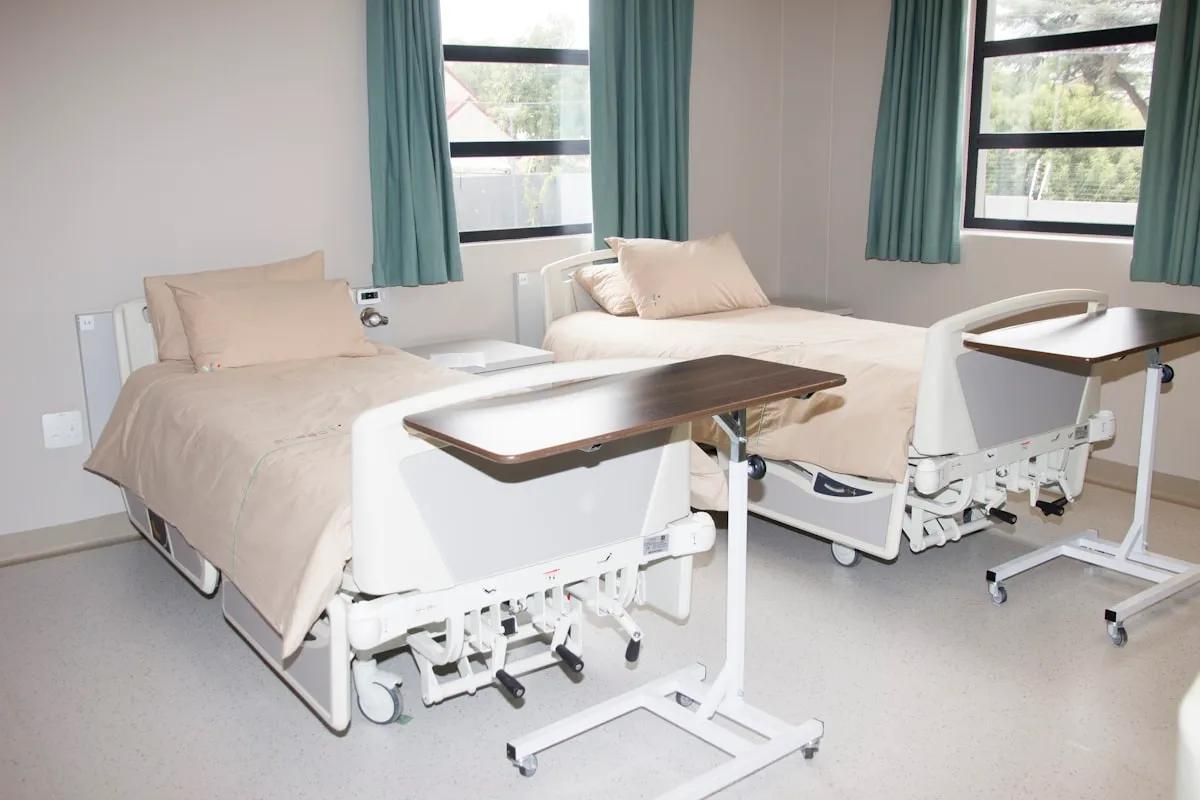
There is a particular kind of relief in the sentence “you’re going home today.” The IV comes out. Someone hands you a folder. Your clothes, which have been in a plastic bag for four days, smell like a plastic bag. You want to be in your own bed so badly that you would agree to almost anything to get there faster.
Here’s the hard truth: discharge is not the finish line. It’s a handoff — and handoffs are where things get dropped.
A hospital discharge checklist is the short list of things to get answered before you leave the floor: reconcile your medication list line by line, get your diagnosis in one sentence, learn the warning signs and exactly who to call, confirm which follow-up appointments are actually booked, confirm what you can’t do yet, confirm whether you were an inpatient or under observation, and confirm who receives your discharge summary. The seven questions below are that list in full.
The hospital has spent your entire stay with a nurse checking on you every few hours. In the space of an afternoon, that becomes you, a folder, and a bottle of pills. Nobody is trying to fail you. But the transition from “watched constantly” to “on your own” happens fast, usually while you are tired, medicated, and eager to leave — which is exactly the wrong condition for absorbing instructions you’ll need for the next month.
If you’re leaving today, skip straight to the seven questions.
Why the Hospital Discharge Handoff Goes Wrong So Often
The numbers here are not close calls. A 2020 systematic review of 54 studies in Drug Safety (opens in new tab), covering research published between January 1990 and March 2019, found a median rate of 50% for unintentional medication discrepancies among discharged adult and elderly patients across the 11 studies reporting it — and a median of 19% experiencing adverse drug events after discharge across the seven studies that measured them.
That second figure lines up with the study that put this problem on the map. In a prospective cohort study of 400 consecutive patients discharged home (opens in new tab) from the general medical service of one academic hospital, published in Annals of Internal Medicine in 2003, 19% had an adverse event in the roughly three weeks after leaving. Adverse drug events were the single most common type, at 66%.
And people come back. The Agency for Healthcare Research and Quality’s (AHRQ) Statistical Brief on 30-day all-cause readmissions (opens in new tab), published in September 2023, put the overall rate at 13.9 readmissions per 100 index admissions across 2016–2020 — 17.0 per 100 for Medicare patients in 2020.
Not all of that is preventable at the bedside. But a meaningful share of it is a paperwork problem wearing a medical costume.
The Hospital Discharge Checklist: 7 Questions to Ask Before You Leave
Ask these while you’re still on the floor, while the people who actually treated you are still within shouting distance. Once you’re in the parking lot, every one of them becomes a phone tree.
- “Can we go through my medication list line by line?” Not “do you have any questions about your medications” — that question gets a no from everyone. Ask them to read the list aloud against what you were taking before you came in, and say out loud which of your home medications you should stop, which you should restart, and which have changed dose. Stopped-and-restarted is the part that gets summarized rather than said out loud.
- “What was actually wrong with me, in one sentence?” You will repeat this sentence to a pharmacist, a primary care office, an employer, and possibly an insurer. Write down the words the discharging clinician uses, not your paraphrase.
- “What are the three signs that mean I should call, and who exactly do I call?” A name, a department, and a phone number — plus what to do with those symptoms at 2am on a Sunday, which is a different answer.
- “What appointments are already booked, and which ones am I responsible for booking?” Assume nothing is booked until someone shows you a date, and get the phone number for anything you have to book yourself.
- “What can’t I do yet?” Lifting, driving, stairs, showering, bathing a surgical site, going back to work. Ask for a number of days or a specific milestone, not “take it easy.”
- “Was I an inpatient, or was I under observation?” Observation status bills to Medicare Part B (outpatient) rather than Part A (inpatient hospital), and it doesn’t count toward the three-day qualifying inpatient stay (opens in new tab) Medicare needs before it will pay for a nursing facility — see The Observation-Status Trap below. This is a billing question people don’t think to ask until the bill arrives.
- “Who is getting a copy of this, and when?” Your primary care doctor should receive the discharge summary — the document describing what happened during the stay and why. Ask whether it’s being sent, and to whom, then check at your follow-up that it arrived.
Bring someone whose only job is to write the answers down. You are not going to remember them. And if you are the person who does this repeatedly for a parent, walk in with the record already built: a standing Caregiver / Aging-Parent Care Binder holding the medication list, the appointment history and an emergency handoff sheet means the next discharge starts from a complete record rather than from memory.
The Medication List Is Really Three Lists
Here is the mechanism behind that median 50% of discharged patients who experience at least one unintended medication discrepancy (opens in new tab), and it is almost embarrassingly simple. At the moment you’re discharged, three different medication lists exist:
- What you were taking at home before you came in — the list a family member recited from memory in the emergency department, which was probably incomplete. Supplements, eye drops and as-needed doses are the usual casualties.
- What you were given in the hospital — including drugs started for a temporary reason (a sleep aid, a stool softener, a stress-ulcer drug) that were never meant to go home with you.
- What’s printed on your discharge sheet — assembled quickly, sometimes by someone who did not manage your care all week. It then becomes the default truth for every clinician you see after this.
A discrepancy is any place those three disagree that nobody intended. Three failures are easy to spot once you look: a home medication silently dropped, a hospital-only drug silently continued, and the same drug appearing twice under a brand name and a generic name — which is a double dose once you’re home.
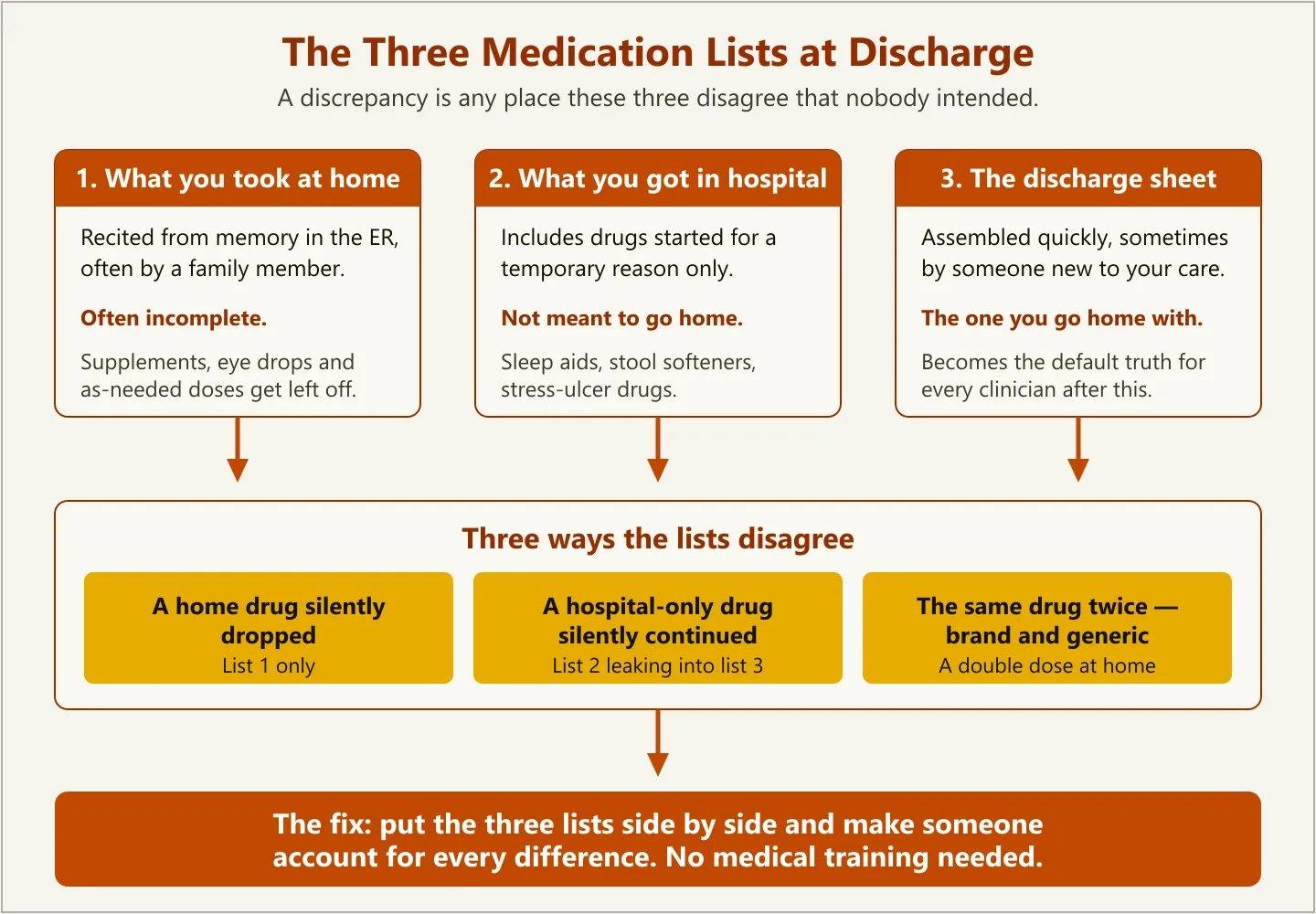
The fix needs no medical training: put the three lists side by side and make someone account for every difference. Then keep the reconciled version somewhere you can hand to the next clinician. Families who already have a running record of doses and refill dates — the same discipline behind how to track family medications before a dose slips — walk into this conversation with the first of the three lists already correct, which is most of the battle. The Medication & Appointment Tracker exists for exactly that: one current list, with doses and refill dates, that survives a hospital stay.
What Your Discharge Paperwork Must Legally Include
If you’re in a Medicare-participating hospital, the discharge process isn’t a courtesy — it’s a federal condition of participation. 42 CFR 482.43 (opens in new tab) requires an “effective discharge planning process that focuses on the patient’s goals and treatment preferences and includes the patient and his or her caregivers/support person(s) as active partners in the discharge planning for post-discharge care.”
Three specific entitlements are worth knowing by heart:
| What the rule requires | Citation | What to say if it’s missing |
|---|---|---|
| The results of the discharge planning evaluation must be discussed with you or your representative | §482.43(a)(3) | “Can we go over the discharge planning evaluation together?” |
| Your medical information must be transferred to whoever handles your follow-up care, at the time of discharge | §482.43(b) | “Which practice is receiving the summary, and when?” |
| If you’re referred to home health or a nursing facility, you must get the list of Medicare-participating providers, and the hospital can’t limit your choice | §482.43(d)(1)–(2) | “Can I see the full list of participating agencies?” |
That last one matters more than it sounds. The rule says the hospital “must not specify or otherwise limit the qualified providers or suppliers that are available to the patient.” Hospitals must also identify any disclosable financial interest they have in a home health agency or nursing facility they refer you to, and must help you compare options using quality and resource-use data. You are allowed to pick a different agency than the one on the top of the pile.
(Regulation text and Medicare guidance in this post are current as of August 2026.)
You Can Say “Not Yet”: How to Appeal a Discharge
If you have Medicare and you think you’re being sent home too soon, you have a formal right to challenge the timing.
Within two days of admission, and again before you leave, the hospital gives you a notice called “An Important Message from Medicare about Your Rights” (opens in new tab), often just called the IM. If you never received it, ask. It lists your right to a fast appeal and how to reach the Beneficiary and Family Centered Care Quality Improvement Organization (BFCC-QIO) for your state — the independent reviewer that decides whether your covered stay should continue.
The timing rule is the part people miss. Medicare’s guidance is explicit: follow the directions on the notice no later than the day you’re scheduled to be discharged. Do that, and “you can stay in the hospital while you wait to get the BFCC-QIO’s decision” without paying for the extra days beyond your usual coinsurance or deductible. Miss it, and you can still ask for a review — but different rules apply and you may owe for the stay past the original discharge date.
One carve-out: if you’re in a Medicare Advantage plan you can ask your plan for an appeal, but different rules apply — check with the plan rather than assuming the timeline above.
This is not the same as leaving against medical advice, and it is not rude. It is a review process the program built on purpose, and asking for it does not make you a difficult patient.
The Observation-Status Trap: Why Three Nights May Not Count
Here is the one that costs real money, and almost nobody asks about it until the bill lands.
You can spend three nights in a hospital bed, in a hospital gown, being treated by hospital staff, and never be an inpatient. If you were classified as “outpatient getting observation services,” your stay bills to Medicare Part B (outpatient coverage) instead of Part A (inpatient hospital coverage) — and, critically, it does not count toward the three-day qualifying inpatient stay (opens in new tab) Medicare requires before it will cover skilled nursing facility care. Medicare states the exclusion plainly: time spent “under observation or in the emergency room before you’re admitted doesn’t count toward the 3-day qualifying inpatient hospital stay, even if you’re there overnight.”
The practical consequence: you get discharged, you need rehab, and you discover the nursing facility is entirely out of pocket. Some arrangements waive the three-day minimum — certain Accountable Care Organizations hold a waiver, and Medicare Advantage plans may waive it too — so ask rather than assume either way.
Since February 14, 2025, there is a remedy. If you were admitted as an inpatient and your status was changed to observation during your stay, you should receive a “Medicare Change of Status Notice (CMS-10868)” (opens in new tab) before you leave, and you have the right to a fast appeal of that change. File it while you’re still in the building if you can. If you didn’t get the notice, ask for it — and if you can’t find it, contact your state’s BFCC-QIO directly.
Ask question six on the checklist. It takes one sentence, and the answer decides whether Medicare pays for your rehab.
The First 72 Hours After Discharge
The discharge folder implies the work is over. It isn’t — it’s just moved. Here’s what actually has to happen, and when.
| When | What has to happen |
|---|---|
| Before you leave the floor | Reconcile the three medication lists; confirm who receives the discharge summary |
| Same day | Fill every new prescription — don’t discover the prior authorization problem on day three |
| Within 24 hours — appointments | Book any follow-up appointment the hospital didn’t book |
| Within 24 hours — warning signs | Write them and the phone number somewhere visible, not in the folder |
| Within 48 hours | Confirm home health or equipment deliveries actually got scheduled |
| Within 72 hours | Call the primary care office and confirm the discharge summary arrived |
| Week 2–4 | Watch for bills; match each one against the explanation of benefits (EOB) before paying anything |
That last line is not paranoia. Post-discharge billing is where observation status, facility fees, duplicate charges and coding errors surface — and it’s a lot easier to contest a charge when you still have the paperwork organized. If something looks wrong, the process for how to dispute a medical bill is winnable, and the Medical-Bill Review & Appeals Organizer keeps the EOB-to-bill matching straight while you do it.
Common Questions About Hospital Discharge
How long does hospital discharge usually take?
Longer than the word “discharge” suggests. The decision to send you home is made on rounds, often in the morning, but the paperwork, the pharmacy, the transport and the equipment order all queue behind it. A morning decision routinely turns into an afternoon departure. Use the wait — that is the window in which the questions on this checklist can still be answered by the people who treated you.
Can I refuse to be discharged from the hospital?
You can’t compel a hospital to keep treating you, but if you have Medicare you can formally challenge the timing. Follow the directions on the Important Message from Medicare no later than the day you’re scheduled to leave, and an independent reviewer decides whether your covered stay should continue while you remain in the hospital. Leaving “against medical advice” is a different thing entirely and is not the same as appealing.
What paperwork should I get when I leave the hospital?
At minimum: a discharge summary describing what happened and why, a complete and current medication list, written follow-up appointments with dates and phone numbers, specific warning signs with a named person to call, and — if you’re being referred on to home health or a nursing facility — the list of Medicare-participating providers in your area. If any of those are missing, ask before you leave the floor.
Who should go with me to a hospital discharge?
Whoever will actually be managing the next two weeks. Discharge instructions are delivered once, quickly, to someone who has slept badly and is on new medication. A second person whose only job is to write things down and ask the questions on this list is worth more than any pamphlet in the folder.
The Takeaway
You are allowed to slow this down. The pressure to leave quickly is real, but almost none of it is coming from anyone who will be responsible for what happens next — that’s you.
Seven questions, three medication lists reconciled, one confirmed answer about your status. The time it takes to ask them, spent while the people who treated you are still standing there, is the cheapest insurance available on the worst week of your year.
Sources & methodology
Federal regulation text and Medicare guidance are current as of August 2026; the inpatient-to-observation appeal right (CMS-10868) took effect February 14, 2025.
- Prevalence and Nature of Medication Errors and Medication-Related Harm Following Discharge from Hospital to Community Settings: A Systematic Review (opens in new tab) — Alqenae, Steinke & Keers, Drug Safety 43(6), 2020 — the 50% median unintentional-medication-discrepancy rate and the 19% median post-discharge adverse-drug-event rate
- The Incidence and Severity of Adverse Events Affecting Patients after Discharge from the Hospital (opens in new tab) — Forster et al., Annals of Internal Medicine 138:161–167, 2003 — the 19% adverse-event rate and the 66% share that were adverse drug events (abstract free; full text paywalled)
- Characteristics of 30-Day All-Cause Hospital Readmissions, 2016–2020 (opens in new tab) — AHRQ HCUP Statistical Brief #304, September 2023 — the 13.9 per 100 overall and 17.0 per 100 Medicare readmission rates
- 42 CFR 482.43 — Condition of participation: Discharge planning (opens in new tab) — eCFR — every entitlement in the paperwork table
- Fast appeals (opens in new tab) — Medicare.gov — the Important Message notice, the same-day deadline and the Medicare Advantage carve-out
- Appeal when a hospital changes your status from “inpatient” to “outpatient getting observation services” (opens in new tab) — Medicare.gov — the February 14, 2025 appeal right and the CMS-10868 notice
- Skilled nursing facility (SNF) care coverage (opens in new tab) — Medicare.gov — the three-day qualifying inpatient stay, the observation exclusion and the ACO/Medicare Advantage waivers