A Social Security survivor benefit lets a widow or widower keep the larger of the couple’s two benefits, usually for life. When the higher earner dies first, that one rule means the higher earner’s claiming age sets what the survivor lives on.
Sound familiar? The two of you sat down with your Social Security statements, each did your own homework, and arrived at two separate answers. One of you plans to claim at 62 because the money is useful now. The other is going to wait a bit. Two people, two decisions, done.
Except it is not two decisions, because of the rule most couples never look at: the Social Security survivor benefit. When the first spouse dies, the smaller check stops and the survivor is paid on the stronger record, possibly for decades. So the higher earner’s claiming age is not really about the higher earner. It is mostly about the survivor.
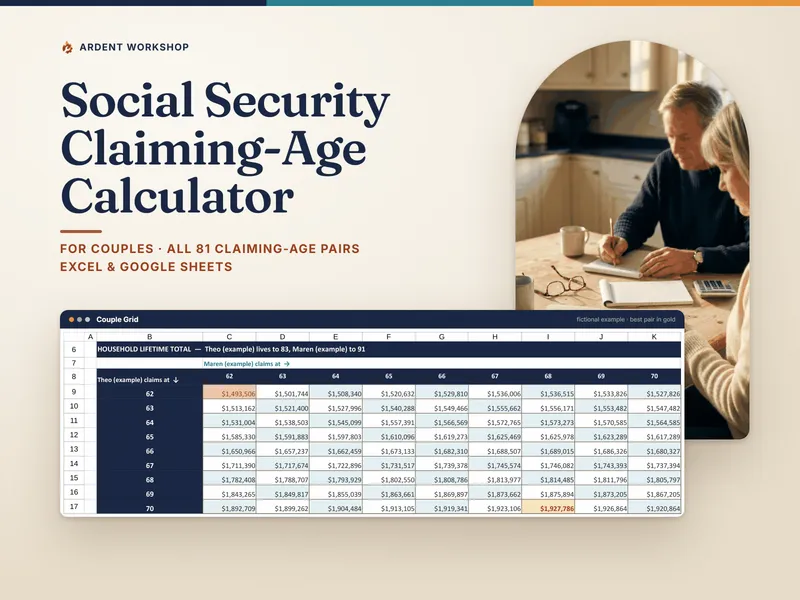
Working that out by hand means comparing every pair of claiming ages for two people across every plausible pair of lifespans, which is where most couples give up. The Social Security Claiming-Age Calculator runs all 81 claiming-age pairs for a couple with the survivor step-up counted, but the rule itself is simple enough to understand in one sitting, and it is worth understanding before you file.
What is a Social Security survivor benefit?
A Social Security survivor benefit is the monthly check a widow or widower collects on their late spouse’s work record. It is paid in place of the survivor’s own retirement benefit when it is the larger of the two, so in practice it lets the surviving spouse step up to the bigger of the two benefits on the couple’s records.
The basic eligibility rules for a widow or widower, from SSA’s policy manual on benefits for widows and widowers (opens in new tab):
- Age 60 or older, or age 50 to 59 if the survivor is disabled.
- Married at least 9 months immediately before the spouse’s death, unless one of the listed exceptions applies.
- Unmarried, unless a remarriage can be disregarded. A remarriage at 60 or later is disregarded (more on that in the questions below).
The part that matters for claiming decisions is not eligibility, though. It is how the amount is worked out.
How the Social Security survivor benefit is calculated
The survivor benefit starts from the deceased spouse’s benefit, then three rules adjust it. Two depend on when the deceased spouse claimed, and one depends on when the survivor claims.
| Rule | What it does | Source |
|---|---|---|
| Delayed credits carry over | If the deceased waited past full retirement age, the survivor’s benefit is based on the full benefit including those delayed retirement credits (8% a year for anyone born after January 1, 1943). | RS 00615.301 (opens in new tab), RS 00615.692 (opens in new tab) |
| The widow’s or widower’s limit | If the deceased claimed early, the survivor’s benefit is capped at the larger of what the deceased was actually being paid or 82.5% of their full benefit. | RS 00615.320 (opens in new tab) |
| The survivor’s own age | If the survivor claims before their own survivor full retirement age, the benefit is reduced, by up to 28.5% at 60. At survivor full retirement age it is paid unreduced. | RS 00615.301 (opens in new tab) |
One detail catches people out: survivor full retirement age is on its own schedule. For anyone born on January 2, 1962 or later it is 67, the same as the retirement age. But for people born from 1955 through 1961, survivor full retirement age arrives two to four months earlier than retirement full retirement age (RS 00615.003 (opens in new tab)). If you are in that window and not yet at either age, check both rows rather than assuming they match. For what the terms mean in the first place, see what full retirement age is and what a delayed retirement credit is.
The takeaway: the first two rules are both set by the deceased spouse’s claiming age, and they pull in opposite directions. Waiting raises the survivor’s check, and claiming early caps it.
Why the higher earner’s claiming age sets the survivor’s check
The higher earner’s claiming age sets the survivor’s check because, after the first death, the household keeps the larger benefit and loses the smaller one. Whatever the higher earner locked in by claiming is, in most couples, the check the survivor lives on.
Here is how that plays out with illustrative numbers. Picture a couple, both born in 1962, so full retirement age is 67 for both retirement and survivor purposes. The higher earner’s full benefit at 67 is $2,800 a month. The lower earner’s own full benefit is $1,500, and they claim it at 67. (At that level they are not due a spousal top-up, which keeps the arithmetic clean.)
Now vary only one thing: the age at which the higher earner claims. Assume the higher earner dies first, and the survivor is 67 or older.
| Higher earner claims at | Higher earner’s own check | Survivor’s check after the first death | How it is worked out |
|---|---|---|---|
| 62 | $1,960 | $2,310 | Widow’s or widower’s limit: 82.5% of $2,800 beats the $1,960 actually paid |
| 67 | $2,800 | $2,800 | 100% of the full benefit |
| 70 | $3,472 | $3,472 | 100% of the full benefit plus 24% in delayed credits |
In every row the survivor stops receiving their own $1,500 as a separate check, because they are now paid the larger benefit rather than both. So the higher earner’s choice at 62 or 70 works out to $1,162 a month in the survivor’s check, or $13,944 a year. If the survivor lives ten years alone, that is roughly $139,000 in flat dollars. With a cost-of-living assumption it is more.
The widow’s or widower’s limit softens the early-claiming penalty (the survivor gets $2,310, not $1,960), but it does not come close to closing the gap.
This is the half of the decision a break-even age cannot see. Break-even compares one person’s own checks at two claiming ages. The higher earner in this example gives up 96 months of $1,960 by waiting to 70, which takes about a decade of the larger check to recover. That comparison is covered step by step in the Social Security break-even age, worked by hand. What break-even leaves out is that the larger check doesn’t stop when the higher earner dies. It continues for the survivor.
Spousal benefit vs survivor benefit: why they don’t grow the same way
The spousal benefit and the survivor benefit are both paid on the other spouse’s record, and they are easy to confuse. They follow different rules, and the difference is the whole argument for the higher earner waiting.
- The spousal benefit stops growing at full retirement age. It is up to 50% of the other spouse’s full benefit (RS 00615.201 (opens in new tab)), and delayed credits do not raise it. SSA’s manual, describing the benefits paid on a worker’s record while they are alive, puts it bluntly: “DRCs only increase the NH’s RIB” (delayed retirement credits raise only the number holder’s own retirement benefit) (RS 00615.695 (opens in new tab)).
- The survivor benefit keeps the delayed credits. It is based on the deceased’s full benefit including any credits earned by waiting (RS 00615.301 (opens in new tab)).
| Feature | Spousal benefit | Survivor benefit |
|---|---|---|
| Paid while | both spouses are alive | after the first spouse dies |
| Based on | up to 50% of the other spouse’s full benefit | up to 100% of the deceased spouse’s benefit |
| Raised by the other spouse waiting past full retirement age? | No | Yes |
| Reduced if claimed early? | Yes | Yes, by up to 28.5% at 60 |
So a higher earner who waits past 67 gets nothing extra for the other spouse while both are alive, and a great deal after one of them dies.
Survivor benefit or your own: you can take one, then switch
A widow or widower who is entitled to both a survivor benefit and their own retirement benefit is paid the larger of the two, not both. SSA’s manual states the principle directly: “a person’s benefit amount can never exceed the highest single benefit to which that person is entitled” (RS 00615.020 (opens in new tab)).
What survivors often miss is that you do not have to take both at once. The deemed-filing rule, which treats an application for one benefit as an application for every benefit you are due, does not apply here: “Deemed filing does not apply to survivor benefits,” and “the claimant may restrict the WIB application and delay filing for RIB” (WIB is the widow’s or widower’s benefit, RIB your own retirement benefit) (GN 00204.035 (opens in new tab)). Because deemed filing does not apply to survivor benefits at all, that opens two sequences:
- Survivor benefit first, your own later. Take a reduced survivor benefit as early as 60, let your own retirement benefit grow with delayed credits, and switch to your own at 70 if it has grown larger. This works when your own record is the stronger one at 70.
- Your own benefit first, the survivor benefit later. Claim your own, possibly reduced, and switch to the unreduced survivor benefit at your survivor full retirement age. This works when the survivor benefit is the bigger of the two, as it is in the example above.
Which sequence pays more depends on both records, both ages and how long the survivor lives. That is why it is worth running the numbers rather than guessing. The claiming-age calculator counts the better of those two starts for every pair of claiming ages.
Five mistakes couples make with survivor benefits
- Treating claiming as two separate decisions. The higher earner’s choice sets the survivor’s check. Decide the two ages together.
- Running break-even on the higher earner alone. A personal break-even of about 80 can look like a coin flip. It is not a coin flip when the larger check continues for a spouse who may live to 90.
- Assuming waiting grows the spousal benefit too. It does not. Delayed credits raise the survivor benefit, never the spousal benefit.
- The lower earner delaying for a check they will never collect. If the lower earner is likely to outlive the higher earner and step up to the survivor benefit, the extra they earn by waiting on their own record may never be paid. That can make the lower earner the better candidate to claim early.
- Assuming survivor full retirement age matches the retirement one. For anyone born from 1955 through 1961 it arrives two to four months earlier.
To be fair to the other side: waiting to 70 is not automatically right. If the higher earner has serious health problems, if both spouses have short life expectancies, or if the household needs the income at 62 to avoid debt, claiming earlier can be the better call. The survivor benefit is the strongest argument for waiting. It isn’t the only thing that matters.
Common Questions About Social Security Survivor Benefits
Can you get your own Social Security and a survivor benefit at the same time?
You can be entitled to both, but you are paid the larger of the two, not the sum. What you can do is take them in sequence, one first and a switch to the other later, because deemed filing does not apply to survivor benefits.
Does remarrying end a Social Security survivor benefit?
Not if you remarry at 60 or later (50 or later if you are already entitled as a disabled widow or widower). SSA disregards a remarriage that happens after reaching those ages (RS 00207.003 (opens in new tab)). A remarriage before 60 does not fall under that exception.
How much does a widow get if her husband claimed Social Security at 62?
If he claimed early, her survivor benefit is capped by the widow’s limit: the larger of what he was actually being paid or 82.5% of his full benefit. The same rule applies to a widower whose wife claimed early. It is also subject to her own reduction if she claims before her survivor full retirement age.
Does a survivor benefit include delayed retirement credits?
Yes. A survivor benefit is based on the deceased spouse’s full benefit including any delayed retirement credits they earned by waiting past full retirement age. That is the main difference from the spousal benefit, which never includes them.
Running the survivor math for your own household
The example above varies one person’s claiming age with everything else fixed. Your real decision has two claiming ages, two statements and two unknown lifespans. That is 81 whole-year pairs of claiming ages from 62 to 70, each worth a different amount depending on who dies first and when.
The Social Security Claiming-Age Calculator was built for exactly this. You type in each person’s full benefit from your own statement (it never estimates one). It totals all 81 pairs with the spousal top-up and survivor step-up counted, and tests your plan against 49 combinations of death ages, showing what the survivor is paid while alone in each. Every rule it follows is listed with its SSA policy manual source. It is a file you own, not a planning subscription.
If you want to see the arithmetic for one person first, the free Social Security Claiming-Age Table shows your benefit at every age from 62 to 70 from the figure on your statement.
Two related reads. For the investment side of retirement, see whether age-based retirement tracks are a good fit. For the survivor, the first practical step after a death is reporting it and gathering the paperwork, which is covered in what to do when a parent dies. Keeping each other’s statements, account details and wishes in one place ahead of time is what the Estate & Life-Admin Binder is for.
Sources
- RS 00207.001: Widow(er)‘s Benefits Definitions and Requirements (opens in new tab)
- RS 00207.003: How Remarriage Affects Widow(er)‘s Benefits (opens in new tab)
- RS 00615.003: Full Retirement Age (opens in new tab)
- RS 00615.020: Dual Entitlement Overview (opens in new tab)
- RS 00615.201: Reduced Spouse’s Benefits (opens in new tab)
- RS 00615.301: Reduced Widow(er)‘s Benefits (opens in new tab)
- RS 00615.320: Reduced WIB, Deceased NH Entitled to Reduced RIB (RIB-LIM) (opens in new tab)
- RS 00615.692: Computing the Amount of the Delayed Retirement Credits (opens in new tab)
- RS 00615.695: Family Maximum and Auxiliary Benefits (DRC) (opens in new tab)
- GN 00204.035: Deemed Filing (opens in new tab)