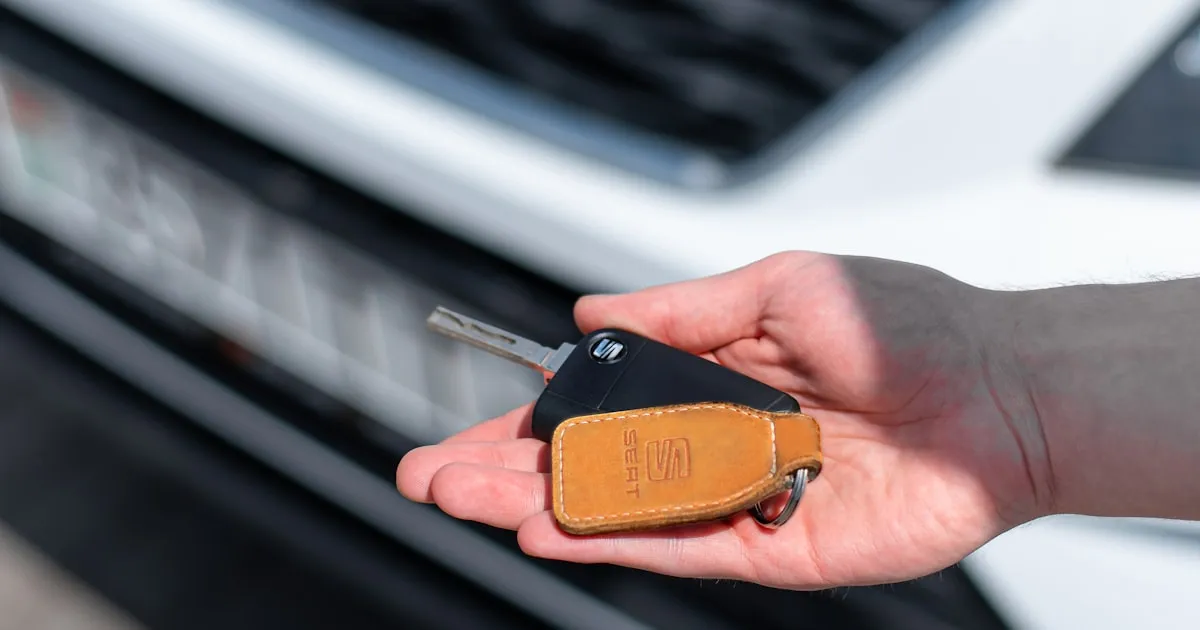
Most families settle this by feel. The car is already in the driveway, campus is four hours away, and handing over the keys looks free — until the parking bill arrives in September.
So: should your college freshman take a car to campus? The short version — a car at school is not a car you already own. It’s a new recurring bill made of a permit, an insurance change, and upkeep, and at some schools it isn’t allowed at all. One gate and three lookups settle it:
- The gate: is a first-year car allowed at all?
- What does the permit cost?
- What happens to the premium?
- What does the alternative cost?
Clear the gate, and the last three become cost lines you can add up — plus one for the upkeep a parked car still needs. Fifteen minutes, a phone, and your insurer’s number — before move-in weekend, not after.
Step 1: Check Whether First-Years Can Have a Car
Start here, because it can end the conversation in ninety seconds. A number of universities simply do not allow first-year students to keep a car on campus.
Stanford’s frosh parking policy (opens in new tab) bars first-year undergraduates from bringing cars for all three quarters. The University of Tampa’s first-year student parking policy (opens in new tab) does the same for fall through spring, exempting commuters. Plenty of schools have no restriction — the point is that you can’t guess which kind you’re dealing with.
Look on the parking or transportation services site, not the admissions packet. Where a ban exists there’s normally an appeal process, but the accepted grounds are narrower than families expect, and they’re school-specific. Tampa’s policy, for example, automatically approves a documented handicapped placard and takes documented waiver requests for off-campus ROTC or military training — while answering its own question “Is obtaining an off-campus job or internship grounds for an appeal?” with a flat “No.” Read your own school’s exception page, including how and when it takes requests, before you assume a case exists.
Step 2: Price the Permit, Not the Parking Space
A permit is usually a license to hunt for a space in a zone, not a reserved spot near the dorm. Price it as a flat annual fee and assume a walk or a shuttle at the end of it.
The spread between schools is enormous, and most schools publish their own rate sheet. UNC Charlotte lists a standard annual permit at $480 for 2026–27 (opens in new tab), with a discounted faculty/staff-and-commuter lot as low as $225 in limited supply. UC Riverside charges $279 per quarter for a residence hall permit (opens in new tab) at rates effective July 1, 2026 — roughly $837 across three quarters, about 75% more than Charlotte’s entire year. Neither is an extreme; they’re just two published rate sheets.
Look up your school’s own rate sheet, then add what it won’t tell you: whether resident permits are waitlisted, and what a citation costs when the lot is full and your student parks somewhere convenient instead.
Step 3: Get Two Insurance Quotes, Not One
Call your insurer once and ask two questions: what the premium is with the car garaged at school, and what it is with no car at school at all. The gap between those numbers is the real insurance cost of sending it.
- The garaging address matters. Where you park a car is one of the factors that determine an auto premium (opens in new tab), and the Insurance Information Institute notes urban drivers pay more than those in small towns or rural areas — so moving the car to a college ZIP can push the premium either way.
- Leaving it home can earn a discount. The same institute notes a young driver away at college without a car may qualify for a lower rate (opens in new tab). Travelers’ student away at school discount (opens in new tab) shows one carrier’s version of the rule, as of August 2026: under 25, school more than 100 miles from home, no car there, driving the insured car only occasionally on breaks.
That discount is what you give up by sending the car. Count it as a cost.
Step 4: Price the Alternative Before You Decide
The car only looks expensive next to something. Price the something: a transit pass (often already bundled into student fees — check before buying one), a monthly rideshare budget, a few trips home, the occasional rental.
Then be honest about how a parked car behaves. AAA’s 2025 study puts the cost of owning and operating a brand-new vehicle at $11,577 a year (opens in new tab) at 15,000 miles — nothing like a hand-me-down driven 3,000. But the shape of that number is the lesson: per-mile costs shrink when a car sits, and fixed costs — insurance, registration, the permit — don’t shrink at all. That’s also where your upkeep number comes from: budget what the car needs to stay road-legal while it mostly sits, not what it cost you last year at home.
What It Costs, Line by Line
Once the gate in Step 1 clears, the money side is four lines: the permit from Step 2, the insurance change from Step 3, the upkeep just above, and the alternative you no longer buy. Here’s how it adds up with illustrative figures — replace each with your own:
| Cost line | Illustrative figure | Where to get it |
|---|---|---|
| Permit | $480 / year (add) | Your school’s published rate sheet |
| Insurance change | $220 / year (add) | Two quotes from your insurer |
| Upkeep while away | $400 / year (add) | Fuel, an oil change, wipers, one tow |
| Alternative you no longer buy | $650 / year (subtract) | Transit pass, rideshare, trips home |
| Net cost of sending the car | $450 / year | Permit plus insurance change plus upkeep, minus the alternative |
A positive net means the car costs money on top of the life your student would otherwise buy; a negative net means it’s the cheaper option. Either way you now have a number instead of an argument — and if yours lands near zero, score it rather than keep arguing it: the Decision Helper is a weighted decision matrix that lets each factor carry the weight your family actually gives it and ranks the two options for you.
When a Freshman Should Take a Car to Campus (and When They Shouldn’t)
Send the Car to Campus When
- An off-campus job, clinical placement, or internship isn’t reachable by transit on the required schedule.
- Regular medical appointments sit off campus.
- The campus is rural, transit is thin, and the trip home is long or badly served.
Leave the Car at Home When
- First-years aren’t permitted one — that’s the whole decision.
- The campus is walkable, the transit pass is already in the fee bill, and groceries are within a mile.
- It’s the household’s second car and someone at home needs it.
- The honest answer to “what will it be used for?” is “the store, twice a month.”
Keep the Numbers Where You’ll Find Them in December
Write the four lines down once, in one file you keep, and winter break becomes a review instead of a re-argument. If the answer is “send it,” the permit and premium are recurring bills like any other, and the Bill Tracker puts them on a calendar next to tuition and the phone plan.
Move-in is the next decision either way — we’ve worked through what to buy for a dorm now versus after you get there, and it’s worth seeing the car next to how much a year of college actually costs before deciding it’s the expensive part.