Introduction
Age-based tracks—also known as target-date funds or lifecycle funds—have become a cornerstone of modern retirement planning for 401(k) and IRA investors. They offer a simple, hands-off approach by automatically adjusting your asset allocation: heavy on stocks when you’re decades from retirement, then shifting toward bonds as you near your target date. This glide path removes guesswork from balancing risk and reward, making retirement planning accessible even if you’re not a financial expert.
Target-date funds first emerged in March 1994, when Wells Fargo unveiled its LifePath funds (opens in new tab) (later managed by Barclays Global Investors and now BlackRock), as employers scrambled to support a growing workforce on defined-contribution plans. Plan providers and financial advisors wanted a standardized way to guide employees through asset allocation without endless one-on-one consultations. By anchoring fund choices to a retiree’s birth year, these age-based tracks simplified both retirement goal setting and long-term risk management for millions of savers.
What a Glide Path Actually Is
Before you can judge whether an age-based track fits you, it helps to know the three terms the fund industry uses — because the differences between them are exactly where a standard track stops matching a real person.
- Target date. The year in the fund’s name (2045, 2060). It’s meant to be roughly the year you retire, and it’s the only input the fund has about you. Not your income, not your savings rate, not your pension, not your spouse — one number.
- Glide path. The pre-set schedule that shifts the fund from stock-heavy to bond-heavy as the target date approaches. Every fund family draws its own; two funds with the same year on the label can hold noticeably different mixes.
- “To” versus “through.” A “to” fund reaches its most conservative allocation at the target date and stops changing. A “through” fund keeps gliding for years or decades past it, on the theory that you’ll be drawing the money down over a long retirement. Same label, different behavior at the exact moment the money starts to matter most. Which one you own is disclosed in the prospectus — and most people have never looked.
That last distinction is the one worth checking today. If you plan to withdraw steadily from age 65 to 90, a “through” fund’s continued stock exposure may be a feature. If you plan to buy an annuity or make a large withdrawal at 65, it may be a risk you never agreed to.
Pros & Cons
Despite their popularity, age-based tracks aren’t a perfect fit for every retirement journey. If you started saving early, have a high risk tolerance, or benefit from employer stock options, a more aggressive equity mix could deliver stronger long-term growth than a standard glide path. On the flip side, if you plan to work well beyond age 65 or seek phased retirement, the automatic shift into bonds might lock you into low-yield investments just when you still have years to grow your portfolio.
Young adults just entering the workforce might find target-date funds a useful entry point into retirement planning. You can set it and forget it, letting the fund handle periodic rebalancing and tax-efficient strategies. For busy middle-aged professionals balancing family budgets and career demands, these funds cut down on the time and mental energy needed for portfolio management. And for anyone who’d rather avoid manual asset allocation, age-based tracks deliver a full-service approach.
Age-Based Track vs. Custom Allocation: Side by Side
Neither approach wins on every line. The honest comparison looks like this:
| Dimension | Age-based track (target-date fund) | Custom allocation |
|---|---|---|
| Inputs it considers | One: your target year | Income, savings rate, pension, spouse, risk tolerance, other assets |
| Rebalancing | Automatic, inside the fund | Manual, or on a schedule you set |
| Ongoing effort | Effectively zero | An hour or two a quarter |
| Cost | The fund’s expense ratio — check whether yours is index-built or actively managed | Depends entirely on the underlying funds you pick |
| Handles a mid-career change | No — the glide path doesn’t notice | Yes, if you update it |
| Handles a spouse with a different timeline | No | Yes |
| Risk of you doing something dumb in a downturn | Lower — there’s nothing to fiddle with | Higher — the levers are right there |
| Fits an early retirement or a work-till-72 plan | Only by picking a different year | Directly |
Read that last-but-one row carefully. The strongest argument for an age-based track isn’t the glide path — it’s that it removes the temptation to panic-sell. That’s a real benefit, and a custom plan only beats it if you actually stick to the custom plan.
Five Ways Age-Based Tracks Quietly Go Wrong
None of these are failures of the fund. They’re failures of fit — and every one of them is common.
- Owning a target-date fund alongside other funds. The whole design assumes it’s your entire portfolio. Put a 2050 fund next to an S&P 500 fund and a bond fund, and the glide path no longer describes what you own. The fund is still rebalancing itself; it just isn’t rebalancing you.
- Owning two of them. Hold a 2035 fund and a 2055 fund in equal amounts and your real allocation is the average of the two — you’ve built a 2045 fund by accident, with none of the intent and both of the expense ratios.
- Picking the year by birthday instead of by plan. The label assumes retirement at a conventional age. If you intend to retire at 55, or to work part-time until 72, the year on the fund is describing someone else. Nothing stops you from choosing a later or earlier vintage on purpose — the year is a risk dial, not a birth certificate.
- Ignoring the fee drag because the percentage looks small. Expense ratios are quoted in fractions of a percent, which makes them easy to wave off. Run the arithmetic instead: if your balance is $200,000 and you’re paying 0.60% a year instead of 0.10%, that half-point gap costs $1,000 this year — and it grows with the balance, every year, whether the market is up or down. Look up your fund’s actual expense ratio before you decide it doesn’t matter.
- Holding one in a taxable brokerage account. Target-date funds rebalance internally, and in a taxable account that internal activity can generate capital gains distributions you didn’t ask for and can’t control. They’re generally built for tax-advantaged accounts — 401(k)s and IRAs — where that activity is invisible.
Who Should Keep the Track — and Who Should Customize
An age-based track probably fits you if:
- Your 401(k) or IRA is the great majority of your invested assets.
- You expect to retire somewhere near a conventional age.
- You have no pension, no large expected inheritance, and no concentrated employer stock position.
- You know you’d be tempted to tinker, and you’d rather not have the option.
A custom allocation probably fits you better if:
- You’re aiming at early retirement, phased retirement, or working well past 65.
- You and a spouse have different timelines, incomes, and account balances to coordinate.
- A pension, rental income, or a business sale changes how much market risk you actually need to take.
- You hold significant employer stock, which already concentrates your risk in one place.
- Your savings live across several accounts — a 401(k), an IRA, an HSA, a taxable brokerage — and no single fund can see the whole picture.
The tell is simple: if the target year is the only true thing the fund knows about you, an age-based track is a good fit. The moment there’s a second true thing, it isn’t.
Custom Planning
However, savvy savers know that personalized retirement strategies can outperform cookie-cutter solutions. Customizing your asset allocation based on your unique risk tolerance, retirement goals, and income streams helps you stay on track even when market conditions shift. Whether you’re a millennial aiming for early retirement or a Gen X’er recalibrating after a career change, a tailored approach puts you back in the driver’s seat.
Our Solution
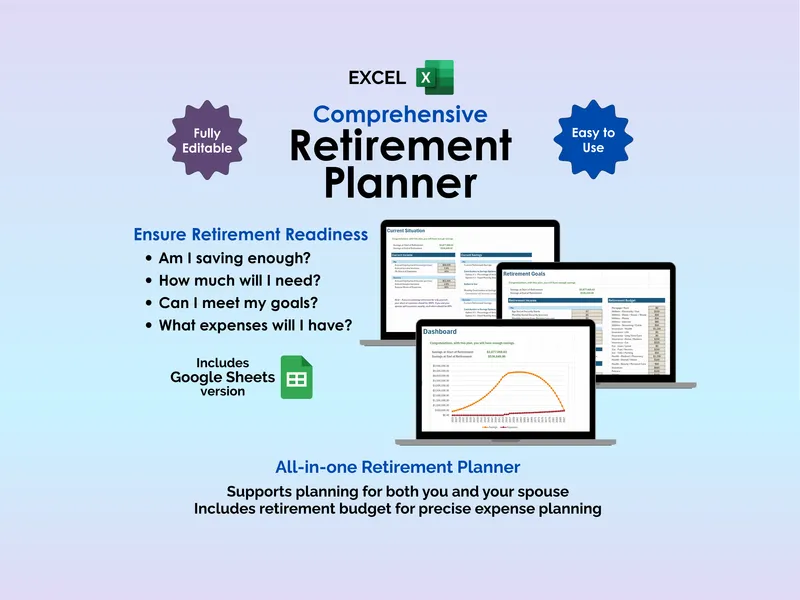
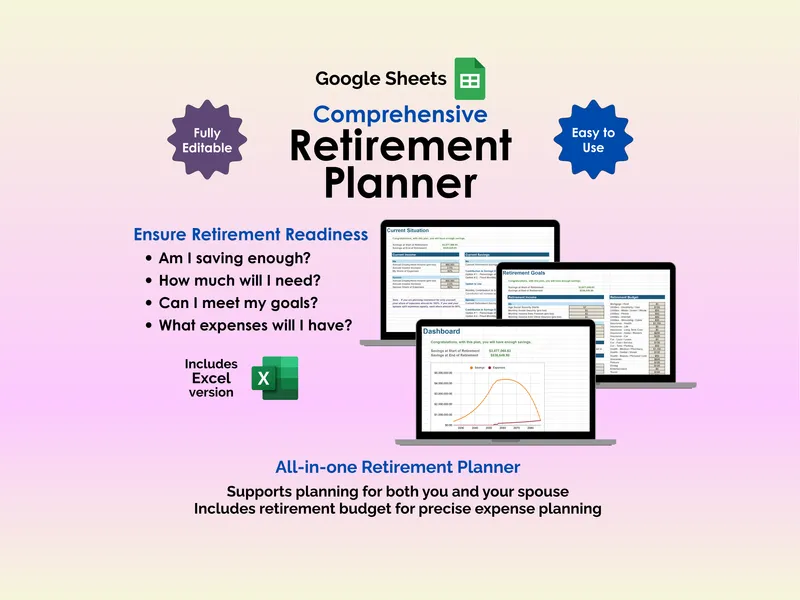
That’s where Ardent Workshop’s Retirement Planner comes in. This Excel-based tool empowers you to plan for your future with ease. Simply enter your income, savings and contributions, and let the tool factor in salary increases, compound interest, inflation and investment returns to project your nest egg. You’ll get instant feedback on whether your savings trajectory aligns with your retirement goals, complete with a dynamic chart delivering your starting balance, ending balance and a clear retirement readiness check.
Couples will love building parallel profiles—one for you, one for your spouse—to assign expense shares, track separate savings pools and see combined progress. The optional retirement budget breaks costs into 26 categories, from healthcare to travel, while customizable assumptions let you tweak inflation rates, adjust return scenarios and factor in Social Security, pension income or side gigs. Every change updates your net worth projection in real time, making this retirement planning software an empowering tool for any life stage.
Common Questions About Target-Date Funds
What does the year in the fund’s name actually mean?
It’s the approximate year the fund assumes you’ll retire, and it’s the fund’s only piece of information about you. It sets where you currently sit on the glide path. It does not mean the fund matures, pays out, or stops on that date — most keep operating well past it.
Can I pick a year that isn’t my retirement year?
Yes, and it’s a legitimate move. Choosing a later vintage than your age suggests leaves you in a more stock-heavy mix; choosing an earlier one makes you more conservative sooner. You’re using the year as a risk dial. The catch is that you’re now making the allocation decision yourself — which is most of the argument for building the plan around your actual numbers instead.
Is a target-date fund enough on its own?
It’s designed to be the whole portfolio, so in a 401(k) that holds all your retirement money, it can be. What it can’t do is coordinate across accounts, account for a spouse’s separate savings, or know that you’re planning to stop at 58. Those are planning questions, not fund questions, and no fund answers them.
What happens to my target-date fund after the target date passes?
That depends on whether it’s a “to” or a “through” fund. A “to” fund has already reached its final, most conservative allocation and holds there. A “through” fund keeps shifting for years afterward. Check the prospectus — this is the single most consequential thing about your fund that isn’t printed on the label.
Do I still need to rebalance if I own one?
Not inside the fund — that’s the entire point, and it’s handled for you. But if you hold anything besides the target-date fund, you’re back to rebalancing the combination yourself, and the fund can’t help you do it.
Conclusion
If you’re serious about securing your financial future, it’s time to move beyond one-size-fits-all target-date funds. Take control of your retirement planning with a tool that adapts to your career milestones, spending habits, and investment philosophy. Purchase Ardent Workshop’s Retirement Planner today and start crafting a retirement strategy as unique as you are.