Ask five people whether you should drop a class and you get five confident, contradictory answers. Your roommate says drop it, a W means nothing. Your advisor says give it three more weeks. Your parents want to know what it costs. They are all partly right, because whether you should drop a class comes down to two questions almost nobody answers: what the drop does to your credit count, and what your grade would realistically be if you stayed.
Short version: drop the class if the average you need on the work that is left is out of reach and the drop still leaves you at or above whichever bar is highest — your school’s full-time threshold, or the one written into your award letter. Stay if the grade is mathematically live, or if aid, housing or eligibility is riding on those credits. Everything below is how to check both. (Already past the refund deadline? The check still works — see the last question.)
The Case for Dropping the Class
Dropping protects the classes you are not dropping. A course you are losing does not fail quietly in its own lane. It takes the extra study hours, the anxious Sunday nights, and the office-hours visits you would have spent elsewhere, and the semester that could have ended with one F and three Bs ends with four Cs instead.
The other arguments for dropping are real too:
- A withdrawal normally does not touch your GPA. A W is usually recorded as a notation carrying no grade points, while a D or F is averaged in and follows you through every graduate application and scholarship renewal for years. Check your registrar’s grading policy, though — some schools convert a late withdrawal into a WF, which does count.
- The earlier you exit, the cheaper it is. Refund tiers step down fast — full refund, then partial, then none — and the transcript notation gets heavier the longer you wait. Your school’s exact steps are on the registrar’s academic calendar.
- A bad grade in a prerequisite often has to be retaken anyway. Paying twice for the same credit is worse than paying once, later, with a better instructor and a free schedule.
- The class may be a prerequisite for a path you have not committed to. If you are grinding through organic chemistry for a major you are still deciding on, the honest first question is how to choose a college major, not how to survive the midterm.
The Case for Staying Enrolled
The real cost of dropping is rarely the class — it is the credit hours attached to it. This is the part the roommate advice always misses, and it is where the money lives.
For federal student aid, full-time enrollment for undergraduates must comprise at least 12 credit hours (opens in new tab). Fall below your school’s threshold and several things move at once:
- Your Pell Grant shrinks proportionally. Enrollment intensity is your enrolled hours divided by full-time hours, and your annual Pell award depends on it. Dropping from 12 hours to 9 puts you at 75% intensity — and roughly three-quarters of the term’s grant.
- Your other awards may not shrink — they may vanish. Institutional scholarships and campus housing contracts commonly require full-time status outright, and campus student health plans often do too. Those are cliffs, not slopes.
- On an F-1 visa it is stricter than a tendency. International students must enroll in a full course of study (opens in new tab) to maintain their status, and a reduced course load has to be approved by a designated school official first. Never drop the class and ask afterward.
- A W counts as attempted but not completed. Schools measure satisfactory academic progress partly by pace, dividing the hours you have successfully completed by the hours you have attempted (opens in new tab), against a maximum timeframe of 150% of your program’s published length — which leaves room to complete only about two-thirds of what you attempt. Two or three withdrawals early can quietly put that ratio underwater.
- Prerequisite chains cost terms, not weeks. If this class only runs in the fall and three later courses sit behind it, dropping can push graduation a full semester — which means another term of tuition plus a term of not earning. Set against how much a year of college actually costs, that is the most expensive line item in the entire decision.
Drop or Stay: What Each Choice Costs
The dividing line is not “am I struggling.” Everyone is struggling in week two; that is what week two is. The line is whether the grade is genuinely unrecoverable, and whether the credit count is carrying money you cannot replace — one a math problem on your syllabus, the other a math problem on your award letter.
| What is at stake | If you drop | If you stay |
|---|---|---|
| GPA | Usually a W, carrying no grade points | Whatever grade you earn is averaged in |
| Tuition | Full, partial or no refund depending on the week | Paid in full, credit earned or not |
| Pell Grant | Scales down if the drop puts you under full-time | Unchanged |
| Scholarships and housing | At risk if you fall under the full-time bar | Unchanged |
| SAP pace | Attempted but not completed, so the ratio drops | Counted as completed if you pass |
| Graduation timing | A term of delay if it gates later courses | On track |
| The rest of your semester | Hours returned to your other courses | Split across every course you are taking |
The 20-Minute Drop Check: Five Numbers to Look Up
Set a timer. Every one of these is a fact, not a feeling — and four of the five you can do alone right now. Step 3 may need a call to the financial aid office, so start the others while you wait.
- Your deadlines. The registrar’s academic calendar lists them separately: the last day for a tuition refund, and the last day to withdraw without a failing notation. Write both down — they are rarely the same date — and while you are on that page, note the last day to switch to pass/fail or audit.
- Your credit count after the drop. Total your remaining hours and compare them against your school’s full-time threshold, published on the registrar’s enrollment-status page: at least 12 credit hours for federal aid, though some schools and many scholarships set the bar higher. If you land at or above it, the enrollment-intensity half of step 3 goes away — but still read your award letter, and still do step 4, because a withdrawal counts against your pace whether you stay full-time or not.
- Your aid delta. Divide your enrolled hours by your school’s full-time hours for the Pell picture, then read your scholarship and housing terms for a full-time requirement. (If you have already run your offers through an award-letter comparison, the net-cost numbers are sitting there.)
- Your pace ratio. Credits completed divided by credits attempted, calculated twice — as things stand, and as they would stand with this course attempted and not completed. A 150% maximum timeframe leaves room to finish only about two-thirds of what you attempt, so a ratio drifting toward that line is a real cost of the W, not a free pass.
- Your realistic grade. Open the syllabus, add the points you have earned, add the points still available, and calculate the average you would need on everything remaining. As a rule of thumb: above roughly 90%, treat it as out of reach unless the syllabus drops your lowest score or curves. Between 80 and 90 it turns on whether your weak spot was the early material or the whole course. Below 80, the grade is still live.
The Verdict
Drop the class if the average you need on the remaining work is out of reach, and the drop leaves you at or above your school’s full-time threshold, and nothing in your award letter or housing contract sets a bar higher than that — some scholarships require more than 12 hours.
Stay enrolled if the grade is still mathematically live, or the drop would take you under a threshold that aid, housing or eligibility is riding on. When money is on the line and the grade is salvageable, the cheaper move is usually to stay, triage your effort, and take the C.
If step 5 left you in the middle — the average you need is somewhere between 80 and 90, so the grade is neither gone nor safe — and steps 2 and 3 cleared your credit count, then neither rule settles it and the deadlines from step 1 decide instead. If the withdrawal window closes this week and you cannot honestly say your weak spot was the early material, take the W while it is still cheap. If the window is weeks away, stay in, redo the syllabus math after the next graded item, and run this check again before the date.
And check the option most people skip entirely: many schools allow a switch to pass/fail, an audit, or a late swap into a lighter section. Know what each one does to your credit count before you pick — a pass/fail switch keeps the hours, while an audit earns no credit and generally will not protect the enrollment status your aid is riding on. Those deadlines and approvals live on the registrar’s academic calendar, but your instructor and your advisor are the ones who will know which door is worth opening.
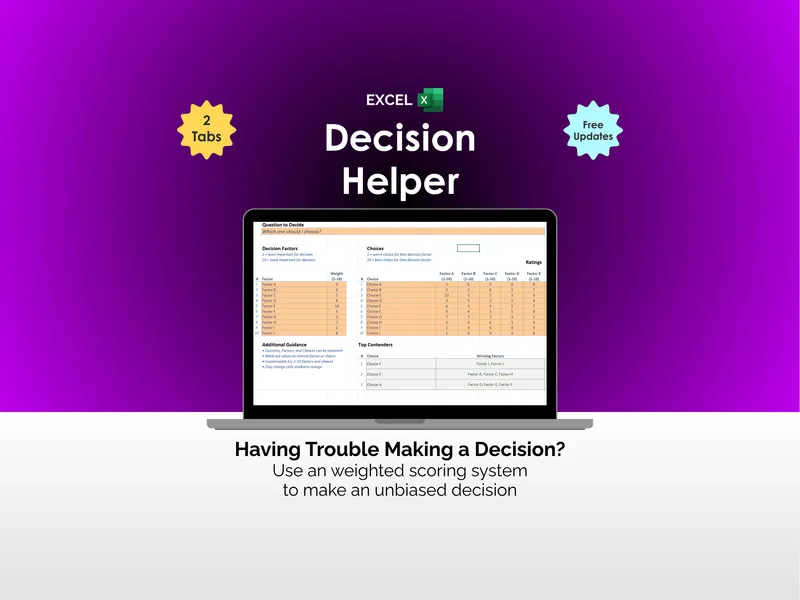
If the rules above return nothing — or return an answer you do not believe — that is exactly what weighted decision scoring is for. The Decision Helper turns “drop or stay” into weighted factors — cost, GPA risk, graduation timing, workload — and ranks the options for you, so the choice comes out of a grid instead of a group chat at midnight.
Common Questions About Dropping a Class
Does a W look worse than a bad grade?
To a GPA, usually not — a withdrawal is normally recorded as a notation carrying no grade points, while a D or F is averaged in. Check your registrar’s grading policy, though, because some schools convert a late withdrawal into a WF that does count. To a graduate program or a scholarship committee, one W in a hard term reads as ordinary; a pattern of them across several terms reads as a habit, and that is the version worth avoiding.
Can I drop below full-time and keep my scholarship?
Sometimes, but never assume it. The gradual scaling that applies when you drop below full-time is specific to the Pell Grant — institutional scholarships, campus housing contracts and campus health plans tend to be cliffs instead, full-time or nothing. The rule lives in your award letter or your housing contract, and the financial aid office can confirm it in one phone call.
Is there any point in dropping after the refund deadline?
Often yes, because the two deadlines protect different things. After the refund window closes you pay for the class whether you sit in it or not, so a later drop no longer buys money back — but it can still buy a W instead of an F, and it still frees the hours you would have spent losing that fight.