
A recruiter calls with a number. Twenty-two hundred a week. Maybe they say it as a blended rate — sixty-one an hour — because that sounds like the hourly rate you are used to hearing. Either way, it is one number, and it arrives sounding like a fact.
It is not a fact. It is a sum, and the recruiter picked which things to put in it. Two offers quoted the same way, on the same shift, at the same hours, can differ by thousands of dollars over a thirteen-week contract — as the worked example further down shows — and the difference rarely shows up in the number said out loud. It hides in what the package is made of, what the city costs, and what happens if the assignment goes sideways.
The method is five steps, in this order: rebuild both offers on guaranteed hours, subtract what the assignment costs you to take, price the stipends twice, model the downside, and score the contract terms. Compare dollar totals only after all five, because until then you are comparing two numbers that were built to different rules.
This post is about the mechanics of taking that apart. Not what a pay package is — what a travel nurse pay package is made of covers that, and it is worth ten minutes if the terms are new. Not which single number to judge by, which is the subject of blended rate vs take-home pay. This is the procedure: how to sit down with two offers and rebuild them until one of them clearly wins.
Why two offers are not comparable as quoted
Two agencies can quote the same weekly total and mean quite different things by it, because each one chose where to draw a line the other drew somewhere else. A travel nursing package is split into a taxable base hourly rate and untaxed stipends — typically weekly housing and weekly meals-and-incidentals — and where that split falls is a design decision, not a fixed formula.
That single design choice makes two quoted numbers non-comparable in four separate ways:
- The tax treatment differs. An offer built on a $20 base and $1,480 in stipends is taxed on a quarter of what an offer built on a $32 base and $958 in stipends is taxed on. Same headline, different paycheck.
- The hours behind the number differ. A weekly package quoted at 36 hours means nothing if the contract guarantees 32, or guarantees nothing at all.
- The city behind the stipend differs. A housing stipend is not income if you spend all of it on housing. In an expensive market you can receive more housing money and keep less of it.
- The risk behind the contract differs. An offer you can be cancelled out of with 24 hours’ notice is worth less than an identical offer with a four-week cancellation clause, and no rate comparison shows this.
The fix is not a better calculator. It is putting both offers into the same five columns and refusing to compare them until they are there.
Step 1: Rebuild both offers on guaranteed hours
Every weekly package is an hours assumption wearing a dollar sign. Before anything else, find out what each contract actually guarantees.
Ask for the guaranteed hours in writing, rebuild both offers at that number, and compare the results. If an offer has no guaranteed-hours clause, compare it at the hours you would still be paid for if the unit went quiet, which may be zero.
This is the step that most often reorders two offers on its own, because a package quoted at 36 hours with a 32-hour guarantee is really two different offers depending on the census — and only one of them was quoted to you.
Three questions get you the number:
- How many hours are guaranteed per week, in the contract, in writing? Not “you’ll definitely get 36.” The clause.
- What happens to the stipends if I’m cancelled for a shift? On some contracts stipends are prorated down with hours. On others they are not. It can be worth hundreds a week, and it is the kind of detail that tends to stay unsaid unless you ask.
- Is overtime at the taxable base rate or the blended rate? Usually the base rate — which means an offer with a low base pays badly for extra hours, and that may be exactly the offer whose headline looked best.
Step 2: Subtract what the assignment costs you to take
This is the step nobody skips twice, and the one no pay calculator does for you. Every assignment charges you for the privilege of taking it, and the charges are not the same between two cities.
Price six lines for each offer: housing you will actually pay, parking and commuting, trips home, licensure and certification, unpaid orientation hours, and the cost-of-living gap on everything you buy weekly.
A few notes on the ones people underestimate:
- Housing you will actually pay. Not the stipend. Get a real listing — a real furnished short-term unit within your real commute — and use that number. If the stipend exceeds it, the surplus is yours. If it does not, the shortfall comes out of your base.
- Trips home. Divide the whole-contract cost by the number of weeks. Three round-trip flights at $420 over thirteen weeks is about $97 a week, every week, and it belongs in the comparison as such.
- Licensure. The Nurse Licensure Compact (opens in new tab) reported that “43 jurisdictions are currently part of the NLC” as of September 2026, and a multistate license covers you in the others — so this line is often zero. Check the current membership before you rely on it. When the line is not zero, it is a few hundred dollars plus a processing delay you may be eating unpaid.
- Unpaid orientation. Sixteen unpaid hours at a $20 base is $320, which is a quarter of a week’s net on a thin contract.
One thing worth checking while you are on this step: the General Services Administration’s per diem rates (opens in new tab), which set federal “allowances for lodging, meal and incidental costs while on official government travel” and are searchable by city and ZIP. They are not a rule that binds agencies, but they are a public, city-specific benchmark for what lodging and meals are reckoned to cost — which makes them a useful sanity check on a stipend you are being quoted. A housing stipend that sits well above the published lodging rate for that city is not automatically a problem, but it is worth understanding before you build a comparison on it.
Step 3: Price the stipends twice
Untaxed stipends are the single biggest lever in a travel package, and they rest on a condition that is about you, not about the offer.
Run each offer once with the stipends untaxed and once with every stipend repriced as ordinary wages, and look at both numbers before you decide.
The condition is the tax home. The IRS states plainly in Topic no. 511, Business travel expenses (opens in new tab) that “your tax home is the entire city or general area where your main place of business or work is located, regardless of where you maintain your family home,” and that “any work assignment in excess of one year is considered indefinite.” The glossary page linked at the top walks through what maintaining one involves; what matters for the comparison is narrower.
It matters because the two offers are not equally exposed to it. The offer leaning hardest on stipends has the most to lose. Run both numbers and you will see which offer is a bet and which one is not — and if you are anywhere near the one-year line in a single metro area, that second number is the one to plan around.
Step 4: Model the downside before you sign
You are not comparing two guaranteed outcomes. You are comparing two ranges, and their floors are further apart than their midpoints.
Reprice each offer three ways — hours cut to the guarantee, contract cancelled at week four, and two weeks of shifts you decline or miss — and take the worst of the three as that offer’s floor.
The cancellation scenario is the one that separates offers most, because it interacts with everything else you have already priced:
- A contract cancelled at week four does not refund your state license fee, your travel out, or your lease deposit.
- If you signed a housing lease longer than the contract, you are carrying it.
- The completion bonus, if there is one, evaporates entirely — so an offer whose margin depends on a completion bonus has a much lower floor than its headline suggests.
Rank on the midpoint. Then look at the floors. If the better offer has a floor you could not absorb, that is a real reason to take the other one, and it is a reason you can only see if you did this step.
Step 5: Score the contract terms, then rank
Money last, because by now you have it. What you do not have is a way to stop a thin dollar advantage from beating an offer you can actually rely on.
Rate each offer on cancellation notice, guaranteed hours, floating clauses, on-call obligations, block scheduling, travel reimbursement, housing deadlines and completion-bonus conditions, then put that score next to the money.
Rate each clause three ways and nothing more elaborate: confirmed in writing, verbal only, or not addressed. The middle category is the useful one, because “verbal only” is where a promise you are counting on turns out never to have been in the contract. Converting a handful of verbal assurances into written ones before signing is usually free, which makes this the highest-return fifteen minutes in the whole process — and the same principle that applies to negotiating salary without losing the offer applies here: ask while you still have leverage, which is before you sign.
A worked example: two offers, one winner
Let us work through illustrative numbers. Both offers are 36 guaranteed hours a week on a 13-week contract.
To keep the arithmetic legible, the tax lines use a flat 12% effective federal rate plus 7.65% FICA on the taxable base, and one deliberate difference: Offer A sits in a state with no income tax, and Offer B in a state that levies 4.5%. So Offer A’s base is taxed at 19.65% and Offer B’s at 24.15% — a real lever between two assignments, and the reason the two tax lines below are not proportional to each other. Your own withholding will differ; the point here is the shape of the result, not the precision of the rate.
| Offer A — big coastal metro | Offer B — mid-size inland city | |
|---|---|---|
| Taxable base | $20/hr × 36 = $720 | $32/hr × 36 = $1,152 |
| Housing stipend | $1,150/wk | $700/wk |
| Meals & incidentals | $330/wk | $258/wk |
| Headline weekly package | $2,200 | $2,110 |
| Blended rate | $61.11/hr | $58.61/hr |
| Tax on the taxable base | −$141 (at 19.65%) | −$278 (at 24.15%) |
| After tax | $2,059 | $1,832 |
| Cost of being there | −$1,226 | −$699 |
| Net in the bank, per week | $833 | $1,133 |
| Over 13 weeks | $10,823 | $14,726 |
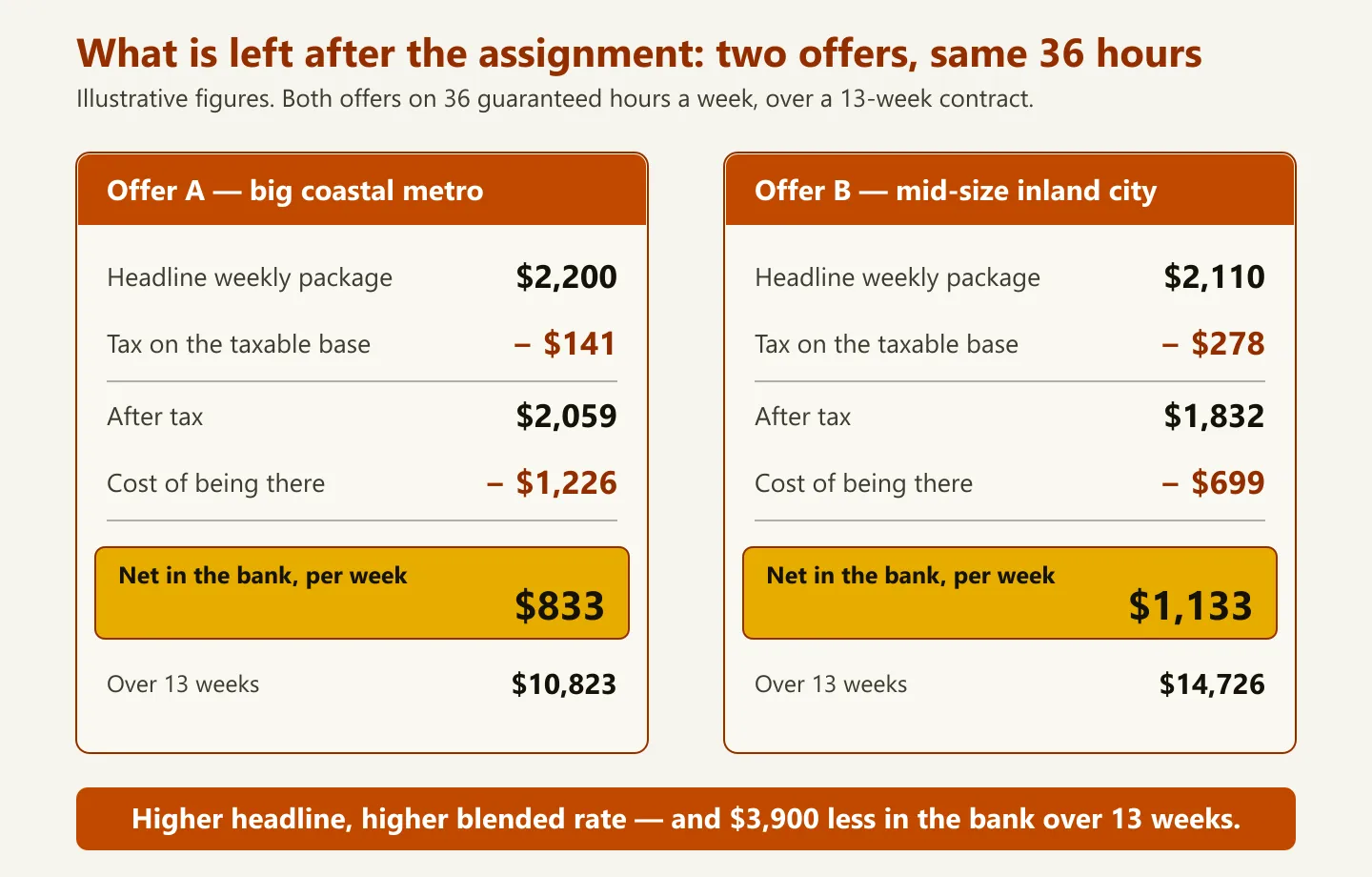
Offer A wins the headline by $90 a week and the blended rate by $2.50 an hour. It loses the contract by about $3,900.
The cost-of-being-there line is doing most of the work. Offer A’s housing stipend of $1,150 buys a $1,000-a-week furnished unit near the hospital; add $30 parking, $97 a week in flights home, $14 for the state license amortized, $25 in unpaid orientation and $60 in the grocery-and-tolls gap, and $1,226 a week never reaches the bank. Offer B’s $700 stipend covers a $610 unit outright, parking is free, the drive home four times over the contract costs $29 a week, licensure is $0 because the state is in the compact, orientation is $20 and the grocery-and-tolls gap is $40 — $699 in total, and $527 a week less than Offer A gives up.
Now run step 3. Reprice every stipend as ordinary wages and Offer A falls to about $542 a week; Offer B falls to about $901. The gap does not close — it widens, from $300 a week to about $360, because the offer leaning hardest on untaxed stipends is the one with the most to lose when they are taxed. The offer that looked best on the phone is the one whose advantage was most conditional.
If you want to run this on your own two offers without building it, the free two-offer comparison sheet does steps 1 through 3 with no signup. The Travel-Nurse Contract & Pay-Package Comparison Workbook runs all five across four offers at once, including the tax-home switch and the downside models.
What to write down while the recruiter is talking
Most of the difficulty in this method is that the inputs arrive verbally, at speed, while you are being sold to. Have this list in front of you on the call:
- Taxable base hourly rate — the actual number, not the blended rate
- Housing stipend, per week
- Meals and incidentals stipend, per week
- Guaranteed hours per week, and whether it is in the contract
- Shift length, shift type, and whether the schedule is blocked
- Overtime rate, and whether it is on base or blended
- What happens to stipends when a shift is cancelled
- Cancellation notice period, both directions
- Float requirements — which units, how often
- On-call obligation and on-call pay rate
- Orientation hours, and whether they are paid
- Travel reimbursement — amount, and when it pays
- Completion bonus amount and the exact conditions
- Licensure — required, and who pays
- Start date and the housing deadline that follows from it
You are not negotiating on this call. You are collecting the fifteen inputs that make the offer comparable to the next one.
Common Questions About Comparing Travel Nurse Offers
How many offers should I compare at once?
Three or four is the practical ceiling, and two is usually the real decision. The work in this method is front-loaded — once you have built the columns for the first offer, adding a second takes about fifteen minutes, because you are filling in the same rows. Beyond four offers the exercise stops being a comparison and becomes data entry, and offers tend to expire on their own timetable rather than yours.
What if the recruiter will not break the package into base and stipends?
Treat that as an answer rather than an obstacle. Every agency knows the split, because they have to run payroll from it. A recruiter who will only quote you a blended weekly number is either withholding the one figure that makes offers comparable or working from a package they have not been given in detail themselves. Ask once in writing, and if the split does not arrive, compare that offer as though the entire package were taxable — which is the honest worst case, and often close to the truth.
Do I have to redo the whole comparison for every assignment?
No, and this is the part that compounds. The rows that take real effort — your trips home, what you actually spend in a week, how much unpaid orientation costs you, which clauses have burned you before — are yours, not the offer’s. They carry over unchanged. After two or three contracts you are only filling in the offer-specific columns, and the comparison takes an evening rather than a weekend.
The takeaway
The number a recruiter quotes is the least informative number in the conversation, because it is the only one that was chosen for you. Everything that actually decides which contract pays more — the guarantee behind the hours, the rent behind the stipend, the tax condition behind the split, the notice period behind the whole thing — sits one layer down, and every one of those layers is knowable before you sign.
Five steps, fifteen inputs, one number per offer. That is the whole method, and it is the difference between choosing an assignment and being assigned one.
Weighing a travel contract against a staff position rather than against another travel contract is a different comparison with different columns — the job offer decision helper scores that one. The reasoning behind it is the same reasoning laid out in choosing between two job offers.