
Picture a hypothetical landlord — call her the owner of one side of a duplex, a composite of the small operators this decision lands on. Her tenant has been there four years. Rent is $1,450. Comparable units down the street are listing at $1,600. The tenant pays two days early, mows the strip of lawn nobody asked him to mow, and once texted a photo of a dripping shut-off valve before it became a wall.
Renewal is ten weeks out. She has been circling the same question for a month: should she raise the rent on a good tenant, or leave a $150 gap on the table to keep him?
The short answer: if the unit is genuinely below market, raise it. A rent increase only loses money in year one if it raises the chance of a move-out by more than the annual gain divided by your turnover cost — and against an illustrative $2,950 turnover like the one below, even a $150-a-month increase needs the tenant to become 61 percentage points more likely to leave before it stops paying. The arithmetic below shows why, and names the cases where holding really is the right call.
Almost every version of this question gets answered on feel. It shouldn’t be. There is a real number on both sides, and once you put them next to each other the decision usually stops being agonizing.
The Question Behind the Question
The decision is not “am I being greedy.” It is: is the money I gain from the increase bigger than the money I lose if the increase makes my tenant leave?
That reframe matters because it turns a values question into an arithmetic one with two inputs you can actually estimate:
- The gain — the monthly increase times twelve, and again every year after.
- The exposure — what a turnover costs you, multiplied by how much more likely the increase makes a move-out.
That second term is the one people get wrong. They compare the increase against the whole cost of a turnover, as if raising the rent guaranteed a move. It doesn’t. Moves get driven by jobs, partners, babies and burst pipes as well as by rent — which means the increase is only responsible for the additional risk it creates, not for the baseline chance your tenant was going to move anyway.
What One Turnover Actually Costs
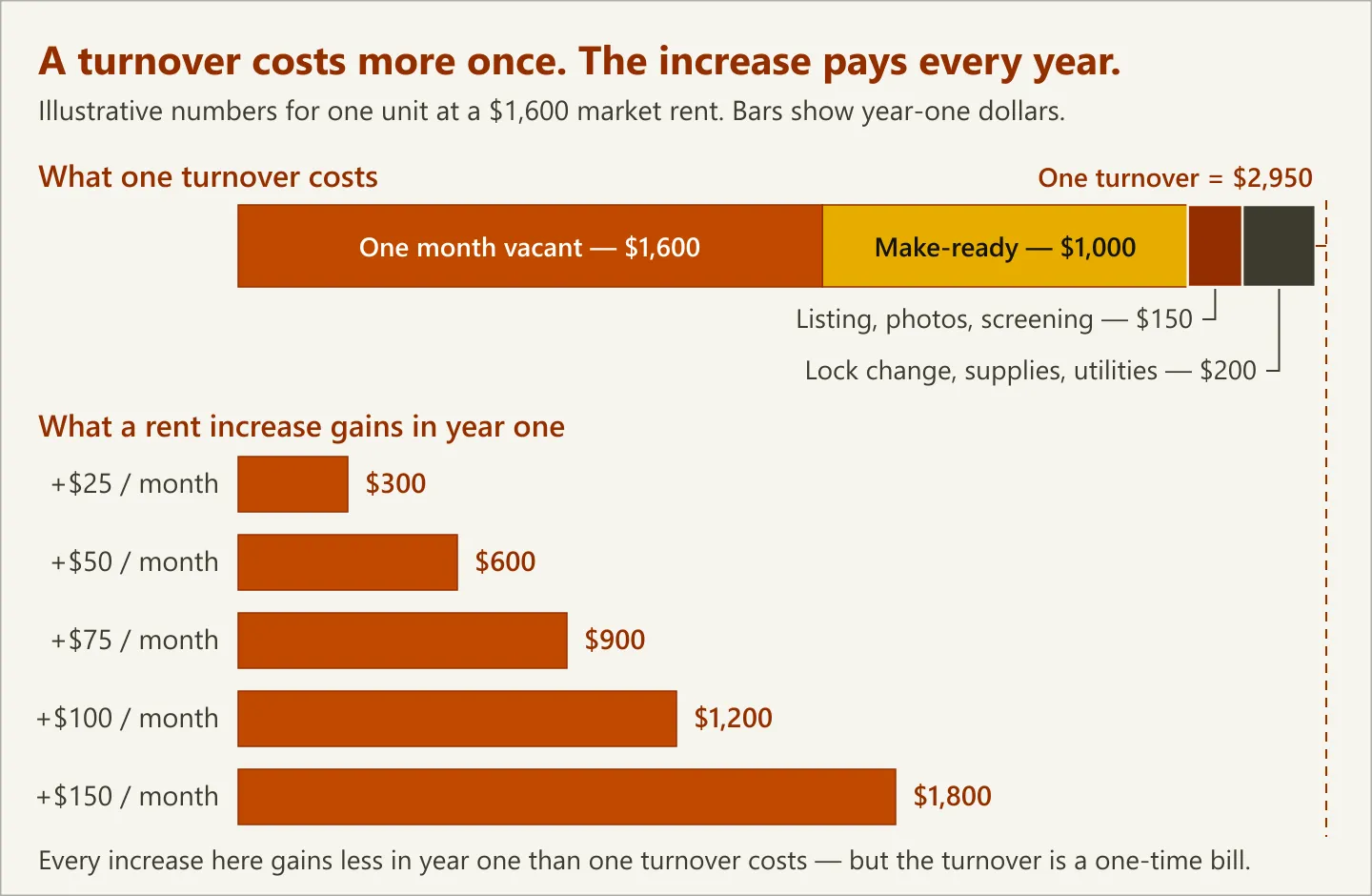
A turnover is not one bill — it is a stack of them, and the biggest line item is the one that never shows up on a receipt. Add the vacant month to the make-ready and the stack below lands at $2,950 on a $1,600 unit: nearly two months of rent, by the time the new tenant’s first payment clears.
The National Apartment Association’s apartment turnover guidance (PDF) (opens in new tab) is the closest thing to a benchmark. Citing the association’s 2019 survey of operating income and expenses, it puts the average cost of a single move-out at a conservatively calculated $1,800 and the average turnover rate at 46.8%. The same guidance notes that many companies use seven working days as a make-ready guideline, while some target five or even three.
Two things to hold onto about that $1,800. The NAA document never says what the figure covers, but the case study inside it books reduced vacancy loss as recovered income, on a separate line from turn-labor savings — so read the $1,800 as a make-ready-side number, and don’t set it against the $2,950 below, which includes the vacant month. And it comes from professionally managed communities with a dedicated turnover process, in-house or contracted; a one-unit landlord booking a painter and listing on a Tuesday has no crew standing by to absorb the labor.
Here is the stack, with illustrative numbers for a unit at a $1,600 market rent:
| Turnover line item | Illustrative cost |
|---|---|
| One month vacant (at the new $1,600 rent) | $1,600 |
| Make-ready: paint, deep clean, minor repairs | $1,000 |
| Listing photos, advertising, tenant screening | $150 |
| Lock change, cleaning supplies, utilities while empty | $200 |
| Total | $2,950 |
The vacancy line is the one worth staring at: a single empty month is more than half the total. For scale, the Census Bureau’s second-quarter 2026 residential vacancies report (PDF) (opens in new tab), released July 28, 2026, put the rental vacancy rate at 7.3% — statistically unchanged from a year earlier — and the median asking rent for vacant for-rent units at $1,531. That is a national stock figure, though, not a forecast of how long your unit sits. Comparable local listings will tell you that, and they are what your vacancy estimate should be built on.
A turnover is not “some paint and a weekend.” It is a month of revenue you will never bill for, plus a contractor, plus your own unpaid hours as leasing agent, photographer and screener.
Keeping this stack somewhere other than your memory is most of the battle — the Small-Landlord (1-4 Unit) Income & Expense Workbook exists so your logged repair spend, the repairs-versus-improvements split and per-unit cash flow land in the same file you already use for the Schedule-E numbers, which means next year’s version of this decision starts from costs you actually recorded instead of a guess.
The Break-Even: How Much Risk an Increase Has to Buy
The increase pays off unless it raises the chance of a move-out by more than the annual gain divided by the turnover cost. That is the whole decision rule, and it is one line of division:
Break-even risk = annual gain ÷ turnover cost
Run it across a range of increases, against the $2,950 turnover above:
| Monthly increase | Gain in year one | Break-even added move-out risk (percentage points) |
|---|---|---|
| +$25 | $300 | about 10 points |
| +$50 | $600 | about 20 points |
| +$75 | $900 | about 31 points |
| +$100 | $1,200 | about 41 points |
| +$150 | $1,800 | about 61 points |
Read the +$150 row carefully, because it is the counterintuitive one. Moving our hypothetical duplex from $1,450 to the full market $1,600 only loses money in year one if it makes the tenant 61 percentage points more likely to leave — if it takes him from, say, a 15% chance of moving to a 76% chance. For a tenant who is currently paying under market and would have to pay market anywhere else, that is not a realistic jump.
You will not find a lookup table for that risk number, but you can bound it with one honest question: at the new rent, is he still paying less than he would for the same place down the street? If yes, moving costs him a deposit, a weekend and a mover to chase savings he would hand straight back — so the added risk stays small. If no, you have crossed from closing a gap into charging a premium for not moving, and the risk climbs quickly. That crossover is the first item in the “when to hold” list below.
And year one is the pessimistic frame. The turnover is a one-time bill; the increase is permanent. By year two the $150 increase has gained $3,600 against a cost that already happened — which is why the arithmetic favors moving rent toward market consistently over freezing and catching up later.
The honest summary: for a unit that is genuinely below market, raising the rent is usually the right call, and the size that feels rude is often the size that is merely correct.
Why the Small, Polite Increase Is the Risky One
A $25 increase — the +$25 row of the table above — needs only a 10-point rise in move-out risk to be a wash. It is the increase most likely to be waved off as “not worth the awkwardness,” and on its own terms it genuinely isn’t: $300 does not survive contact with a turnover.
But the $25 increase is not really competing with the turnover. It is competing with the gap it prevents.
Take a different unit, also renting at $1,450, but one that was at market three years ago. Skip the increase three years running while the market rises 4% a year and you are not $25 behind — you are about $181 a month behind, and now you face a genuinely dangerous choice: absorb a permanent $2,170-a-year shortfall, or ask a long-term tenant to swallow a 12.5% jump in one renewal. The second option is the one that can genuinely move the risk needle — not because 12.5% is a magic threshold, but because a jump that arrives as a surprise after three flat years is the kind a tenant answers by pricing moving trucks rather than by re-reading the lease. And you gave up three years of the increase to get there.
The expensive mistake is almost never raising the rent. It is letting the gap grow until the catch-up is big enough to cause the move you were trying to avoid.
When You Should Hold the Rent
There are real cases where holding is the better call, and none of them are “he’s a nice guy.” Hold when:
- You are already at or above market. The break-even math above assumes the tenant would pay more elsewhere. Once you cross market rate, you are charging a premium for the privilege of not moving, and the risk curve gets steep fast. Check comparable listings before you check your feelings.
- Your local market has visible slack. If similar units near you are sitting for weeks with concessions attached, your turnover cost estimate should go up and your risk tolerance should come down.
- The tenant is doing work you would otherwise pay for. A tenant who handles lawn care, coordinates with contractors, or keeps an eye on a property you don’t live near is providing a service. Price it honestly — if it is genuinely worth $60 a month to you, then a $50 increase is not free.
- You are about to sell or renovate. If the unit is coming empty in eight months anyway, an increase collects for eight months at most while carrying full turnover risk in exactly the window where an early vacancy hurts you. Hold, and take the increase up with the next tenant.
- Local law caps or complicates it. Rent regulation, notice periods and renewal rules are set at the state and local level, not federally, and a capped increase changes the whole calculation above. Run the number your jurisdiction actually allows rather than the one the break-even math wants — that capped figure is also what carries through to the rent line on your Schedule E at tax time. Start with USAGov’s page on landlord disputes, which links onward to your state’s tenant-rights agency (opens in new tab), and with your own lease — not a forum post about someone else’s state.
Notice what is missing from that list: gratitude. A good tenant is a reason to raise the rent carefully and predictably — not a reason to never raise it.
The Cadence That Beats Both the Big Increase and the Freeze
The pattern that keeps this decision small is boring: a modest, scheduled, expected increase every single year, delivered the same way each time.
- Every year, at renewal. Predictability is the actual product. A tenant who knows a modest increase arrives each spring plans around it. A tenant who gets nothing for three years and then a 12.5% jump feels ambushed, and ambushed tenants shop.
- Tied to something concrete. Property taxes, insurance premiums and a specific repair are real, verifiable, and shift the conversation off your personal generosity.
- Sized against market, not against last year’s rent. The question is never “how much more than $1,450?” It is “how far under $1,600 am I willing to stay?”
- Paired with something visible. If you are moving the rent up meaningfully, do the thing that has been on the list — the disposal, the storm door, the closet shelving. It reframes the renewal as an exchange.
This is the same logic that governs the other direction of the decision — if you find yourself repeatedly choosing stability over income, it may be worth stepping back and asking whether to sell the house or rent it out at all. And it is worth remembering that your tenant is running a mirror-image version of this calculation on his side of the door when he weighs whether to renew the lease or move; his moving costs are the reason your increase has more room than it feels like it does.
How to Deliver the Increase
The number matters less than most landlords think. The delivery matters more.
- Check your state’s notice requirement first, then add margin. If the rule is 30 days, send it at 60. Late notice reads as disorganized and invites negotiation.
- Put it in writing, and lead with the renewal, not the increase. “I’d like to renew your lease for another year” is the headline. The new rate is the second sentence.
- Give one concrete reason and stop. Insurance went up; taxes went up; here is the new rate. Do not present your whole cost sheet — it invites line-item debate about your business.
- Name the market. “Comparable units nearby are listing at $1,600; I’m renewing you at $1,525” tells the tenant he is still getting something, which is true and worth saying.
- Offer a term choice. A two-year renewal at a slightly lower rate can be worth more to you than the extra $25 a month, because it eliminates a turnover risk entirely for a second year.
- Say what you’re fixing. Attach the improvement, if there is one, to the same message.
The Tax Footnote Nobody Mentions
A vacant month is not a tax write-off. This surprises people who assume lost rent is deductible the way a repair is. The IRS states the underlying principle in its rental income and expenses guidance (opens in new tab): “If you’re a cash basis taxpayer, you can’t deduct uncollected rents as an expense because you haven’t included those rents in income.”
The repairs and services during a turnover generally are deductible operating expenses. The rent you never collected simply never existed. So the vacancy line in that $2,950 stack — the biggest one — comes out of your pocket at full weight, with no offsetting deduction to soften it. That is a good reason to treat a vacant month as more expensive than it looks, not less.
Write the Call Down Before You Find Out If It Was Right
Whatever you decide, the decision is worth more to you next year if you record why you made it. Write down the rent, the market rate you compared against, the increase you chose, and — this is the part everyone skips — what you predicted would happen. “I expect him to renew, maybe 80%.”
Then look at it in twelve months. The point is to find out whether your fear of the increase matched what actually happened. Nothing forces that check, so it rarely happens on its own — which is why the same anxiety turns up unchanged at the next renewal. A decision journal and outcome tracker turns that into a habit rather than a resolution.
Three renewals in, the record is worth more than any single call it contains: you can see whether your below-market units are drifting further behind each year, and which of your predictions about tenants leaving actually came true. If you want the underlying method — weighted scoring, flip distance, and the specific ways people rig their own comparisons — How to Make a Big Decision is the longer version of the framework this post applies to one narrow case.
Common Questions About Raising the Rent on a Good Tenant
How much can I raise the rent at once?
Legally, that depends entirely on where the unit is — some states and cities cap annual increases, most don’t, and nearly all set a minimum notice period. Financially, the ceiling is the point where the tenant starts pricing out a move, which is roughly where your rent crosses the market rate for comparable units. Below market, you have room. At or above market, you are asking the tenant to pay a premium to avoid moving, and some of them will do the arithmetic and move.
Should I raise the rent mid-lease?
Not on a fixed-term lease — the rent is set by the contract until it ends, and that is the whole point of a fixed term. On a month-to-month arrangement you generally can, subject to your state’s notice rules. The clean moment is renewal: it is the one time the tenant is already deciding whether to stay, so the increase lands as part of a decision they were making anyway rather than as a surprise.
What if my tenant asks me to waive the increase?
Ask what they are offering in exchange, because there is usually a trade available that is worth more to you than the money. A longer term, an earlier renewal commitment, or taking over a service you currently pay for can all be worth more than $50 a month, and they cost the tenant less than moving does.
Does a below-market rent hurt me if I sell?
Yes, and this is the version of the cost that surprises people. Buyers of small income properties weigh the rent the unit actually produces, so a unit renting $200 under market is not just losing $2,400 a year — it is carrying a lower valuation into any conversation with a buyer who is pricing the unit off its income, for as long as the lease runs.
Is it worth raising the rent by only $25?
Sometimes, but not for the money. A $25 increase gains $300 in a year, which is a rounding error against a turnover — its real value is keeping the rent moving so a gap never opens. If you are going to make a token increase, do it every year without fail. A token increase every third year is the worst of both worlds: it collects almost nothing and still lets the unit drift below market.
The Short Version
Back to the duplex. Her tenant is $150 under market on a unit where a turnover would cost roughly $2,950. The increase only loses in year one if it makes him 61 percentage points more likely to leave, and it gains $1,800 a year, every year after that. The answer is to raise it — probably not the full $150 in one step after four flat years, but $75 now to $1,525, which gains $900 a year and needs a 31-point risk jump before it loses, and the rest at the next renewal. In writing, with 60 days’ notice, and the disposal finally replaced.
Raising the rent on a good tenant is rarely the mistake. Waiting until the gap is big enough to justify their move is.