You found the listing. The Saturday showing is two hours away. You’re already mentally arranging furniture in the living room.
Stop. Open a tab. Run this 5-minute affordability check first.
The point isn’t to talk yourself out of buying. It’s to walk into the showing knowing whether the asking price is within your budget, not just within what a lender said you “qualify for.” Those two numbers are not the same — and in 2026, they can be wildly apart. (If you’re still on the bigger question of whether to buy at all this year, our framework on whether you should buy a house in 2026 is the post that comes before this one.)
Here’s the move.
The 5 Numbers to Pull Up
You need five things on screen: the listing price, your gross monthly income, your current monthly debt payments, your liquid savings, and the property tax rate for the zip code (one search). That’s it.
Run these checks in order. If any of them lights up red, the listing is a stretch — not a “no,” but a “go in with your eyes open.”
| Check | What to calculate | Green light | Red light |
|---|---|---|---|
| 1. All-in monthly payment (PITI + HOA) | Principal & interest + property tax/12 + homeowners insurance/12 + HOA | ≤ 28% of gross monthly income | ≥ 32% of gross monthly income |
| 2. Total debt-to-income | All-in housing payment + every other monthly debt (auto, student loans, credit-card minimums) | ≤ 36% of gross monthly income | ≥ 43% of gross monthly income |
| 3. Cash-to-close reality | Down payment + closing costs (≈ 3% of price) + escrow setup + moving + 1% of price for immediate repairs | Covered by liquid savings (not retirement, not gifts you haven’t confirmed) | You’re tapping a 401(k) or asking family |
| 4. Emergency reserve after closing | Liquid savings remaining after cash-to-close ÷ new monthly all-in housing spend | ≥ 3 months of housing-and-essentials covered | < 1 month — house-rich and cash-poor on Day 1 |
| 5. Property-specific gotchas | HOA fee, special-assessment history, age of roof/HVAC/water heater, flood zone, septic vs sewer, well vs municipal water | All known and budgeted | Any one of these unanswered before the offer |
Five rows. About four minutes if you’ve done it before, six the first time.
Why Each Number Actually Matters
Check 1 and 2 — the 28/36 rule — is the conservative end of mortgage lending math. Most explainers, including Bankrate’s breakdown of the 28/36 rule (opens in new tab), describe it as a general guideline: no more than 28% of gross monthly income on housing (PITI plus HOA), no more than 36% on total debt. Lenders will absolutely approve you well above those numbers — the Fannie Mae Selling Guide on debt-to-income ratios (opens in new tab) allows manually underwritten conventional loans up to 45% total DTI with compensating factors, and casefiles run through Desktop Underwriter can reach 50%. Approval is not the same as affordability. The 28/36 thresholds are designed to absorb a furnace replacement, a job change, or a property-tax reassessment without forcing a hard choice.
Check 3 — closing costs — is the number nobody mentions during the listing photos. Closing costs typically run 2% to 5% of the loan amount, and the Bankrate 2025 state-by-state average closing costs analysis (opens in new tab) (using Lodestar data) shows real geographic spread — from around $1,500 in the cheapest states to over $17,000 in the District of Columbia. On a $400,000 home, that range alone is an $8,000–$20,000 swing. Budget the higher end of your state’s average, not the lower.
Check 4 — the post-close emergency reserve — is the one most buyers skip. Wiping out your savings to close means the first water-heater failure or HVAC repair becomes a credit-card event. A home that empties your buffer isn’t “affordable” — it’s a single emergency away from financial stress. Three months is the floor, six is comfortable.
The Check, Run on a Real Listing
Abstract thresholds don’t land until you watch one fail. So here’s the whole five-check pass on a single listing, start to finish.
Every input below is hypothetical. It is not a quote, a rate forecast, or an average — it’s a worked example so you can see the shape of the arithmetic and then run it with your own numbers.
The inputs:
| Input | Value |
|---|---|
| Listing price | $400,000 |
| Down payment (10%) | $40,000 |
| Loan amount | $360,000 |
| Assumed rate / term | 6.5%, 30-year fixed |
| Gross monthly income | $9,000 |
| Other monthly debts (car $450, student loans $280, card minimums $90) | $820 |
| Liquid savings | $75,000 |
| Assumed property tax rate | 1.1% of price |
Check 1 — the all-in monthly payment. Principal and interest on a fixed-rate loan comes from one formula: monthly payment = loan × monthly rate ÷ (1 − (1 + monthly rate)^−months). At 6.5% over 360 months, $360,000 works out to about $2,275. Then stack the rest on top:
| Component | Math | Monthly |
|---|---|---|
| Principal & interest | $360,000 at 6.5%, 30 yr | $2,275 |
| Property tax | 1.1% × $400,000 ÷ 12 | $367 |
| Homeowners insurance | $1,800/yr ÷ 12 | $150 |
| PMI (under 20% down) | 0.5% × $360,000 ÷ 12 | $150 |
| HOA | none on this listing | $0 |
| All-in housing payment | $2,942 |
$2,942 ÷ $9,000 = 32.7% of gross income. Red. Note what did it: the payment cleared 28% before PMI was even added, and PMI is the line most buyers forget exists at 10% down.
Check 2 — total debt-to-income. $2,942 + $820 = $3,762. Divided by $9,000, that’s 41.8%. Above the 36% guideline, below the 43% red line — and comfortably inside what a lender may well approve. This is the exact gap the post is about: approvable and affordable are different words.
Check 3 — cash to close.
| Line | Amount |
|---|---|
| Down payment | $40,000 |
| Closing costs (≈3% of price) | $12,000 |
| Escrow setup (tax + insurance reserves) | $2,500 |
| Moving | $2,000 |
| Immediate repairs (1% of price) | $4,000 |
| Total cash to close | $60,500 |
Against $75,000 in liquid savings, that clears. Green — barely.
Check 4 — the reserve after closing. $75,000 − $60,500 = $14,500 left. Monthly housing ($2,942) plus essentials (say $2,300 for food, utilities, insurance, transport) = $5,242. $14,500 ÷ $5,242 = 2.8 months. Red.
Check 5 — property gotchas. Roof age unknown, HVAC age unknown, no HOA. Two unanswered. Red until the inspection.
Verdict: three reds. Not “you can’t buy this house” — a lender would likely say yes. It means you’d close with under three months of cushion, at a payment above the conservative guideline, in a house whose two most expensive systems are an unknown. That’s a decision to make on purpose at the kitchen table, not one to stumble into because the light was beautiful at the showing.
What actually moves the needle
Here’s the useful part. Once the check fails, you can see exactly which lever is worth pulling — same buyer, same income, one change at a time:
| Change | All-in payment | Housing ratio | Total DTI |
|---|---|---|---|
| Baseline ($400k, 10% down) | $2,942 | 32.7% | 41.8% |
| Pay off the car first (−$450/mo debt) | $2,942 | 32.7% | 36.8% |
| Target a $360k listing instead | $2,663 | 29.6% | 38.7% |
| Both | $2,663 | 29.6% | 33.7% |
Neither lever alone gets both rows green. Together they do — and notice that the $40,000 price change did less for the debt ratio than paying off one car loan. That’s not intuition; that’s arithmetic you can only see once the numbers are on screen.
That’s the whole argument for running this before the showing rather than after the offer. Not to kill the deal — to know which of the two conversations you’re actually having.
When the 5-Check Version Isn’t Enough
The check assumes a fairly standard buyer. A few situations need an extra pass before you trust the green lights:
- You’re self-employed or commission-based. Lenders typically average a couple of years of documented income, which may be well below what you earned last year. Run Check 1 and 2 against the averaged figure, not your best twelve months.
- You’re looking at a condo or an HOA community. The HOA fee goes in Check 1 — but the real risk is Check 5. Ask for the reserve study and the special-assessment history. An underfunded reserve is a bill that hasn’t been mailed yet, and it is not optional.
- You’re using an FHA, VA, or USDA loan. The down payment and mortgage-insurance mechanics differ from the conventional example above — VA loans have a funding fee instead of monthly PMI, FHA has its own upfront and annual premiums. The five checks still apply; the inputs in Check 1 and 3 change.
- Two incomes, one of which might pause. Run Check 1 twice: once on both incomes, once on the one that’s certain. If the second run is catastrophic, you’re not buying a house — you’re buying a requirement that nothing changes for thirty years.
- The house needs work. The 1% repair line in Check 3 covers a water heater, not a kitchen. If you’re buying a project, price the project before the offer, then add the buffer everyone tells you to add and nobody does.
Common Questions About Affordability
Isn’t a pre-approval already an affordability check?
No. A pre-approval answers “will a lender lend?” — a question about their risk, backed by the house as collateral. Affordability answers “can I live here without the payment eating everything else?” — a question about your life. The Fannie Mae guidance above allows total DTI well past 43% with compensating factors. That’s a lending decision, not a budget.
Why 28/36 and not the number my lender gave me?
Because the 28/36 thresholds leave room for the things you can’t schedule: a furnace, a job change, a property-tax reassessment, a baby. A payment at 43% DTI works fine right up until one of those happens, and then it doesn’t work at all. Use 28/36 to decide and use the lender’s number to know your ceiling.
How do I estimate property tax before I have a bill?
Search the county assessor’s site for the listing’s address — most publish the current assessment and the millage rate, and many list the last actual tax bill. Be aware that in many places a sale triggers a reassessment, so the seller’s current bill can understate what you’ll pay. When in doubt, use the county’s rate against your purchase price, not the seller’s old assessment.
What if I’m putting less than 20% down?
Then Check 1 gets a PMI line, as in the example above, and it’s usually meaningful — $150 a month in the worked example, which is most of what pushed the ratio red. PMI on a conventional loan can typically be removed once you’ve built enough equity; FHA mortgage insurance often can’t be, without refinancing. Ask which one you’re signing up for.
The numbers say no but I really want the house. Now what?
Then say that out loud, and decide on purpose. “We’re going to 32% and running a two-month cushion for two years until the car’s paid off” is a plan. “It’ll probably be fine” is not. The check isn’t there to give you permission — it’s there to make sure you know what you’re choosing.
The 5-Minute Rule
If you can’t run this exercise in five minutes for any listing you’re seriously considering, the math isn’t the bottleneck — your tracking is.
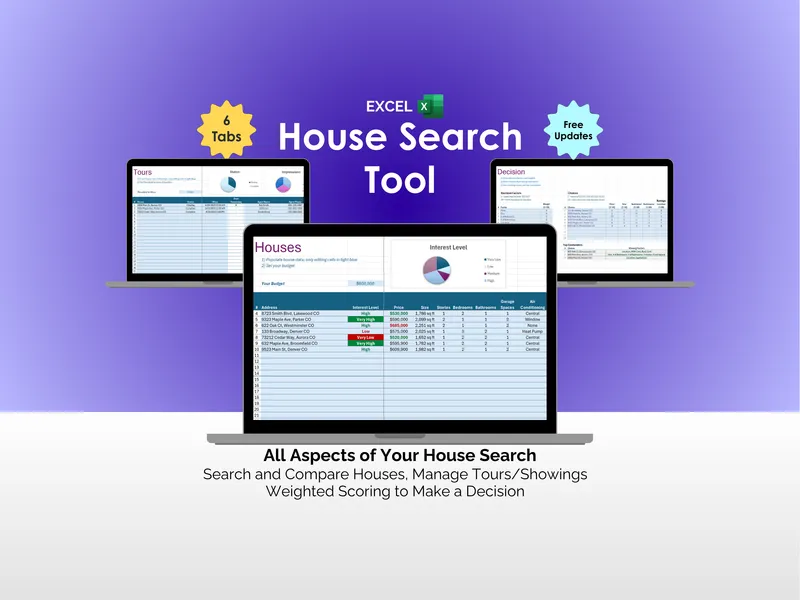
That’s why many house hunters end up building a spreadsheet after a few showings. You’re trying to remember whether 2912 Maple had a $300/month HOA, or whether that was the place on Birch with the special-assessment history. The House Search Tool pre-builds the 5-minute affordability check across every listing you tour, so you can rank them apples-to-apples instead of by which one had the cleanest staging.
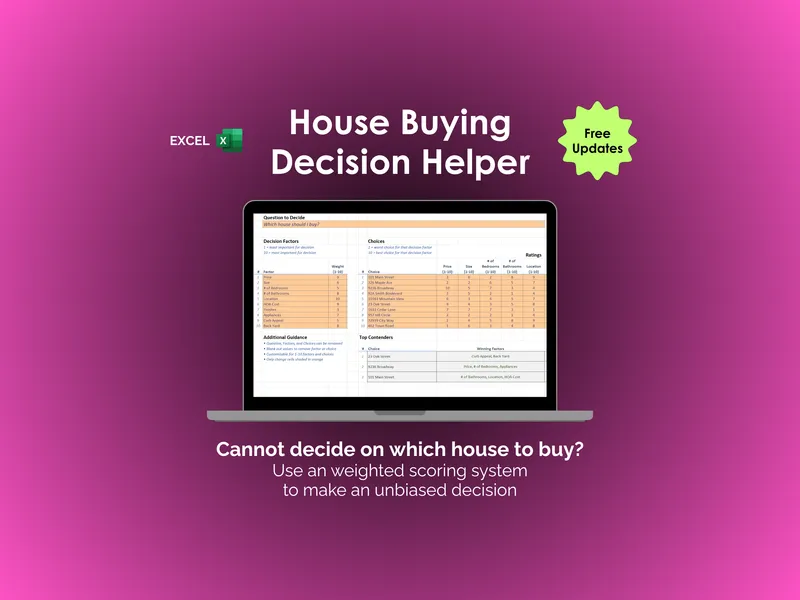
For the buy/don’t-buy decision once the math passes and you’re choosing between two finalists, the House Buying Decision Helper is built specifically for that head-to-head call.
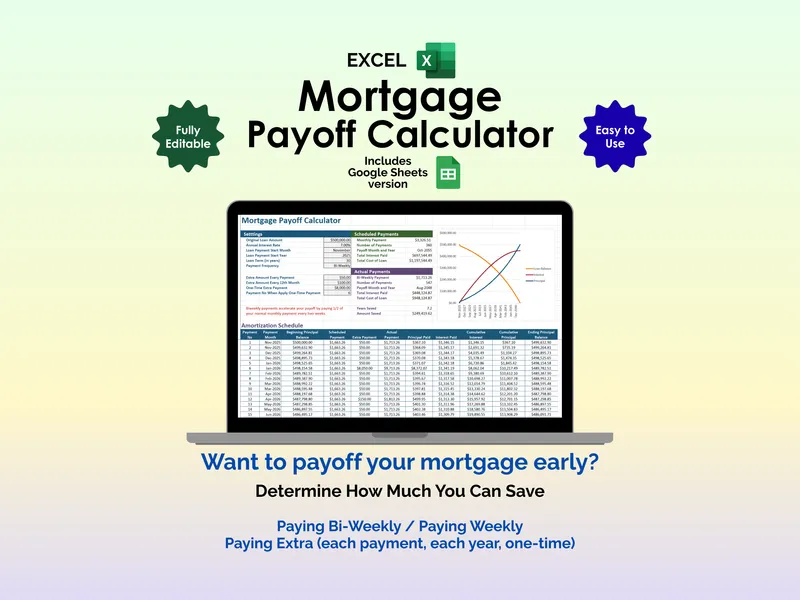
And if you want to model paying it off faster the moment you sign, the Mortgage Payoff Calculator shows what each extra principal payment is actually worth over the life of the loan.
The Move, One More Time
Before any Saturday showing:
- Pull up the five inputs (income, monthly debts, savings, listing price, tax rate).
- Run the 5-check table above.
- Anything red? Bring it up with the agent and the lender before you fall in love at the front door.
Five minutes. That’s the whole post.