Ask five people whether you should live on or off campus and you will get five confident answers. The upperclassman says the dorm is a waste of money. The parent says the dorm is safer. The friend with an apartment says they save a fortune on groceries. The financial aid letter implies it barely matters. And the housing portal says the deposit deadline is in eleven days.
They are all partly right, which is exactly why the decision feels impossible. The problem is that everyone is arguing about averages when the answer is entirely local — to your school, your city, your summer plans, and whether you will actually cook.
Here is how to settle it with numbers instead of opinions.
Should You Live On or Off Campus? The Short Answer
Live on campus if any one of these is true:
- The housing contract’s monthly rate is close to what a shared apartment costs in your town.
- You are a first-year student, or your school requires on-campus housing.
- You will not be in town over the summer.
Live off campus if all of these are true:
- You can find a shared place well below your school’s per-month room charge.
- You will actually cook rather than order in.
- You will be around in June and July — because that is when a 12-month lease either pays for itself or quietly costs you an extra $1,500.
The rest of this post is how to check which of those describes you, in about twenty minutes.
What the National Numbers Actually Say
They say the choice is close to a wash — which is the most useful thing they could possibly tell you.
The federal government tracks this directly. In the National Center for Education Statistics table on cost of attendance by living arrangement (opens in new tab), first-time full-time undergraduates at public four-year in-state institutions faced an average total cost of $28,349 living on campus and $29,483 living off campus and not with family in 2023–24. At private nonprofit four-year schools it tips the other way: $60,924 on campus versus $60,290 off campus.
Read that again. Nationally, moving off campus at a public university costs slightly more, and at a private university it saves about $600 on a $60,000 bill. Neither difference is a reason to do anything.
For scale, the College Board’s Trends in College Pricing and Student Aid 2025 (opens in new tab) puts the average 2025–26 total budget at $30,990 for in-state students at public four-year institutions and $65,470 at private nonprofit four-year institutions. Housing and food are a large share of that — NCES room and board charge data (opens in new tab) puts the average 2023–24 dormitory room charge at $7,515 and the board charge at $5,789 at public four-year schools, or roughly $13,300 combined.
The takeaway: there is no national answer, only a local one. The averages exist to tell you that the decision is genuinely close, so it will be decided by three or four line items specific to you — not by which option “everybody knows” is cheaper. If you want the full picture of where housing sits among every other bill, we broke down how much a year of college actually costs line by line.
The Case for the Dorm
The strongest argument for on-campus housing is not comfort or safety. It is that the price is complete.
- One number covers everything. Rent, electricity, water, internet, trash, pest control, furniture, and a maintenance crew that shows up. Nothing is billed separately, and nothing surprises you in February.
- It ends in May. A housing contract typically runs about nine months, from late August to mid-May. You are not paying for a bedroom in a city you have left.
- No capital required. There is no security deposit to float, no first-and-last month, and no empty apartment to furnish before your aid disburses.
- Proximity is a real budget line. No car, no parking permit, no gas, no bus pass, no 25-minute commute that makes an 8 a.m. class optional.
- Friction-free social life. In first year especially, the dorm is a social default. Off campus, you have to go build one on purpose.
- You may not have a choice. Many schools require first-years to live on campus. Check your housing policy before you plan anything else.
The dorm’s weakness is equally simple: you are paying a premium for a small, shared, rule-bound room, and the meal plan is usually the least negotiable expense of your entire year.
The Case for the Off-Campus Apartment
The strongest argument for off campus is not “it’s cheaper.” It is that the costs become controllable.
- The meal plan becomes optional. This is the single biggest swing item in the whole comparison. At the NCES average board charge (opens in new tab), a meal plan runs about $5,800 a year. Groceries for a student who genuinely cooks can run well under that, depending on diet and local grocery prices.
- More space per dollar, usually. A shared bedroom in a residence hall and a private bedroom in a three-bedroom apartment can cost about the same in a lot of college towns.
- You keep it over breaks. Residence halls frequently close over winter break and between terms. Your apartment does not.
- It’s practice. Leases, utilities, renters insurance, and splitting a bill with roommates are skills you will need within a year or two regardless.
- You choose your roommates. Not a random assignment.
The apartment’s weakness is that every one of those advantages is conditional. The meal plan savings vanish if you order takeout five nights a week. The space advantage vanishes in an expensive rental market. And the calendar advantage becomes a calendar problem.
The 12-Month Lease Problem Nobody Budgets For
Here is where off-campus cost estimates quietly fall apart: a housing contract is nine months and a lease is usually twelve.
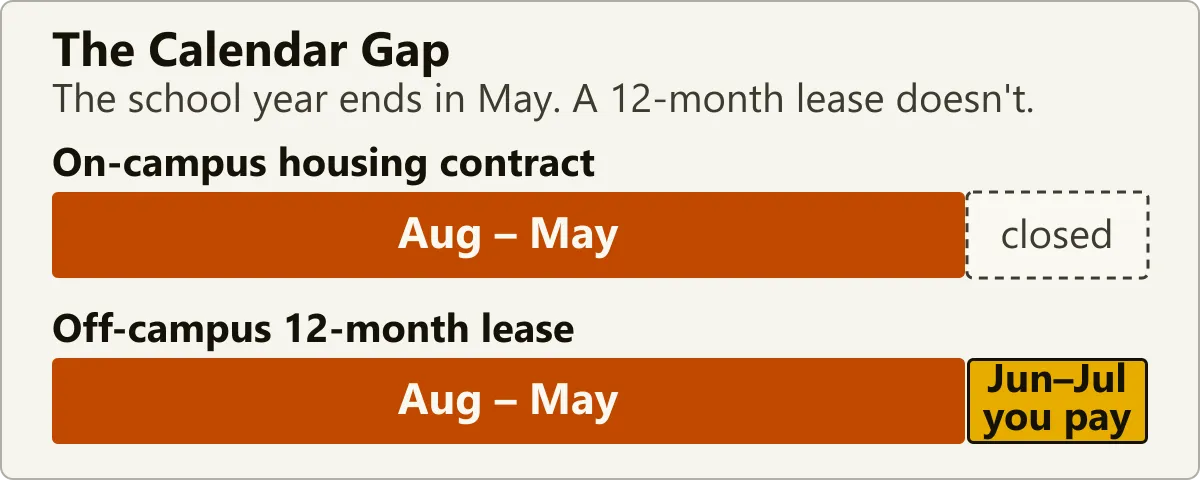
The shaded block is the gap: the months a 12-month lease charges you for after the housing contract has already ended.
If you go home for the summer, those extra months are money spent on an empty bedroom — roughly $1,500 at a $750 monthly share, more in a pricier market. You can try to sublet, but summer subletting in a college town is a buyer’s market, and you are generally still on the hook if your subletter stops paying.
If you stay for the summer — a research position, an internship, a co-op, a job you want to keep, a lab you cannot leave — those same months are not a cost at all. They are the thing you would otherwise be scrambling to arrange in April, when summer housing is expensive and residence halls are shut.
Same $1,500, opposite meaning. Which one it is for you is not a detail. It is arguably the whole decision.
Run the Numbers on the Same Terms
A common mistake in this comparison is measuring the two options differently — comparing a nine-month all-inclusive contract against a rent figure with no utilities, no groceries, and no bus pass in it. Whatever you count in one column, count in the other.
Here is that comparison with illustrative numbers, anchored to the NCES averages above. Substitute your own school’s room and board rates and a real rent quote from your city.
| Cost for one academic year (illustrative) | On campus | Off campus, shared 2-bedroom |
|---|---|---|
| Room / rent | $7,500 (9-month contract) | $9,000 ($750/mo × 12) |
| Food | $5,800 meal plan | $3,000 groceries (9 months) |
| Utilities + internet | Included | $1,020 |
| Renters insurance | Usually covered at home | $180 |
| Furniture and move-in | $300 | $900 |
| Getting to campus | $0 | $540 (transit pass or parking) |
| Total | $13,600 | $14,640 |
On these numbers the dorm wins by about $1,040 — and then two levers decide everything:
- Rent. Drop the monthly share from $750 to about $663 and the two columns tie. Below that, off campus wins outright even if you leave for the summer. In a lot of college towns that gap is easy to find with a third roommate; in others it does not exist at all.
- Food. The $3,000 grocery figure assumes you cook most nights. Add $150 a month of delivery and takeout, and the off-campus column gains $1,350 — erasing any plausible rent savings. Be honest with yourself here, because this is a common way off-campus budgets go wrong.
One more thing the table does not show: a security deposit plus first month’s rent is real cash you need before classes start, and it usually arrives back at the end, if at all. Budget it separately.
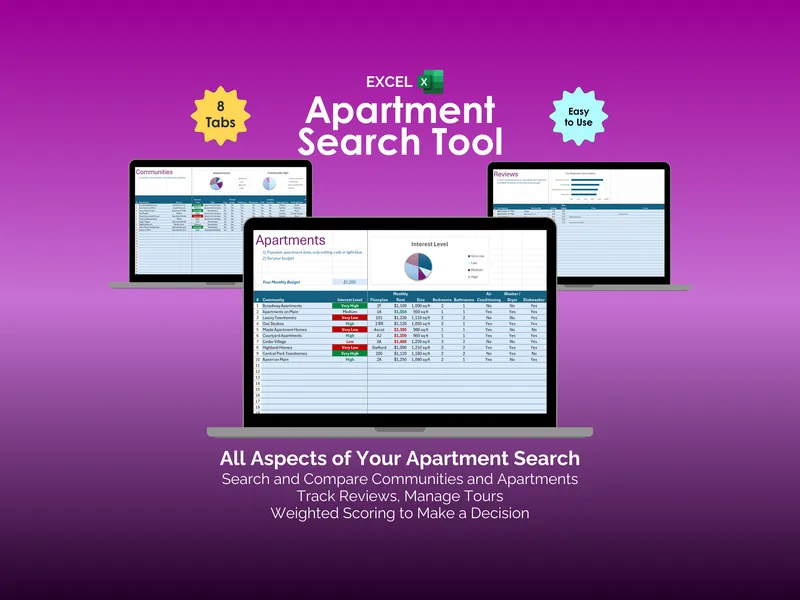
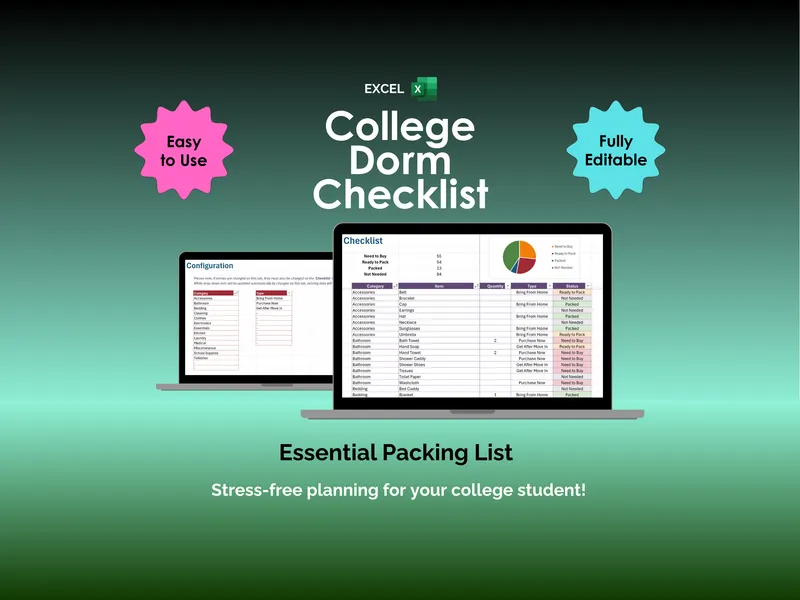
If you want to run this with your own figures rather than these, the Apartment Search Tool scores real listings on total monthly cost — rent plus utilities plus commute — instead of the headline rent number. On the dorm side, the College Dorm Checklist prices out what a residence hall actually requires you to buy.
Does Financial Aid Still Cover Off-Campus Housing?
Yes. Financial aid does not disappear when you move off campus — but it arrives on a different schedule than your rent is due, and that timing gap is what catches people out.
Federal rules require schools to build a housing and food allowance into every student’s cost of attendance. The Federal Student Aid Handbook’s cost of attendance chapter (opens in new tab) specifies that for “students living off campus (not in institutionally owned or operated housing),” schools must include “a standard allowance for rent or other housing costs,” plus a food allowance equivalent to three meals a day. Schools set those allowances from local market rates for modest shared housing — not from whatever you actually signed.
Three practical consequences:
- Your aid package will not shrink just because you left the dorm, though the allowance may be lower or higher than your real rent, since it is a standard figure rather than your lease.
- On campus, housing charges go straight onto your student account. Off campus, aid pays tuition first and the remainder is refunded to you — often a few weeks into the term, while rent was due on the first.
- Ask your financial aid office for the off-campus housing allowance figure before you sign. It is a published number, and it is the best evidence you will get of what your school considers a reasonable rent in that town.
Where the Real Dividing Line Is
Strip away the arguing and the decision comes down to four questions. Answer them honestly and the answer usually announces itself.
- Will you be in town this summer? If yes, a 12-month lease is a feature. If no, it is a $1,500 penalty.
- Can you find a share below your school’s per-month room rate? Divide your housing contract by nine to get the real monthly number to beat. It is easy to compare against the annual figure instead and get it wrong.
- Will you actually cook? Not “could you.” Will you, in November, during midterms, at 9 p.m.
- Can you float the deposit and first month before aid disburses? If that answer is no, the rest of the math does not matter this year.
Three or four yeses point off campus. Two or fewer point at the dorm. An even split means the decision is genuinely close — and when a decision is close, the deciding factor should be something other than whoever argued last.
The Verdict
Choose the dorm if any one of these applies:
- You are a first-year student, or your school requires on-campus housing.
- You are far from home, or your campus is not walkable without a car.
- You will not cook.
- You cannot comfortably cover a deposit and first month before your refund lands.
The premium you pay buys simplicity, and in first year simplicity is worth real money.
Choose the apartment if all of these apply:
- You can get a share meaningfully below your school’s per-month room rate.
- You will be in town over the summer.
- You cook.
- You have the upfront cash.
The savings are real, but they are earned through work the dorm was doing for you.
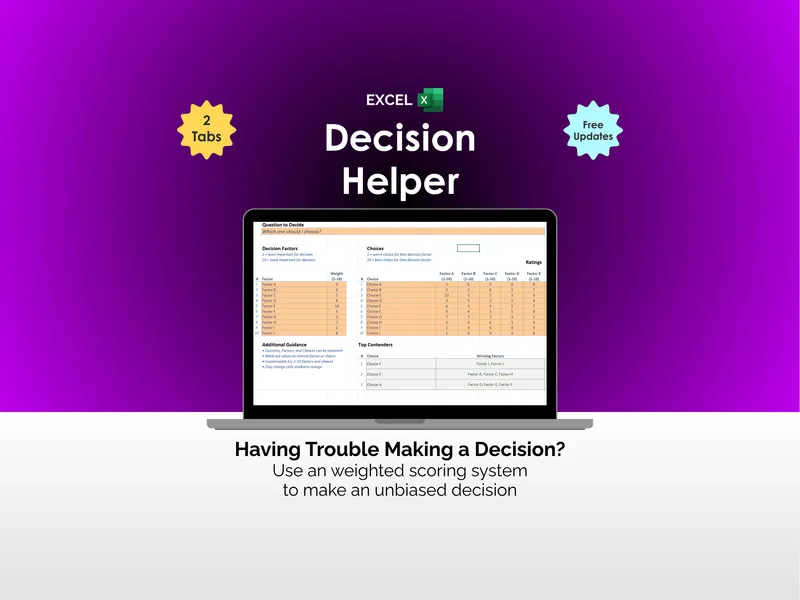
If it is genuinely close, score it rather than argue it. Write down the four or five factors that actually matter to you — total monthly cost, commute, summer coverage, roommate certainty, kitchen — weight them, and rate each option. The Decision Helper does this in a single tab: you set the criteria and the weights, it computes the score. The point is not that a spreadsheet is wiser than you are. It is that writing down what you care about before you tour a nice apartment is the only reliable defense against deciding based on how good the kitchen island looked.
And if you have already narrowed it to two specific units, we wrote a five-minute scorecard for how to choose between two apartments that takes it from here.
Before You Commit: A 10-Minute Check
Run this list before you accept a housing contract or sign a lease. Every item is something people discover afterward.
- Confirm whether your school requires on-campus housing for your year. This overrides everything else.
- Divide the housing contract by nine to get the true monthly rate you are comparing against.
- Get the meal plan tiers in writing — including whether the cheapest one is available to you, and whether unused dining dollars expire.
- Ask the financial aid office for the off-campus housing allowance for your school.
- Check the lease term and start date. A lease beginning August 1 when you move in August 20 is three weeks of rent for an empty apartment.
- Ask what utilities are not included and get a 12-month average from the landlord or the utility company, not a summer estimate.
- Check the sublet clause before you assume you can escape the summer months.
- Confirm whether the residence hall closes over winter break and where you would go if it does.
- Price the commute honestly — parking permit, gas, or a transit pass, times nine months. If the car itself is still an open question, run whether a freshman should take a car to campus first.
- Total the upfront cash: deposit, first month, application fees, and furniture. Compare it to what you will actually have in August.
Once you have decided, the buying decisions come next, and they are their own trap. We sorted what to buy for a dorm into buy-now, buy-there, and skip. For the off-campus version — where nothing is provided and everything is a separate purchase — the First Apartment Checklist covers it room by room.
The housing decision is one of the few college choices you get to remake every single year. Get it wrong and you will know by October — and you will make a much better call next spring, with a year of real numbers instead of five people’s opinions.