Your Dilemma
The current economic climate can feel like a rollercoaster of rising interest rates, inflation, and market volatility. New homeowners and first-time buyers especially know the jitters of balancing a mortgage payment with everyday expenses. You deserve a sense of control and stability, even when headlines keep reminding you how unpredictable things can be.
It might not sound possible to pay a little extra toward your mortgage when you’re living paycheck to paycheck. You’re juggling student loans, utility bills, groceries, and maybe even daycare costs—every dollar feels precious. But shifting your mindset from “I can’t” to “I’ve got this” is the first step toward financial freedom.
Every Little Bit Counts
Even a small extra mortgage payment each month can make a huge difference over the life of your loan. Adding just $50 or $100 to your principal can shave years off your mortgage term and save thousands in interest. Those extra payments accelerate your mortgage payoff, reduce your interest burden, and bring you closer to full homeownership sooner than you thought possible.
That sounds like a slogan until you run the arithmetic. So let’s run it.
Why Extra Payments Work So Hard
Here’s the mechanic that makes this worth doing, and it’s the part most people never get told.
Your regular monthly payment is split two ways. Part covers the interest owed on the balance this month; whatever’s left chips at the principal. Early in a 30-year loan, that split is lopsided — most of your payment is interest, because the balance it’s charged against is still enormous.
An extra payment is different: 100% of it goes to principal. It skips the interest side entirely. And because next month’s interest is calculated on the now-smaller balance, that one extra dollar keeps reducing interest every month for the remaining life of the loan. It compounds in your favor.
That’s why $100 doesn’t buy you $100 of progress. It buys you $100 of principal plus every future interest charge that principal would have generated.
A Worked Example: $300,000 at 6.5%
Let’s make it concrete. Take a $300,000 loan on a 30-year fixed at 6.5%. The standard monthly payment for principal and interest works out to $1,896. Pay exactly that for 360 months and you’ll hand the bank about $682,600 total — roughly $382,600 of it interest. You paid for the house, and then you paid for it again.
Now watch what a small monthly addition does to that:
| Extra per month | New payoff time | Time saved | Interest paid | Interest saved |
|---|---|---|---|---|
| $0 | 30 years | — | ~$382,600 | — |
| $50 | ~27 yr 9 mo | ~2 yr 3 mo | ~$349,000 | ~$33,600 |
| $100 | ~25 yr 11 mo | ~4 yr 1 mo | ~$321,600 | ~$61,000 |
| $200 | ~23 yr 0 mo | ~7 yr 0 mo | ~$279,200 | ~$103,500 |
| $300 | ~20 yr 9 mo | ~9 yr 3 mo | ~$247,500 | ~$135,100 |
Illustrative figures for a $300,000 30-year fixed loan at 6.5%, principal and interest only. Your loan’s numbers will differ — plug in your own.
Read the $100 row again. One hundred dollars a month — about $3.30 a day — returns roughly $61,000 and hands you back four years of your life. You contributed $100 × 311 months ≈ $31,100 in extra payments to save $61,000 in interest. The loan paid you back roughly two dollars for every one you put in.
Notice too that the returns aren’t linear. Going from $0 to $100 saves ~$61,000. Going from $200 to $300 only adds ~$31,700 more. The first dollars are the most powerful ones, which is genuinely good news if $50 is all you’ve got.
What About Biweekly Payments?
You’ve probably seen a lender offer a “biweekly plan.” Here’s what it actually is, minus the mystique.
Paying half your mortgage every two weeks means 26 half-payments a year — which equals 13 full monthly payments instead of 12. That’s the whole trick. There’s no special interest magic; you’re just making one extra payment a year, spread out.
On our $300,000 example, that extra payment is $1,896 a year, or about $158 a month. Result: payoff in roughly 24 years 2 months — about 5 years 10 months early.
Two cautions worth knowing before you sign up:
- Some servicers charge a setup or per-transaction fee for biweekly programs. You can replicate the exact same result for free by dividing your payment by 12 and adding that to your monthly check.
- Some servicers hold the half-payments and only apply them monthly anyway, which means you get the extra-payment benefit but none of the timing benefit.
How to Actually Make an Extra Payment Count
This is the step where good intentions leak away. Do these four things:
- Tell your servicer the money is for principal. This is the big one. Unpaid extra money often gets applied to next month’s payment by default — which just puts you ahead on the schedule, not ahead on the balance. Look for a “principal only” field, or call and set the standing instruction.
- Verify on the next statement. Check that your principal balance dropped by the extra amount. If it didn’t, it went somewhere else.
- Automate it. A transfer you have to remember is a transfer you’ll skip in December. Set it up once.
- Confirm there’s no prepayment penalty. Rare on modern conforming loans, but read your note before you commit.
When Extra Payments Are the Wrong Move
Honest advice includes the cases where this doesn’t win. Pay down the mortgage last if:
- You carry credit card debt. A card charging 22% costs you far more than a 6.5% mortgage saves you. Kill that first — it’s not close.
- You have no emergency fund. Money paid into a mortgage is extremely hard to get back out. A furnace failure with no cash reserve puts you right back on a credit card at 22%.
- You’re leaving employer 401(k) match on the table. An employer match is an immediate return on your contribution before the market does anything at all. Take it.
- You might move in a few years. The interest savings compound over decades. On a short horizon, there’s much less to capture.
Once those boxes are clear, extra principal becomes one of the most reliable, lowest-drama returns available to a household budget — because unlike the market, the savings are contractual.
5 Budget Hacks to Help
Finding that extra cash doesn’t require drastic lifestyle changes. Try these budget hacks:
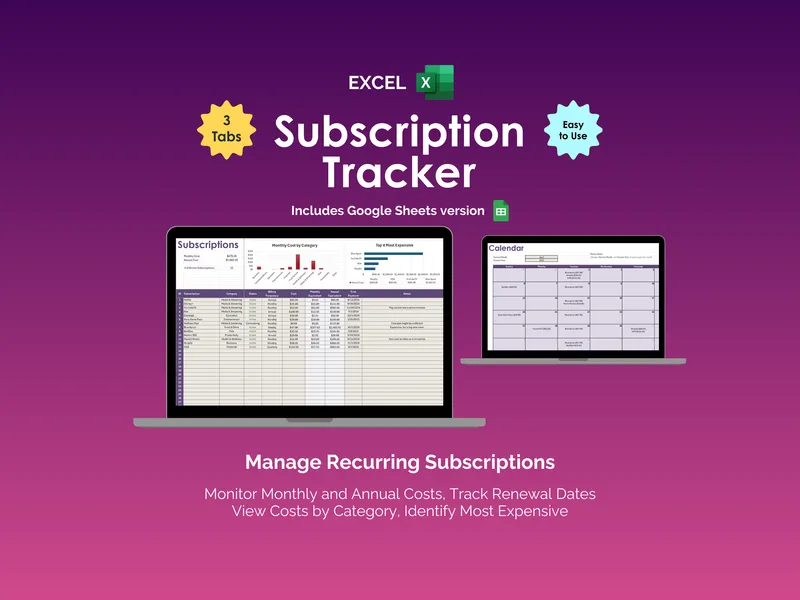
- Review and cancel unused subscriptions for streaming, apps, or gym memberships. The Subscription Tracker (Excel) — or its Sheets edition — surfaces every recurring charge in one place so the “forgotten $14.99” line items become obvious.
- Meal-plan once a week to cut food waste and lower grocery bills.
- Automate a small weekly transfer—say $10—to a “mortgage boost” savings jar.
- Sell gently used clothes or household items on resale apps.
- Take advantage of cashback and rewards programs on everyday purchases.
Stack the first and third alone and you’re most of the way to that $50 row in the table — which, on our example loan, is $33,600 and two years. Two forgotten subscriptions at $14.99 and a $10 weekly transfer is a rounding error in your month and a serious number over your loan.
Before you decide how much extra to throw at the mortgage, get an honest read on your fixed monthly costs with the Bill Tracker (Excel). Knowing your real baseline keeps you from overcommitting to extra principal payments and then scrambling when an annual bill lands.
How We Can Help
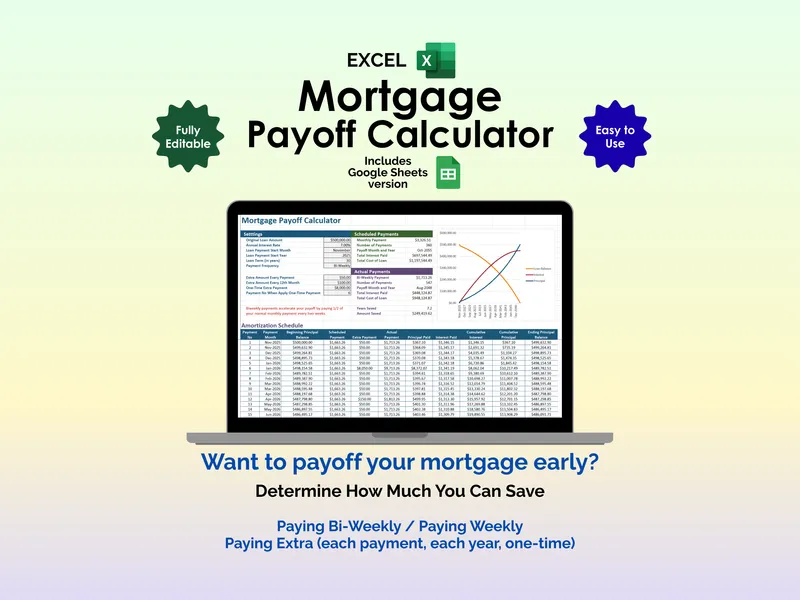
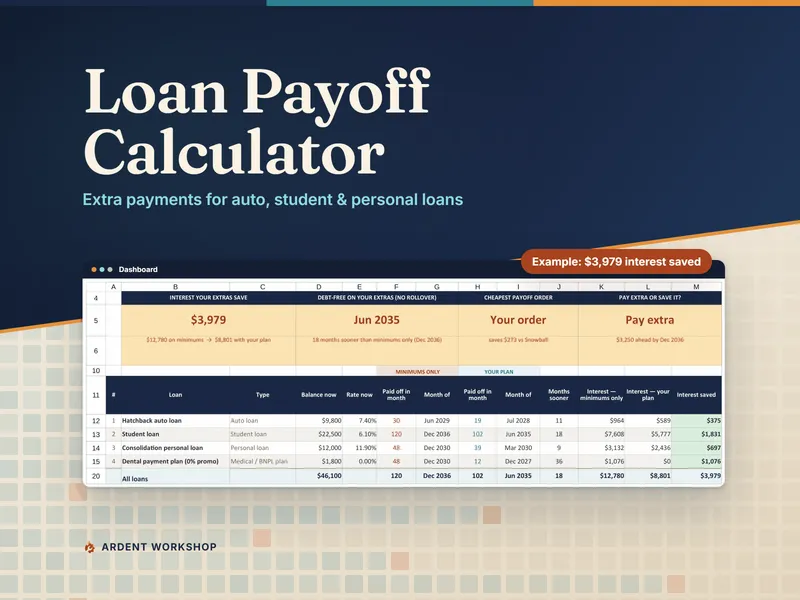
To take the guesswork out of extra mortgage payments, check out Ardent Workshop’s Mortgage Payoff Calculator. This Excel mortgage calculator lets you plug in your loan details and experiment with different extra payment amounts. You’ll see exactly how much interest you’ll save and how many months (or even years) you can cut off your mortgage. Empower yourself with real numbers, plan strategic extra payments, and watch your path to financial freedom become crystal clear. Carrying a car, student or personal loan too? The Loan Payoff Calculator runs the same math on up to eight of them, and shows which one to pay down first.
The table above is someone else’s loan. The version that changes your decision is the one with your balance, your rate, and your actual spare $50 in it.