Stop Donating to the IRS
If you have a Health Savings Account (HSA) or a Flexible Spending Account (FSA), you already know they’re powerful tools for saving money on eligible medical expenses. But every year, unused HSA and FSA funds quietly slip away because account holders miss key deadlines or don’t fully understand the rules. That’s money you’ve earned — and if you don’t claim it, you don’t keep it. The good news is that avoiding these traps is easier than you think, and the right tools can help you track every dollar with confidence.
First: HSA and FSA Are Not the Same Account
Most of the money that gets forfeited is forfeited by people who assumed their account worked like the other one. Get this table straight and four of the five traps below stop being possible.
| HSA (Health Savings Account) | FSA (Flexible Spending Account) | |
|---|---|---|
| Do funds expire? | No. Roll over indefinitely, year after year | Yes — generally forfeited at plan year end |
| Who owns it? | You | Your employer sponsors it |
| If you leave your job? | It goes with you | You generally lose the balance |
| Requires a specific health plan? | Yes — a qualifying high-deductible plan | No |
| When is the money available? | As you contribute it | Your full annual election on day one |
| Can you invest it? | Usually yes, once past a minimum | No |
Two lines there deserve a second look, because they cut in opposite directions.
An HSA has no expiration problem at all. If you have an HSA and you’ve been panic-buying sunscreen every December, you’ve been solving a problem you don’t have. HSA money is yours forever — it’s arguably the best long-term tax-advantaged account available, since qualifying contributions go in pre-tax, grow untaxed, and come out untaxed for qualified medical expenses.
An FSA gives you the whole year’s election on January 1. This surprises people. Elect an amount for the year and it’s available in full on day one, even though you’ve contributed one paycheck’s worth. If you leave your job mid-year having spent more than you contributed, your employer generally eats the difference. That’s the trade for the “use it or lose it” risk.
Trap 1: Missing Your Year-End Spending Deadline
Many FSA plans are “use it or lose it,” meaning any leftover funds vanish after the plan year ends. Some employers offer a short grace period or allow a small rollover, but that still leaves most of your unused balance at risk if you’re not paying attention.
Here’s the rule most people never get told: under IRS rules, an employer may offer either a grace period of up to 2½ extra months or a carryover of a limited amount into the next year — but not both. Many plans offer neither. Which one you have is a plan design decision your employer made, and it is not printed on your debit card.
There’s also a third date that gets confused with the first two:
- Grace period — extra spending time. New expenses incurred in that window can use last year’s money.
- Carryover — a limited amount of last year’s money survives into the new year for use anytime.
- Run-out period — extra filing time only. You can still submit claims, but the expense must have been incurred during the plan year. This is not extra shopping time, and mistaking it for one is a classic way to forfeit.
Find your three dates now, in writing, from your benefits portal. Not from a coworker.
Trap 2: Forgetting to Submit Receipts
Even if you’ve spent the money, failing to submit receipts on time can mean your expenses go unpaid. This is one of the easiest mistakes to avoid with a simple tracking system that alerts you when you’re missing documentation.
It gets worse than unpaid. FSA administrators can retroactively deny a debit card charge if you don’t substantiate it — and when they do, you’ll typically be asked to repay it or have it added to your taxable income. A swipe that goes through at the pharmacy is not the same as a claim that’s been approved.
Keep, at minimum: the date of service, the provider, the patient, a description of the service, and the amount you actually owed. A credit card statement line reading “CVS $47.12” is not substantiation — it doesn’t prove what you bought.
Trap 3: Not Knowing What Qualifies as an Eligible Expense
From copays to sunscreen, the list of eligible HSA and FSA expenses is longer than most people realize. Missing out on these purchases — especially toward year-end — means missing a chance to spend funds before they expire.
The list genuinely surprises people. Commonly eligible categories include:
- Over-the-counter medications and menstrual care products — without a prescription, following a change made by the CARES Act in 2020. If you last checked the rules before then, you’re working from an outdated list.
- Sunscreen (broad spectrum, SPF 15+), first aid supplies, thermometers
- Prescription eyeglasses, contacts and solution, reading glasses, eye exams, LASIK
- Dental work, orthodontia, and hearing aids
- Breast pumps and related supplies; fertility treatments
- Chiropractic care, acupuncture, and physical therapy
- Mileage driven to and from medical care
- Some items with a Letter of Medical Necessity from your doctor — this is the underused one
Things that are commonly assumed eligible but generally aren’t: cosmetic procedures, gym memberships and general fitness, most vitamins and supplements taken for general health, and toiletries. The dividing line the IRS draws is roughly treatment of a specific condition versus general wellbeing. Check the current list in IRS Publication 502 (opens in new tab) and your plan’s own documentation, since plans can be stricter than the IRS.
Trap 4: Leaving Reimbursable Expenses Unclaimed
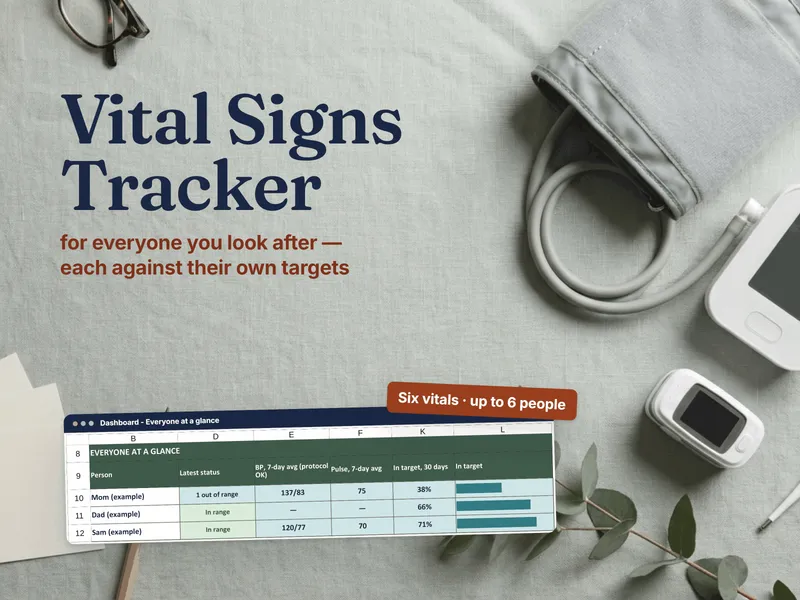
Sometimes receipts end up buried in drawers, email archives, or glove compartments. Months later, the reimbursement window has closed. A real-time medical expense tracker makes sure no eligible purchase slips through the cracks. If you also track the underlying health metrics those visits were for — blood pressure, weight, hydration — the Vital Signs Tracker (Excel) keeps the clinical record alongside the financial one.
HSA holders have an advantage here that’s worth knowing about, because almost nobody uses it: there is generally no deadline to reimburse yourself from an HSA. As long as the expense was incurred after your HSA was established and you never deducted it elsewhere, you can pay out of pocket today, let the HSA stay invested for years, and reimburse yourself later. That only works if you kept the receipt — which is the entire point. Your shoebox of receipts is, for an HSA holder, a stack of tax-free withdrawal permissions with no expiration date.
Trap 5: Ignoring Changes to Contribution and Spending Rules
Annual contribution limits, qualifying expense lists, and rollover policies can change. Staying up to date ensures you’re not accidentally forfeiting funds or missing ways to maximize your tax savings.
Contribution limits are indexed and are re-announced by the IRS each year, as are the numbers that define a qualifying high-deductible plan. Look them up fresh at open enrollment rather than reusing last year’s figure — IRS Publication 969 (opens in new tab) is the primary source for how these accounts work.
Whether you use your HSA for long-term savings or your FSA for annual spending, having clear visibility into your balance and deadlines could be the difference between keeping your hard-earned money or donating it to the IRS.
How Much Is This Actually Worth?
Let’s put numbers on it — using assumptions, not claims about you.
Say you elect $2,400 for the year, or $200 a month. FSA contributions come out before federal income tax and before FICA. If you’re in the 22% federal bracket, and FICA is 7.65%, your combined saving rate is about 29.65%:
$2,400 × 29.65% = ~$712 in tax you never paid.
Now suppose December arrives and you’ve only spent $1,900. You forfeit $500.
| Amount | |
|---|---|
| Elected | $2,400 |
| Tax saved (~29.65%) | +$712 |
| Forfeited unspent | −$500 |
| Net benefit | +$212 |
You still came out ahead — that’s why over-electing slightly isn’t a catastrophe. But look at what happened: you handed back 70% of your own tax break for want of a $500 pair of glasses you were going to buy anyway. Spend that $500 on something eligible and the net benefit goes from $212 to $712.
That’s the whole game. The tax break is generous enough to survive some sloppiness, and small enough that sloppiness eats most of it.
Your December Checklist
If the year is running out and you have an FSA balance, work this list in order:
- Look up your exact balance and your exact deadline — including whether you have a grace period, a carryover, or neither.
- File every claim you already incurred. Free money first, before you spend a dollar more.
- Book the care you’ve been postponing. Dental cleaning, eye exam, dermatologist, physical therapy. Care beats stuff.
- Refill prescriptions and replace glasses or contacts.
- Ask about a Letter of Medical Necessity if a doctor has recommended something borderline.
- Then, and only then, buy supplies — first aid, sunscreen, OTC medicine you’ll genuinely use.
- Set next year’s election using this year’s actual spend, not a guess. That’s the number that stops this from happening again.
Note the order. Booking a real appointment converts your dollars into healthcare. Panic-buying eligible items in the last week converts them into a cupboard of things you didn’t need — technically not forfeited, functionally not much better.
How We Can Help
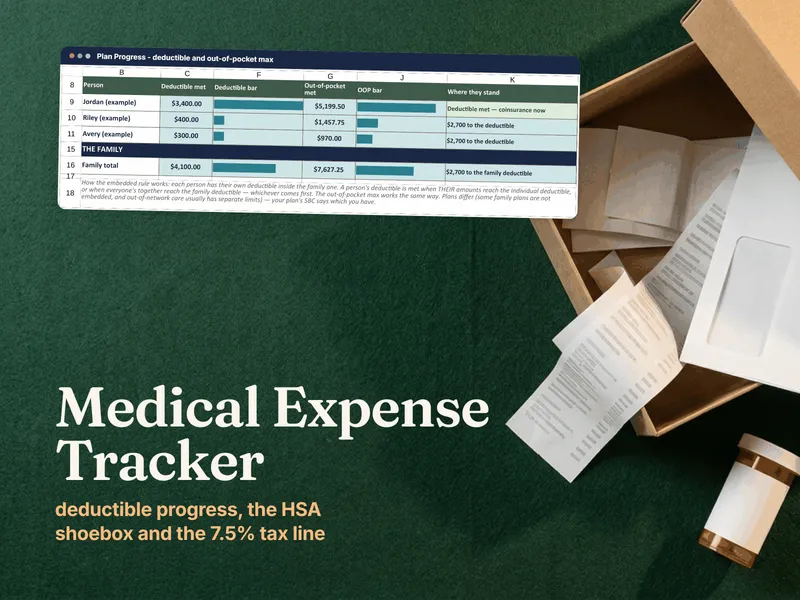
Don’t let your unused HSA or FSA funds slip away this year. Purchase the Ardent Workshop Medical Expense Tracker today and take control of your healthcare dollars. Start tracking now, save money, and keep every cent you’ve set aside for your health.
Track it as you go and step 7 writes itself — next year’s election stops being a guess and becomes a number you can point at.