A nanny share is an arrangement in which two families (occasionally three) employ one nanny together, who cares for both families’ children at the same time, usually in one family’s home. The families split the cost of one combined hourly rate. The nanny usually earns more per hour than a solo nanny would, and each family pays less than it would for a nanny of its own.
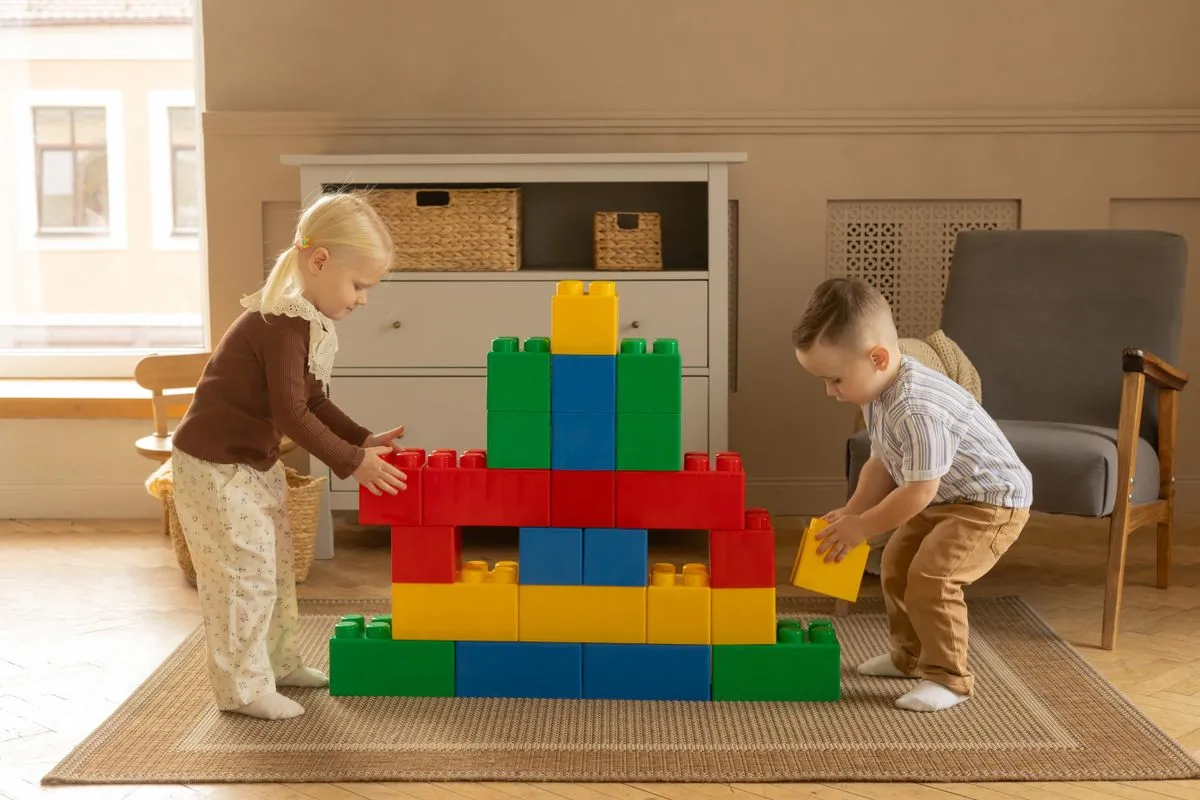
Picture it: two toddlers building one block wall on the same living-room rug at 7:45 on a Monday morning. One lives in this house; the other was dropped off ten minutes ago. The adult beside them is one nanny, paid by two families, with two separate jobs on paper. That last part is the one that is easiest to miss.
The savings are why people do it. The arithmetic is where shares break: two families, two payrolls, one shared week, and a running question of who owes what when one family’s toddler has a cold.
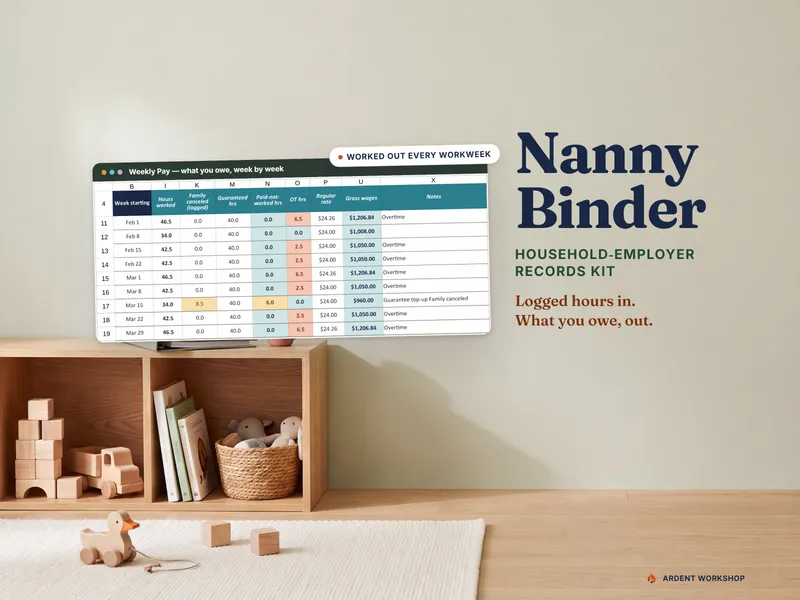
That arithmetic is the part a spreadsheet should do. The Nanny Binder & Household-Employer Records Kit works out a family’s week (guaranteed hours, a second rate for solo hours, overtime, paid time off) and keeps one household’s pay records for the year, so in a share each family keeps its own. The concept matters more than the tool, though, so here it is either way.
A nanny share is two employers, not half a nanny
The mental model that causes trouble is “we are splitting a nanny.” It sounds like splitting a restaurant bill: one cost, divided in two, done.
The model that works is two small employers who happen to share one employee and one schedule. Each family hires the nanny. Each family pays the nanny for its own part of the week. Each family has its own records, its own tax filings and its own obligations if something goes wrong. The two families then sign an agreement with each other, and with the nanny, about how those two jobs fit together.
Seen that way, most of the hard questions answer themselves:
- Who pays when one child is sick? Each family pays for its own job. Whether the sick child’s family still owes a full day is a term in the agreement, not a favor.
- Who files the taxes? Each family files for the wages it paid.
- What happens if one family leaves? One employer has ended a job. The other job continues, at a price that now has to change.
How do you split the cost of a nanny share?
You split a nanny share by agreeing a combined hourly rate for the shared hours, then dividing that rate between the families by a method everyone signs. The combined rate is usually higher than a solo rate because the nanny is caring for more children. Each family’s portion is lower than a solo rate because the cost is shared.
Here is how the math plays out with illustrative numbers. Say a solo nanny in your area earns $24 an hour and the two families agree a share rate of $30 an hour for 40 shared hours a week:
| Cost measure | Solo nanny | Nanny share, per family | Nanny share, nanny’s pay |
|---|---|---|---|
| Hourly rate | $24.00 | $15.00 | $30.00 |
| Weekly cost (40 hours) | $960 | $600 | $1,200 |
| Difference vs. solo | Baseline | $360 less per family | $240 more for the nanny |
In this example each family saves $360 a week and the nanny earns $240 a week more. That is the whole appeal of a share, and it only holds while both families stay in it.
The four common split methods
A straight 50/50 split is the simplest, but it is not the only one, and it is not always the fairest.
| Split method | How it works | Example at $30/hour | When it fits |
|---|---|---|---|
| Even split | Each family pays half | $15 / $15 | One child each, similar ages |
| Per child | Each family pays per child enrolled | $10 (1 child) / $20 (2 children) | One family brings more children |
| Host credit | The host family pays a little less for providing the space | $14 host / $16 guest | Care is always in one home |
| Rotating host | Even split, and the care location alternates by week or month | $15 / $15 | Both homes are suitable and close together |
The host credit exists because hosting costs something real: the heating, the snacks that go missing, the wear on the sofa, and the toys that are now everybody’s toys. Whether that is worth a dollar an hour or nothing at all is a negotiation, not a formula. Write it down either way.
Who is the employer in a nanny share?
In the usual setup, each family is its own household employer for the wages it pays. The IRS’s guide for families who hire help at home, IRS Publication 926 (opens in new tab), treats you as a household employer when you hire someone to work in your home and control not only what work is done but how it is done. In a share, both families control the work: they set the schedule, the routines and the house rules together.
Publication 926 does not have a section on nanny shares. GTM Payroll, a household payroll service, treats a share as two employers: its guide to nanny share taxes (opens in new tab) says both families are household employers even when the care happens in one family’s home. Each family gets its own employer identification number, pays its own part of the wages, and gives the nanny a W-2 at the end of the year. The nanny gets two paychecks and two W-2s.
Because each family is its own employer, the thresholds apply per family, and in a full-time share each family will usually cross them. Publication 926 says Social Security and Medicare taxes apply when you pay any one household employee $3,000 or more in cash wages in 2026, and federal unemployment tax (FUTA) applies when you pay $1,000 or more in cash wages in any calendar quarter. In the illustrative share above, each family pays $600 a week, so each one passes the annual threshold in its fifth week. If you want the detail on what those taxes are, the site’s page on what the nanny tax is covers them, and what makes someone a household employer covers the control test.
Why one family should not run payroll for both
The shortcut is tempting: one family pays the nanny the full $30 an hour and the other family pays that family back. It means one payroll instead of two.
The shortcut does not change who the employers are. Under Publication 926’s control test, the family paying its share back still controls the work, so it is still an employer, and the shortcut leaves it out of step with its own obligations. GTM’s guide warns that if only one family in a share is set up as an employer and the nanny later files for unemployment naming both families as employers, the family that was not contributing will be caught avoiding its tax responsibility and the nanny may not receive full benefits. The shortcut also muddies which family paid what for the year-end filings. Two employers is more paperwork, and it is the arrangement that matches reality.
The eight terms every nanny share agreement needs
A nanny share agreement is a written contract between both families and the nanny that sets the rate, the split, the schedule and what happens when any of it changes. These are the eight terms it should name. Most share disputes come back to one of them that nobody wrote down.
- The share rate and the split. The combined hourly rate, each family’s portion, and the split method behind it.
- The host home. Where care happens, whether it rotates, and any host credit.
- Guaranteed hours. The hours each family pays for every week whether or not its child attends. Without a guarantee, the nanny’s income drops every time one family takes a long weekend.
- Solo hours and the solo rate. What one family pays when only its children are in care, such as an extra hour at the end of the day, and who must agree before solo hours are added.
- Sick days, for children and for the nanny. Whether a family whose child is home sick still pays its share for that day (usually yes, under the guarantee), and how the nanny’s own sick days and paid time off are funded and covered.
- Holidays and vacations. Which days are paid holidays, how much notice a family gives before traveling, and whether a traveling family keeps paying.
- Payroll and records. That each family runs its own payroll, keeps its own pay records and gives its own W-2.
- Exit and notice. How many weeks’ notice a family gives before leaving, and what the remaining family’s options are.
A family using the records kit has somewhere to put terms 3 to 7. The Work Agreement tab holds the summary, the Weekly Pay tab applies the guarantee and the solo rate every week, and the PTO & Leave tab keeps the nanny’s balance. The kit tracks one household’s employees, so in a share each family keeps its own records for the wages it pays.
What happens to overtime when one family needs extra hours?
Under federal law, a nanny who does not live with the family they work for is generally owed one and a half times their regular rate for hours over 40 in a workweek. That comes from the Department of Labor’s Fact Sheet 79B on live-in domestic service workers (opens in new tab), which exempts live-in domestic workers employed by the household from overtime and says those who do not meet the live-in definition are owed it. If your share nanny does not live with either family, the live-in exemption does not apply.
In a share, overtime usually shows up through solo hours. Suppose the shared week is 40 hours and the second family adds five solo hours. The nanny has now worked 45 hours, and five of them are past 40.
Which family pays for those five hours, and at what rate, is a term to settle in the agreement and check with a professional. The usual starting point is that the family that asked for the extra hours pays for them. What federal law requires is less settled than that sounds. There is no federal rule written for nanny shares, and the Department of Labor removed its joint-employer regulation in a 2021 rescission of its joint employer rule (opens in new tab), so the question of how two households sharing one employee are treated is left to general case law and your state’s own wage rules. Some states also have their own overtime rules for domestic workers. Before the first solo hour, ask an employment attorney or your state labor department how your state handles it.
Whatever the answer, the records need to show it. Each family’s copy of the kit computes overtime on the hours that family logs, at a weighted regular rate when two rates apply in the same week.
How to keep a nanny share’s records straight
Each family keeps its own pay records for the wages it pays, and the two families compare their weekly hours. The comparison matters because the shared hours should match in both families’ records. If one family logs 38 shared hours and the other logs 40 for the same week, one of the two paychecks is wrong.
A simple rhythm that works:
- Daily: each family’s record shows the day as worked, a family cancellation, a nanny sick day or a holiday.
- Weekly: both families check that their shared hours match before payday, and each family pays its own share plus any solo hours.
- Quarterly: each family checks its own cash wages against the FUTA quarter threshold.
- Yearly: each family files its own Schedule H and gives the nanny its own W-2, which Publication 926 says is due to the employee by February 1, 2027 for 2026 wages.
The step-by-step version of the record-keeping, for any family that employs a nanny, is in the tutorial on how to organize your records when you employ a nanny. How long to hold on to them once the year is filed is covered in how long to keep documents. If you are weighing a payroll app against a spreadsheet for the job, there is a comparison of a spreadsheet and a nanny payroll app too.
Common Questions About Nanny Shares
Does each family in a nanny share pay taxes separately?
Yes, in the usual setup. Each family pays its own part of the wages, so each family checks its own payments against the household-employer thresholds, files its own Schedule H and gives the nanny its own W-2.
Who pays the nanny when one family goes on vacation?
Whoever the agreement says pays. A common arrangement is that the traveling family keeps paying its guaranteed share, because the nanny is still working for the other family and cannot replace half a paycheck for one week.
What happens if one family leaves the share?
The remaining family either finds a new partner family or takes the nanny on alone at the solo rate. The notice period in the agreement exists to give everyone time to do one of those two things.
Do I need a written nanny share agreement?
You need one in writing, signed by both families and the nanny. The disputes that come up in a share are usually about something nobody wrote down: who pays for a sick day, whose home hosts, what happens when one family moves.
Nanny share cost split, in short
A nanny share works when both families treat it as what it is: two employers, one employee, and one agreement holding the schedule together. Agree the rate and the split, write down the eight terms, run two payrolls, and compare your hours every week.
The Nanny Binder & Household-Employer Records Kit was built for the employer’s half of that. It keeps one household’s records: a family logs its own days and gets the week’s pay, the guarantee top-ups, overtime, the PTO balance and a year-end packet for its preparer. It is bought once, works in Excel and Google Sheets, and keeps the caregiver binder (routines, consents, pickups) in the same file. For what belongs in the caregiver binder itself, see what to put in a nanny binder.