What a roommate agreement is not
Start here, because it is the most common misunderstanding. A roommate agreement is not a lease, and it is not a substitute for one. Your lease governs the relationship between the tenants and the landlord — who may live there, what the rent is, what notice applies, how the deposit is handled — and it is set by that document and by the law where you live. Nothing housemates write between themselves overrides it.
Whether an agreement between roommates creates any obligation a court would recognize varies by jurisdiction and by what was actually agreed, and it is well outside what a template can tell you. That is not a reason to skip it. A roommate agreement earns its keep as a commitment device: it forces the conversation while it is cheap, and it gives the house a written answer to point at instead of four different memories. If real money or someone's housing is at stake, that is the point to talk to a lawyer, a tenants' rights service, or your local housing office.
What goes in a roommate agreement
A useful agreement covers the eight areas shared households reliably fall out over. In practice that is around twenty-six terms — an hour of conversation, once:
- Rent & bills — how rent splits (evenly, by room, or negotiated), how utilities split, whose name each account is in, the day the house settles up, and what happens when somebody is short.
- The deposit & the lease — who paid what into the deposit, how it comes back and how fast, and who covers damage that is not ordinary wear and tear.
- Quiet, space & shared things — quiet hours on weeknights and weekends, what stays in common areas, how the fridge works, and the thermostat range anyone can move within.
- Guests — overnight guests, the threshold at which a partner staying regularly becomes a conversation about contributing, and how much notice a party needs.
- Chores & supplies — how the rotation works, what "done" means for each job, dishes, and which supplies are a house expense rather than one person's standing tax.
- Pets, parking & storage — whether a new pet needs everyone's agreement, who covers its costs and damage, and who has which parking space and which shelf.
- Moving out — how much notice housemates give each other, who finds the replacement and who gets a say in them, and clearing balances before the last box goes out.
- When we disagree — a standing house meeting so nobody has to be the one who calls one, and an agreed next step when something does not resolve.
The term most houses skip, and shouldn't
"What happens if someone is short." Money gets tight for everyone eventually, and the difference between a house that survives it and one that quietly comes apart is whether there was already an answer. A term as simple as tell the house before the due day, agree a catch-up date, and write it down converts a crisis into a scheduling problem. Without it, the first time it happens it happens in silence, somebody covers a share without saying so, and resents it for a year.
Roommate agreement vs. lease vs. house rules
Three documents get confused with each other. A lease is between the tenants and the landlord and carries legal force. A roommate agreement is between the housemates and records what they have decided among themselves. House rules is the informal name for the same content when it lives on a fridge whiteboard instead of a dated page. The practical difference between the last two is not formality — it is whether anyone can point at it in November and say when it was agreed and by whom.
How to actually get one agreed
- Do it in the first week, or on the day someone new moves in. Every term is easy to discuss in the abstract and hard once it is about a specific person.
- Start from a draft, not a blank page. Reading a written term out loud and arguing with it for ninety seconds is far faster than inventing it from nothing — and it surfaces the disagreements you actually needed to find.
- Record who confirmed each term and the date. That is what makes it a record rather than a recollection.
- Print and sign it if it helps. Signing does not make it a contract; it does make it stick, because everyone has put a name to it.
- Revisit it at a standing house meeting and write anything you change back into the same page.
Not ready to write the whole thing? The free Roommate Bill-Split Calculator settles the money half — enter a month of shared costs and it tells you who pays whom.
Keep the money and the agreement in the same file
An agreement about how bills split is only as good as the arithmetic that follows it. Houses that write down "utilities split by rent share" and then do the splitting in a group chat end up back where they started. Keeping the terms and the ledger in one file the house owns — rather than in a bill-splitting app that needs everyone to hold an account — means the rule and the number that follows from it never drift apart. That comparison is laid out in spreadsheet vs. a bill-splitting app, and the practical method is in splitting rent and bills with roommates fairly.
Related terms and guides
A roommate agreement pairs naturally with a household operations manual (how the place actually runs — trash day, the shutoffs, whose name the electric is in) and with the tools for shared households. This is a record-organizing approach, not legal advice, and no substitute for a lawyer, a tenants' rights service, or your local housing office.
Templates that implement this
Write your house agreement
3 templates
Twenty-six house-agreement terms already drafted — plus a shared-expense ledger that works out who pays whom, and a chore rotation that fills itself in.
- $19.95 Spreadsheet

Roommate Agreement & Bill-Split Spreadsheet — Who Owes Whom, Chore Rotation & House Agreement (Excel + Google Sheets)
A roommate bill-split and house-agreement spreadsheet for Excel & Google Sheets — split any cost four ways and see exactly who pays whom.
Life AdminView details - $14.95 Mix
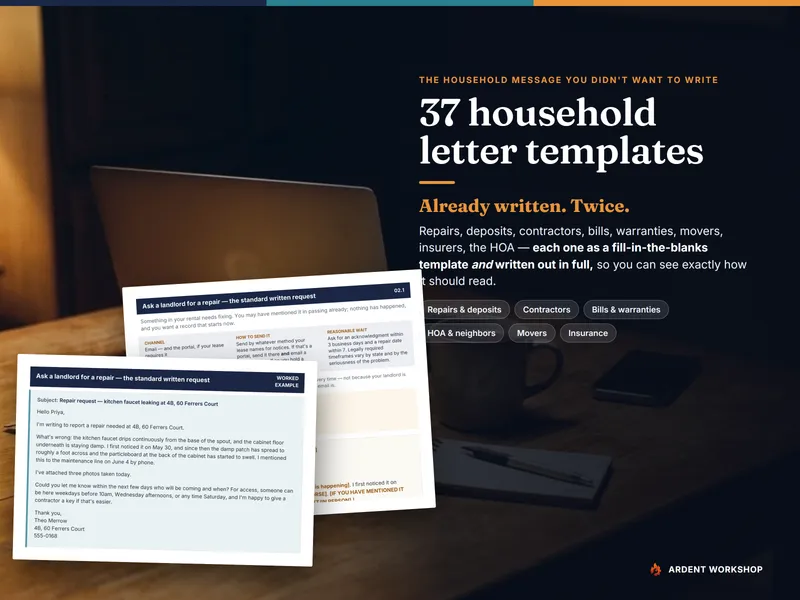
Home & Household Scripts & Letters Swipe Bank — 37 Household Letter Templates, Each Also Shown Written Out in Full: Repair Requests, Deposit Demands, Billing Disputes & HOA Letters
37 household letter and message templates, each shipped twice — as a fill-in-the-blanks version and written out in full. 74 written messages in all.
Life AdminView details - $24.95 Spreadsheet
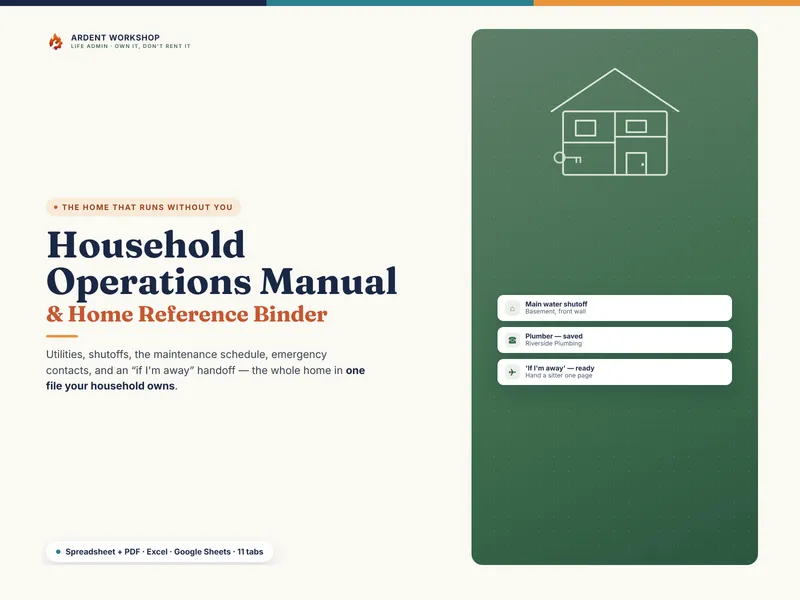
Household Operations Manual & Home Reference Binder — Utilities, Shutoffs, Maintenance, Emergency Contacts & House-Sitter Info (Excel + Google Sheets)
Run your whole home from one file — utilities, shutoffs, the maintenance schedule, emergency contacts, and an 'if I'm away' handoff, all in a file you own.
Life AdminView details