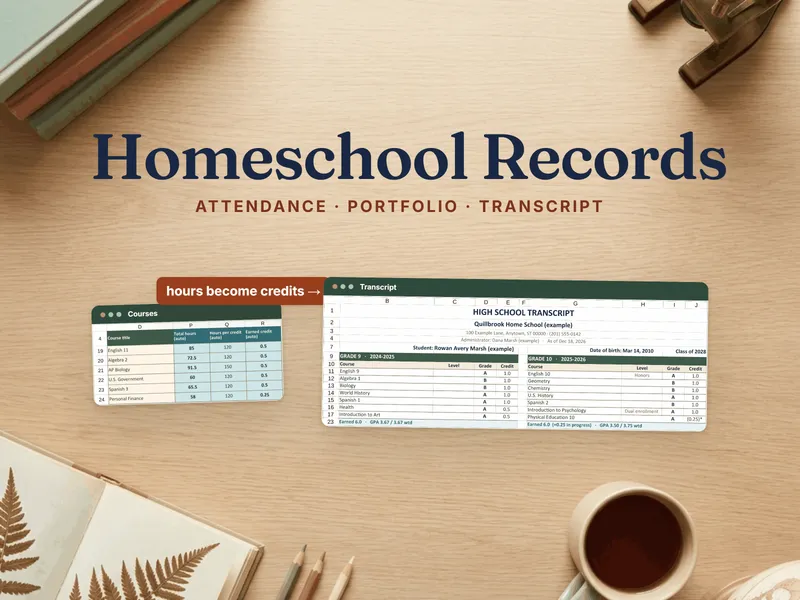
A homeschool transcript is the one-page record of everything a student completed in high school: every course by grade year, the credit each earned, the grade, and the GPA those add up to. Colleges, scholarship committees, employers and the military may all ask for it, and in a homeschool the parent is the one who writes it. To make one, you set a credit rule, turn logged hours into credits, name and grade each course, calculate GPA, lay it out by grade year, and sign it.
The page itself is not the hard part. The hard part is four years of logged hours that have to become credits, grades that have to become a GPA, and a total that has to add up when a stranger checks it. That is the part that is easy to end up rebuilding by hand every spring. The Homeschool Portfolio, Attendance & Transcript Records Binder does that arithmetic from the hours you already log, but the method matters more than the tool, so here is all of it, with a worked example you can copy.
What goes on a homeschool transcript
There is no single required layout. HSLDA, the homeschool legal association, notes that there is no standard transcript format that all high schools use nationwide (opens in new tab), but the information on them is broadly the same. A complete homeschool transcript carries:
- Student details: full legal name, date of birth, and (optionally) address.
- School details: the name of your homeschool, the parent administrator’s name, and contact details.
- Courses by grade year: every high school course, grouped under grade 9, 10, 11 and 12.
- Credits per course: usually 1.0 for a full-year course and 0.5 for a semester course.
- A grade per course: a letter grade, or a percentage with its letter.
- GPA: per year and cumulative, unweighted, plus weighted if you use it.
- The grading scale: what each letter means in percent and in grade points.
- The credit rule: how many hours make one credit in your homeschool.
- Totals: credits earned per year and in all.
- Graduation date once it is set, and the administrator’s signature and date.
The last three are the easiest to leave off, and they are the ones that make the rest believable. A reader who can see your credit rule and grading scale can check every line on the page.
How to make a homeschool transcript in seven steps
Making a homeschool transcript means turning the records you already keep into a finished page in seven steps, in this order. Credits and grades have to exist before a GPA can, so work through them in sequence.
1. Set one credit rule and write it down
Decide how many logged hours make one credit, as one figure for every course or one for each kind of course, and use that rule every year. The traditional benchmark is the Carnegie unit, which, per the Carnegie Foundation, typically represents 120 hours of study, with classes meeting four to five times a week for 40 to 60 minutes over a school year (opens in new tab). HSLDA’s guide to determining high school course credit (opens in new tab) suggests a higher bar for core and lab courses, at least 150 hours for a core course and at least 180 for a lab science, and 120 or more for an elective, the same as the Carnegie figure.
The number matters less than the consistency. If you use different figures for core courses, lab sciences and electives, set each one once. Whatever you choose, it goes on the transcript itself (“1 credit = 120 hours of logged work”), so a reader never has to guess.
2. Turn each course’s logged hours into credits
Divide each course’s total logged hours by your hours-per-credit rule, round down to the nearest half credit, and never award more credit than the course was planned for. A full-year course that logs 168 hours under a 120-hour rule earns 1.0 credit, not 1.4. Extra time made the course thorough, not bigger. A course that falls short is different: while it is still running, list it as in progress, with no credit or grade, until the hours are in. Only if a full-year course truly ends at, say, 115 hours does it round down to 0.5 credit.
If you assign credit by finishing a full-year textbook instead of counting hours, that works too. Just say so in the credit rule, and keep the completed work as evidence.
3. Name each course by its content
Title courses by what was studied, not by the textbook or curriculum brand. “Biology with Lab” tells an admissions reader what the student learned; a publisher’s product name tells them nothing. Use the names a school would use: English 10, Algebra I, US History, Spanish II.
4. Grade each completed course on a stated scale
Give every completed course a letter grade, and print the scale. The common 4-point scale is A = 4, B = 3, C = 2, D = 1, F = 0. Choose the percentage bands too (for example A = 90–100) and apply them the same way to every course. Only grade a course once its hours are in; a grade beside an unfinished course is the fastest way to make a reader distrust the whole page.
5. Calculate unweighted and, if you use it, weighted GPA
GPA is quality points divided by credits. Multiply each course’s grade points by its credits, add those up, and divide by the total credits. That is the unweighted GPA.
Weighted GPA adds a bonus to harder courses. HSLDA’s transcript tool (opens in new tab) is one example: it calculates Honors courses on a 4.5 scale and AP courses on a 5.0 scale, so an A is worth 4.5 in Honors and 5.0 in AP. One simple way to apply that, and the one the worked example below uses, is a flat bonus added to whatever grade an Honors or AP course earns: 0.5 for Honors and 1.0 for AP.
The same tool notes that dual-enrollment grades typically get no extra weight and leaves that call to the parent; whichever you choose, apply it the same way every year. Only weight a course that was genuinely harder than the standard version and is labeled that way on the transcript. Use the AP label only for College Board–approved courses. If you weight, print both numbers.
6. Lay it out by grade year on one page
Group courses under each grade year, with credits and grade beside every course. Give each year a credit total and a GPA, and put cumulative totals, the grading scale and the credit rule at the bottom. One page is the target: a transcript is a summary, and the evidence lives in your records behind it.
7. Sign, date and keep the records behind it
Sign and date the transcript as the school administrator. Add the graduation date once it is set. Then keep the hours log, work samples and reading lists that support every line, because a transcript is only as credible as the records you could produce if asked.
The worked example: a two-year homeschool transcript
Here is the method applied to an illustrative student’s grades 9 and 10. The student, courses and numbers are invented to show the arithmetic; the rule is 1 credit = 120 logged hours for every course, labs included, with half credits for semester-length work. Under HSLDA’s figures (150 hours for a core course, 180 for a lab science), English 9, World History, Spanish I and Biology with Lab would each earn only 0.5 credit, so pick your rule before the year starts and plan each course’s hours to meet it.
First, step 2: hours become credits.
| Course | Logged hours | Hours ÷ 120 | Credit awarded |
|---|---|---|---|
| English 9 | 140 | 1.17 | 1.0 |
| Algebra I | 150 | 1.25 | 1.0 |
| Biology with Lab | 168 | 1.40 | 1.0 |
| World History | 130 | 1.08 | 1.0 |
| Spanish I | 125 | 1.04 | 1.0 |
| Physical Education (semester) | 65 | 0.54 | 0.5 |
Grade 10 converts the same way, and every grade 10 course logged enough hours for its planned credit.
Then steps 4 to 6: grade, compute GPA and lay it out by year. The table below shows the course lines; on the finished page each year also carries its credit total and GPA (worked out underneath), with the grading scale, credit rule and signature at the bottom.
| Course | Year | Credit | Grade | Points |
|---|---|---|---|---|
| English 9 | 9 | 1.0 | A | 4.0 |
| Algebra I | 9 | 1.0 | B | 3.0 |
| Biology with Lab | 9 | 1.0 | A | 4.0 |
| World History | 9 | 1.0 | B | 3.0 |
| Spanish I | 9 | 1.0 | A | 4.0 |
| Physical Education (semester) | 9 | 0.5 | A | 4.0 |
| English 10 | 10 | 1.0 | A | 4.0 |
| Honors Geometry | 10 | 1.0 | B | 3.0 (3.5 weighted) |
| Chemistry with Lab | 10 | 1.0 | B | 3.0 |
| US History | 10 | 1.0 | A | 4.0 |
| Spanish II | 10 | 1.0 | B | 3.0 |
| Personal Finance | 10 | 0.5 | A | 4.0 |
The GPA arithmetic, so you can check every number:
- Grade 9: 5.5 credits. Quality points = 4 + 3 + 4 + 3 + 4 + (4 × 0.5) = 20. GPA = 20 ÷ 5.5 = 3.64.
- Grade 10: 5.5 credits. Unweighted points = 4 + 3 + 3 + 4 + 3 + (4 × 0.5) = 19, so GPA = 19 ÷ 5.5 = 3.45. Weighted, Geometry counts 3.5, so 19.5 ÷ 5.5 = 3.55.
- Cumulative: 11.0 credits. Unweighted 39 ÷ 11 = 3.55 (the same figure as grade 10’s weighted GPA, by coincidence). Weighted 39.5 ÷ 11 = 3.59.
Notice what the reader can verify from the page alone: the credit rule explains every credit, the scale explains every point, and every GPA is a division they can redo. That is what makes a parent-made transcript credible.
Course descriptions: the document colleges ask for next
A course description is a short page per course explaining what was taught, how it was graded and what materials were used. It sits behind the transcript, and some readers require it. HSLDA’s guide to writing high school course descriptions (opens in new tab) says rigorous and selective colleges, including the military academies, require descriptions of core courses, that students competing for academic scholarships need them, and that the NCAA requires them for athletic eligibility.
A useful description holds:
- the course title and credit, matching the transcript exactly;
- a short overview of goals, skills and major projects;
- how the grade was made up (for example tests 50%, labs 30%, written work 20%);
- the main materials, with title and author.
Write them as each course finishes, while you still remember what the course actually covered. Reconstructing four years of them in a senior-year autumn is the version of this job nobody enjoys.
Mistakes that make a homeschool transcript hard to trust
- No credit rule on the page. Credits with no stated basis read as invented, even when they are not.
- Credit over 1.0 for a full-year course. Extra hours do not make one course worth 1.4 credits.
- Weighting everything. If every course is Honors, none of them are. Weight only courses that were genuinely harder, and show unweighted GPA too.
- Textbook names as course titles. A reader needs the subject, not the publisher.
- Grades on unfinished courses. List in-progress courses as in progress, with no grade, until the hours are in.
- Totals that don’t add up. Recalculate every GPA from the table before you sign. A single arithmetic error invites the reader to doubt the rest.
Common questions about homeschool transcripts
Can a parent make a homeschool transcript?
Yes. In a homeschool, the parent is the school administrator, so the parent writes, signs and dates the transcript. What makes it credible is a clear credit rule, a stated grading scale and numbers that add up.
How many hours is one homeschool high school credit?
There is no single national number. The traditional benchmark is the Carnegie unit, about 120 hours of study for a full-year course. HSLDA suggests at least 150 hours for a core course, at least 180 for a lab science and 120 or more for an elective. Pick one rule, or one for each kind of course; use it every year, and print it on the transcript.
Should a homeschool transcript show weighted or unweighted GPA?
Show unweighted GPA always, and add weighted GPA only if some courses were genuinely harder than a standard course and are labeled Honors or AP. Print both if you weight, so a reader can compare like with like.
Do middle school courses go on a homeschool transcript?
Usually not. A high school transcript covers grades 9 to 12. The common exception is a high-school-level course taken early, such as Algebra I in grade 8, which can be listed for credit if it meets the same standard as a high school course.
Keep the records once, and the transcript writes itself
A homeschool transcript is the last step of a records system, not a separate project. If the hours log, the courses and the grades live in one place all along, the transcript is a summary you print, not a reconstruction you dread.
That is the whole design of the Homeschool Portfolio, Attendance & Transcript Records Binder: logged hours become credits under the rule you set once, only completed courses count toward credit and GPA, and the one-page transcript, with weighted and unweighted GPA, fills in for up to six learners. It is a workbook you own, with no subscription and no per-child fee.
For the day-to-day side, working out how many lessons a week finishes a homeschool curriculum keeps each course on pace, and if your state uses evaluations, what a homeschool portfolio review looks at covers the other record that matters. When the transcript is done and the acceptances arrive, how to choose a college picks up from there.