When the Holidays Sneak Up on You
One minute you’re sipping pumpkin spice lattes, and the next you’re knee-deep in wrapping paper, wondering if you already bought Aunt Linda that scarf… or if that was last year. Between school concerts, cookie swaps, and the annual “who’s hosting this time?” debate, keeping track of gifts can feel like juggling candy canes while riding a sleigh.
The Secret to Stress-Free Gift Giving
Thoughtful gift-giving doesn’t have to mean frantic last-minute shopping or awkward “oops, I forgot you” moments. The secret is simple—track everything. And no, that doesn’t mean scribbling on sticky notes that mysteriously vanish or keeping a mental list that evaporates the second you walk into a store. It means having a clear, organized system that works for you, your family, and your holiday style.
Why Tracking Matters More Than You Think
You’ve got gifts to send, gifts to receive, and a whole lot of people to keep happy. There’s the teacher who loves tea, the cousin who’s into retro board games, the neighbor who bakes you banana bread every December, and the kids’ friends who suddenly have very specific toy preferences. Without a plan, it’s easy to double-buy, forget someone, or lose track of what’s already wrapped and ready.
First, Count Your Actual List
Ask someone how many people they buy for and they’ll say “oh, ten or so.” Then they write it down.
Here’s what a fairly typical household list looks like once it’s on paper instead of in a head:
| Group | People | Per person | Total |
|---|---|---|---|
| Kids | 2 | $150 | $300 |
| Spouse | 1 | $150 | $150 |
| Parents & in-laws | 4 | $75 | $300 |
| Siblings | 3 | $50 | $150 |
| Nieces & nephews | 4 | $30 | $120 |
| Teachers | 3 | $20 | $60 |
| Neighbors & friends | 4 | $20 | $80 |
| Office Secret Santa | 1 | $25 | $25 |
| Gift subtotal | 22 | $1,185 | |
| Wrapping, bags, tape, ribbon | $45 | ||
| Cards & stamps | $40 | ||
| Shipping to out-of-town family | $60 | ||
| Total | $1,330 |
An illustrative list, not an average — build your own and the numbers will surprise you differently.
Twenty-two people. Not ten. That’s the first thing a written list does: it corrects the number you’ve been budgeting against.
The second thing it does is expose the last four rows. Wrapping paper, gift bags, tape, ribbon, cards, stamps, and shipping came to $145 here — more than the entire nieces-and-nephews category — and almost nobody budgets a dollar for them. They just show up as a series of $12 drugstore trips in December that never get counted as “gift spending.”
The third thing: it lets you notice, in October, that $1,330 is either fine or not fine. In December, that’s not a discovery. It’s a credit card statement.
The Fix Is a Status Field, Not a Shopping List
Here’s where most gift lists fail. They have two states: on the list, and crossed off. But “crossed off” is doing far too much work, because bought is not the same as done.
A gift has to travel through a pipeline:
Idea → Bought → Arrived → Wrapped → Shipped/Under the tree → Given
Every one of those transitions is a place things go wrong, and a list with a checkmark can’t tell you which one you’re stuck at:
- You bought it, but it’s still in a warehouse and the shipping estimate just slipped to December 26th.
- It arrived, but it’s in the trunk of the car under a blanket, unwrapped.
- It’s wrapped, but you never labeled it, and now there are four identical silver boxes.
- It’s beautifully wrapped and sitting in your closet, 900 miles from the person it’s for.
A checkmark says “handled.” A status field says “arrived, not wrapped” — which is the only version that tells you what to do on Saturday.
The Fields That Actually Earn Their Column
If you’re building or choosing a tracker, these are the ones that pay for themselves:
| Field | Why it matters |
|---|---|
| Recipient | The list you’re actually working |
| Budget | Set before you shop, so you’re comparing against something |
| Actual cost | The only way next year’s budget improves |
| Idea / notes | Captures the November thought you’ll lose by December |
| Status | Where it is in the pipeline above |
| Where it’s hidden | See below. This is the sleeper hit |
| Order / tracking number | For the inevitable “where is it” week |
| Ship-by date | Out-of-town gifts have a real deadline |
| Received from | Powers thank-you notes without detective work |
That “where it’s hidden” field looks like a joke until it isn’t. The single most reliable holiday failure isn’t forgetting a person — it’s hiding a gift so effectively in October that you find it the following March. You already hid it well. The tracker’s job is to be the one place where “top shelf, guest closet, behind the luggage” is written down.
And “received from” solves the January problem nobody plans for. Thank-you notes get written days later, from memory, by which point the wrapping paper is in the bin and nobody’s sure whether the sweater came from Aunt Linda or Aunt Carol. Logging gifts as they’re opened takes ninety seconds and saves a genuinely awkward conversation.
A Timeline That Beats Panic
The reason December feels like chaos is that everything competes for the same two weekends. Spread it out:
- October — build the list. Names, groups, budget per person. Total it. Adjust now, while adjusting is free and unemotional.
- October / November — capture ideas. Not purchases. Ideas. Every “oh, Dad would love that” goes in the tracker the moment it happens, because those thoughts do not survive until December.
- Black Friday through early December — buy. With a list of ideas already in hand, sales become useful instead of a hypnosis machine. This is the difference between shopping from a plan and shopping for one.
- Early December — ship the far-away gifts first. These have the hardest deadline and the least flexibility. Carrier cutoffs are published every year; look yours up and work backwards.
- Mid-December — wrap in one session. One evening, one movie, everything at once, labels on as you go. Wrapping piecemeal is how unlabeled boxes happen.
- Late December — log what you receive as it’s opened.
- Late December — record actual costs. Ten minutes now is next year’s honest budget.
Note what’s at step 2 and what isn’t. The ideas phase is the whole trick. Most December stress isn’t buying — it’s trying to invent twenty-two thoughtful ideas in one week under deadline. That’s why panic-bought gifts feel generic: they were generated by a stressed brain in a store, not by a year of noticing what people actually like.
Meet Your Holiday Sidekick: Ardent Workshop’s Gift Tracker
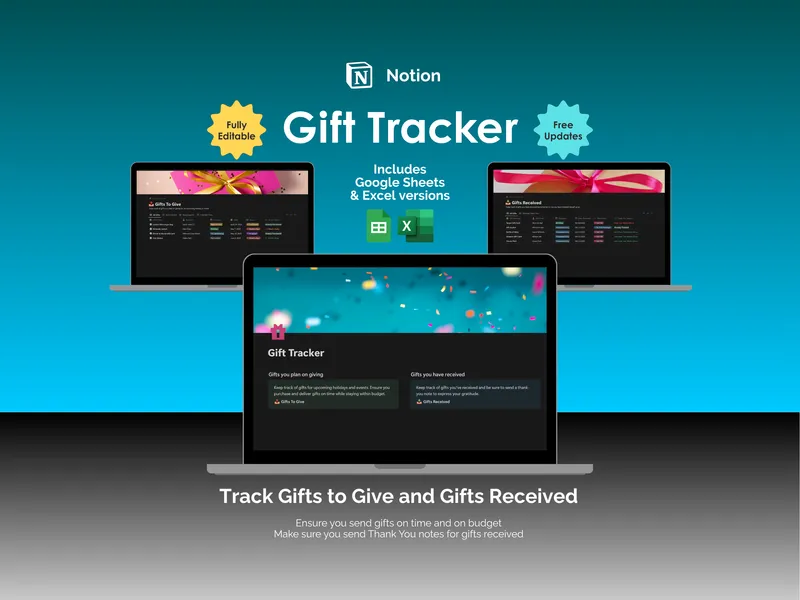
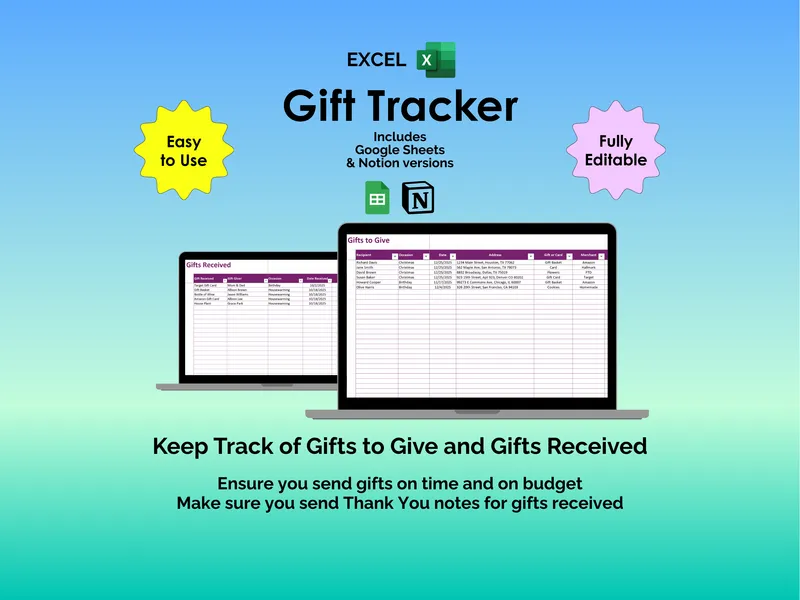
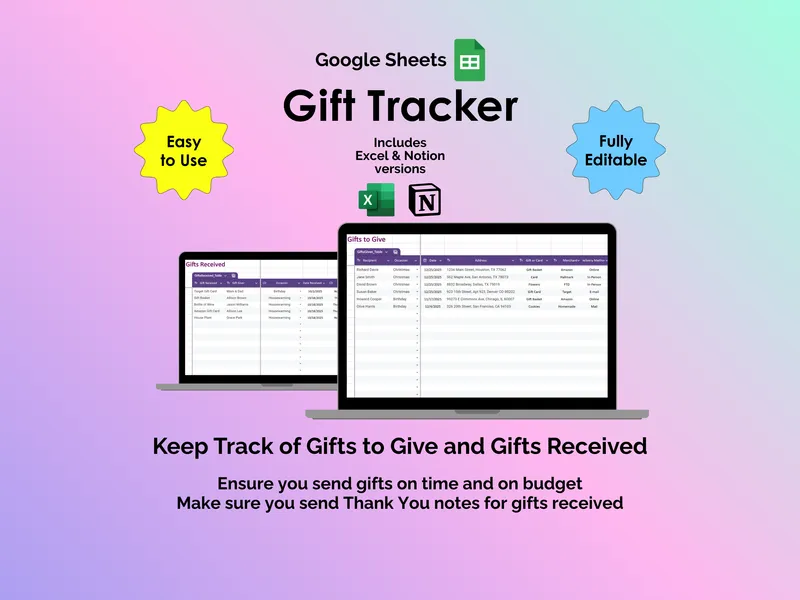
That’s where Ardent Workshop’s Notion Gift Tracker comes in. It’s a Notion template designed for real-life holiday chaos—er, cheer. You can log every gift idea, track purchases, set a budget, and even record what you’ve received so you can send thank-you notes without scrambling. It’s like having a personal holiday assistant who never forgets, never misplaces a list, and never eats the last cookie. We also have an Excel Gift Tracker available.
How a Digital Tracker Saves the Day
The beauty of using a digital tracker is that it works whether you’re a meticulous planner or a “buy it when inspiration strikes” kind of gifter. You can sort by recipient, budget, or status—so you’ll know exactly who’s done, who’s in progress, and who still needs a little holiday magic. Plus, with the Notion version, you can access it from your phone while you’re out shopping, which means no more standing in the aisle wondering if you already bought that LEGO set.
That aisle moment is worth dwelling on, because it’s the one that costs real money. Standing in a store unsure whether you already bought something has exactly two outcomes: you buy it again, or you don’t buy it and nobody does. One wastes $40; the other means a person opens nothing. A list you can check from your phone eliminates the entire category.
Why Families and Planners Love It
Families love it because it keeps everyone on the same page. No more duplicate gifts from different relatives or awkward “we thought you were getting that” moments. Planners love it because it’s neat, searchable, and endlessly customizable. And spontaneous shoppers? They love it because it catches all those “oh, that would be perfect for Dad” moments before they vanish into the December haze.
Shared visibility solves a specific, recurring family failure: three people independently buy the same popular toy for the same kid, or — worse — all three assume someone else handled Grandma. Coordination isn’t about control. It’s about the assumption gap.
Focus on the Fun, Not the Frenzy
The holidays are about connection, joy, and showing people you care—not about stressing over whether you’ve ticked every box. With a tool like Ardent Workshop’s Gift Tracker, you can focus on the fun parts: picking out gifts that make people light up, wrapping them in your signature style, and maybe even sneaking in a Hallmark movie or two.
Give Yourself the Gift of Sanity
This year, start tracking early, keep it all in one place, and let your holiday season be about the moments, not the mayhem. Your future self—probably sipping cocoa by the tree—will thank you.
And your future-future self, opening next October’s list to find last year’s real numbers and a note that Aunt Linda already has the scarf, will thank you even more.