
The schedule that ran your shop all summer has about three weeks left to live.
You built it back in June, when your part-timers could open on a Tuesday, close on a Thursday, and pick up a Saturday without blinking. It worked. It has been working for two months. And then the first week of school arrives, and the person who has been opening for you every Tuesday can no longer be in your shop before 3:30 p.m. — and neither can two of the others.
Sound familiar? Here’s the part that stings: if fall is your busy season, that collapse lands right as orders start climbing.
The short version: your summer schedule was never a schedule. It was a snapshot of summer availability. To schedule staff around school hours you rebuild it from scratch — and that is the same five-step job every year:
- Re-collect availability in writing
- Rebuild around the fixed blocks first
- Measure the gap in hours, not in people
- Close the gap in the cheapest order
- Price the gap before you fill it
Do it before the first day of school and it takes an afternoon. Do it after and you are covering shifts yourself.
Why Your Staff Schedule Breaks the Week School Starts
This is structural, not personal. Your staffing peaked at the same moment youth employment nationally did.
July is when youth employment hits its summertime peak: 53.1 percent of 16- to 24-year-olds were employed that month in 2025, and a quarter of those working (5.4 million people) were in leisure and hospitality, the single largest share of young workers (BLS, Employment and Unemployment Among Youth — Summer 2025 (PDF) (opens in new tab)). If your shop sells food, drinks, or handmade goods at a counter, you were hiring out of the same pool as everyone else, at its deepest point of the year.
So the schedule you are running right now was built against the most generous availability your team will have all year. It was never going to survive September. And nobody quit. The roster looks identical — only the hours moved.
Here’s what that looks like for one person, using an illustrative part-timer:
| Shift block | Summer schedule | School-year reality |
|---|---|---|
| Weekday mornings | Available | Gone — in class |
| Weekday afternoons | Available | After 3:30 p.m. only |
| Weekday evenings | Until close | Homework, practice, curfew |
| Saturdays | Available | Usually still available |
| Usable hours/week | ~24 | ~10 |
Multiply that illustrative case by three student employees and you have not lost a person — you have lost roughly 40 hours a week, most of them in your weekday daytime, which is where a small shop’s production happens.
What the Law Lets Your Student Staff Actually Work
Before you rebuild anything, know the ceiling. Federal child labor rules under the Fair Labor Standards Act cap what your youngest workers can do once school is in session, and the caps tighten the moment the school year starts.
For 14- and 15-year-olds, the Department of Labor’s child labor provisions for nonagricultural jobs (opens in new tab) (accessed August 2026) set these limits:
| Restriction | Federal rule |
|---|---|
| When they may work at all | Outside school hours only |
| Hours on a school day | 3 |
| Hours on a nonschool day | 8 |
| Hours in a week when school is in session | 18 |
| Hours in a week when school is not in session | 40 |
(The outside-school-hours rule has narrow exceptions: students enrolled in a work-experience or work-study program the school runs with federal Wage and Hour Division approval, and children working in a business wholly owned by their parent — which is still off-limits for manufacturing, mining, or any hazardous occupation.)
Watch the two axes, because mixing them up is the classic scheduling error. The daily caps turn on whether that particular day is a school day — so a Saturday in October is a nonschool day and the 8-hour cap applies, even though the school year is underway. The weekly caps turn on the week: that same Saturday sits inside a school week, so the 18-hour weekly total still binds.
The time-of-day limit works differently again. It is not keyed to the school calendar at all — it runs on the ordinary calendar. A 14- or 15-year-old may only work between 7:00 a.m. and 7:00 p.m., extended to 9:00 p.m. from June 1 through Labor Day. The later finish applies on every day inside that window and on no day outside it, so a teacher in-service day in October is still a 7:00 p.m. night.
Two more things that are easy to miss here:
- Three hours on a school day is a hard cap, not a guideline. A 14- or 15-year-old cannot close for you on a Wednesday. If your close takes four hours, they are the wrong person for that shift, full stop. And a Friday your school is in session is still a school day, whatever it feels like.
- The 9:00 p.m. extension expires on Labor Day, not on the first day of school. In 2026 Labor Day falls on Monday, September 7. If your district starts before then — check your own calendar — you get a few weeks where school has started but evenings are still legal until 9:00 p.m., inside the 3-hour school-day cap. Then, overnight on September 8, you lose two hours off the end of every evening shift. Build your fall schedule in late August and you are building it on a rule that is about to change.
For 16- and 17-year-olds, the FLSA sets no limit on daily or weekly hours — but the hazardous occupation orders still apply until they turn 18, and many states impose their own school-week caps that federal law does not. New York, for instance, caps 16- and 17-year-olds at 28 hours per week while school is in session (opens in new tab). Where both a federal and a state rule apply, the stricter one wins. Check your state’s rules before you promise anyone a shift.
Step 1: Re-collect Availability in Writing
Ask every person the same four questions, in writing, and ask before the first day of school rather than after:
- What are your exact school hours, including any zero-period or early release day?
- What recurring commitments do you have — practice, rehearsal, a lab, a second job — and on which days?
- What is the latest you can work on a school night?
- Which days are you fully free?
Written answers matter for a boring reason: verbal availability drifts. A text thread you can scroll back to in October settles the “I thought I told you” conversation before it starts.
Step 2: Rebuild Around the Fixed Blocks First
Put the immovable things on the grid before you put people on it. School hours are the most immovable thing on your schedule — more immovable than your own opening time.
Block out the school day, then block out the shifts that genuinely cannot move: your bake window, your pickup hours, your market day. What is left is the negotiable space, and it is smaller than you think. Fill that space with the people who are actually free in it, starting with whoever has the least flexibility, because those people have exactly one slot and everyone else has several.
Step 3: Measure the Gap in Hours, Not in People
This is the easiest place to go wrong, and it is expensive. The instinct after losing three students’ weekday availability is “I need to hire someone.” Often you don’t. The gap is the number of hours you need covered minus the number of hours your team can actually give you — and it is frequently not a whole person’s worth.
Work it out concretely. With illustrative numbers: say you need 62 hours of coverage a week, your two adult staff can give you 34 hours of availability, and your three students can now give you 10 each, or 30. That is 64 available against 62 needed — you are technically fine on volume and completely broken on shape. All 30 student hours land after 3:30 p.m., your adults’ 34 all sit in evenings and weekends, and 20 of the hours you need are weekday mornings.
Which means everything outside weekday mornings — afternoons, evenings, weekends — is now 22 hours over-covered while the mornings sit empty. That is the whole problem in one sentence: you do not have a volume problem, you have a shape problem, and shape problems do not get solved by hiring. Whether any of that surplus can actually move depends on who is genuinely free before noon, which is rung 1 of the next step.
Write down the gap as a shape: “20 hours, weekday 8 a.m. to noon.” That sentence is what you go solve. “I need to hire someone” is not.
Step 4: Close the Gap in the Cheapest Order
Once you know the shape of the gap, close it by working down this ladder of four rungs, stopping as soon as the hours are covered.
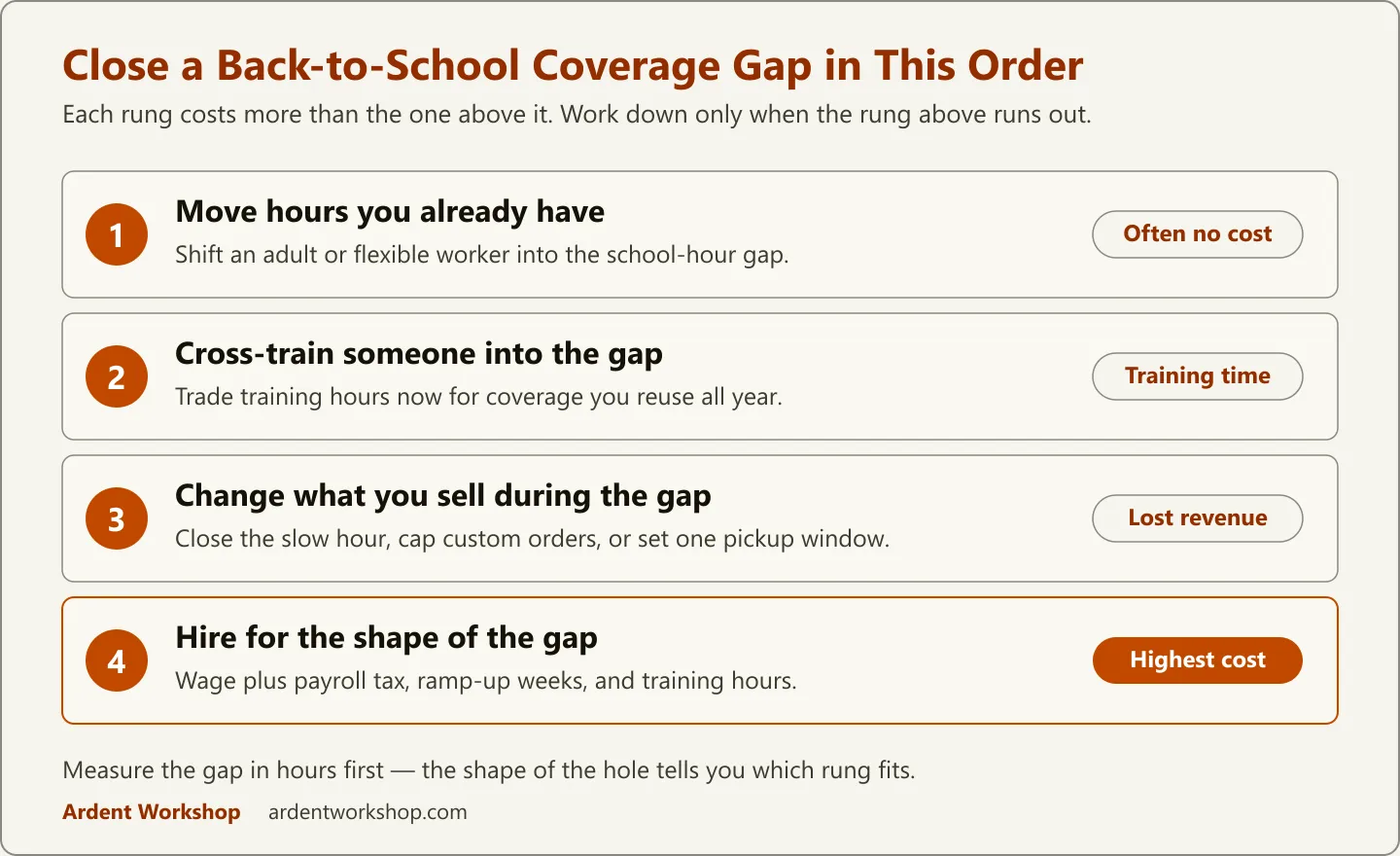
- Move hours you already have. Shift an adult or flexible worker into the school-hour gap and give their evening hours to the students who can only work evenings. It usually costs nothing, and it is the first thing to try because that availability already sits on your roster — you are rearranging it, not buying more of it.
- Cross-train someone into the gap. If the morning hole exists because only one person can run the mixer, that is a training problem wearing a scheduling costume. Trade a few training hours now for coverage you can reuse every time someone is sick, on vacation, or graduating. If the choice between broadening your existing team and bringing in a specialist is the real question, we work it through in cross-train or hire a specialist; a cross-training coverage planner makes the single-point-of-failure obvious before it costs you a morning.
- Change what you sell during the gap. Close the slow hour, cap custom orders for six weeks, or move pickup to one set window instead of all day. This costs revenue rather than payroll — sometimes that is the better trade, and it is always worth pricing before you drop to the last rung.
- Hire for the shape of the gap. Last resort, and when you get here, hire against the shape you wrote down in Step 3 — “weekday mornings,” not “part-time help.” If this is where you land, our guide on how to hire seasonal staff before the fall rush covers the ramp-up math.
Step 5: Price the Gap Before You Fill It
An hour of coverage costs more than the wage. Payroll taxes, any benefits, and the training hours before a new person is at full speed all sit on top of it — and the ramp is longer than you would budget for.
So make the comparison visible, the same way you made the gap visible in Step 3:
20 hours × hourly rate + payroll taxes + benefits + ramp-up hours, versus what a weekday 8 a.m. to noon block earns you.
If the second number is smaller, you have your answer, and it is not “hire someone.” Sometimes it goes the other way and a Tuesday morning is worth covering at almost any price. Sometimes the honest answer is that you should not be open Tuesday morning in October. If the gap does turn into a real offer, how much to pay your first employee walks through the same loaded-cost layers in more detail.
The 30-Minute Version
If you only have one sitting before school starts, work straight down this list:
- Check your state’s school-week hour caps for anyone under 18
- Diary the Labor Day change — September 8, 2026 — if you employ 14- or 15-year-olds
- Text all staff the four availability questions and set a reply deadline
- Mark every school-hour block, and your immovable production blocks, as unavailable on next month’s grid
- Write your gap as a shape — hours plus days plus time of day
- Work down the cost ladder and stop at the first rung that covers the hours
- Price the gap before you commit — loaded cost of those hours against what the hours earn
Own the Schedule Instead of Rebuilding It Every Year
Here is the useful part: this is the same problem as summer vacation, the same problem as flu season, and the same problem as your best person taking two weeks in December. The trigger changes; the method does not. Once you have written your coverage needs down as hours-by-shape and know who can be cross-trained into what, you are running a system rather than reacting to a calendar — the same system behind a vacation coverage plan for a small team.
That is worth owning outright rather than renting. A file you keep, with your roster, your availability, and your loaded cost in it, is still there next August — and next August, this whole exercise is an hour instead of a crisis. That file is the shift schedule and labor cost workbook: your roster, everyone’s availability, and what each shift actually costs you, on one page. (If what you are facing is a genuine seasonal ramp rather than a reshuffle, the seasonal and peak-season hiring workbook works the forecast backward into how many people to bring on and when.)
The schedule itself stays in your file. When the production behind those shifts — inventory, batches, and sales — outgrows a spreadsheet, Ardent Seller (opens in new tab) picks that side up.