The two questions succession planning answers
Underneath the formality, succession planning answers two plain questions — and keeping them apart is what makes it useful:
- Which roles are critical? Not the most senior roles — the ones whose sudden loss would actually hurt. A role is critical when it controls something essential: the money, the core product, a make-or-break client, a key system, or knowledge that lives in one person's head. A junior-looking seat can be critical, and a senior one may be well covered.
- Who could step in, and how ready are they? For each critical role, who is the candidate successor — and are they ready now, ready in a year with development, or not a successor yet? A critical role with nobody named is the gap to close first.
Succession planning vs. replacement planning
The two get confused. Replacement planning is reactive — a name in a box marked “if this person leaves, call this person.” Succession planning is developmental: it actively grows candidates toward readiness over time, so the backup is real before you need it, not a name you'd scramble to make work. Replacement planning asks “who would we call?”; succession planning asks “who are we getting ready, and what would it take?”
Readiness — now, in a year, or not yet
The heart of a succession plan is a readiness timeline for each successor. A common, plain scale runs:
- Ready now — could step up today; the main risk is losing them first.
- Ready within a year — close, with a specific development plan and a date.
- Ready in one to two years — a real bench candidate who needs broader exposure.
- Longer-term — promising but a way off.
- Not yet a successor — no ready internal candidate, which is exactly the gap a plan exists to surface.
A whole register with no “ready now” names anywhere is a succession gap across the business — worth naming long before a key person leaves.
Key-person risk and the bus factor
Succession planning is the answer to key-person risk — the exposure a business carries when one person is the only one who can do something essential. The measure of that exposure is the bus factor: how many people would have to be lost before the work stops. A bus factor of one is a single point of failure, and the most dangerous kind sits on a business-critical seat. A good succession plan makes those single points of failure visible, role by role, so you can raise the bus factor before it bites.
How to build a succession plan
- List the critical roles. Don't list everyone — list the seats whose loss would genuinely hurt, and score how critical each is.
- Score the coverage of each. Be honest about the bus factor: only count a real, named, at-least-partly-trained backup as cover. “Someone could probably figure it out” is not cover.
- Name successors and their readiness. For each critical role, who could step in, how ready are they, and what's the development action that would close the gap?
- Capture the knowledge. Some of the most dangerous single points of failure are about knowledge in one head, not a title. A backup isn't real until that knowledge is written down and shared.
- Re-run it on a cycle. Coverage changes as people are cross-trained, promoted, or leave. A seat sliding toward single-point cover is an early warning worth catching.
Common mistakes
- Confusing important with irreplaceable. The most senior role can be well covered; a junior one can be a critical single point of failure. Score criticality and coverage separately.
- Wishful coverage. Marking a seat “covered” on the strength of someone who could maybe step in, rather than a trained, named backup.
- Forgetting to retain the bench. A ready successor at high flight risk is the person to keep this quarter — and promoting your best successor often empties their seat one level down.
- Treating it as done. A succession plan written once and filed is a fire drill nobody runs. The value is in keeping it current and acting on the gaps.
Related templates and concepts
Succession planning pairs naturally with a 9-box grid (which scores how people perform and where they could grow, so you can see who's ready to step up) and a skills matrix (which maps what your team can actually do). To map your single points of failure for free, the key-person risk checklist is an ungated taste; the full Succession-Planning & Key-Person-Risk Workbook scores every critical role and tracks successor readiness. Weighing build-versus-buy? See succession planning template vs talent management software, and the templates for HR & team leads hub for the rest of the toolset.
Templates that implement this
Templates that build a succession plan
2 templates
Score each critical role's criticality and coverage, see your single points of failure on one grid, and track who's ready to step into each seat — in a workbook you own.
- $29.95 Spreadsheet
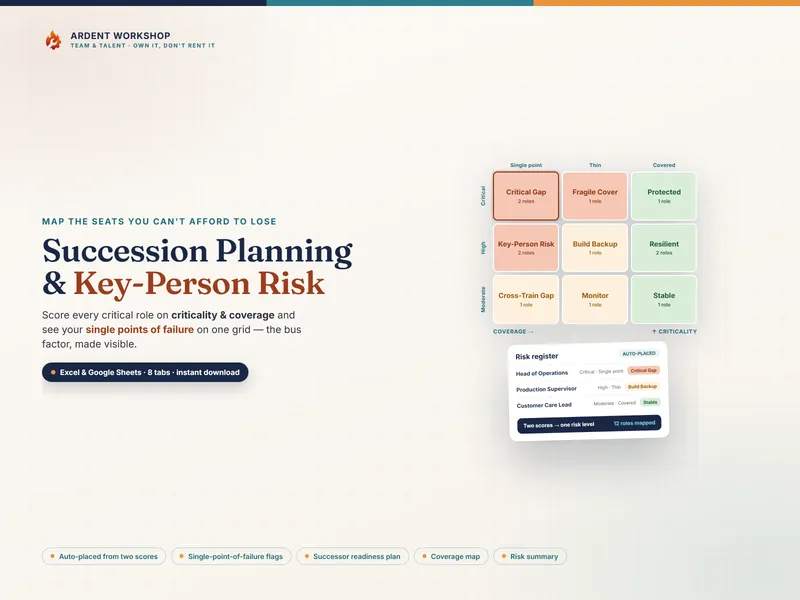
Succession-Planning & Key-Person-Risk Workbook for Excel & Google Sheets
A succession-planning & key-person-risk workbook for Excel & Google Sheets — score criticality and coverage to map your single points of failure.
Team & TalentView details - $24.95 Spreadsheet
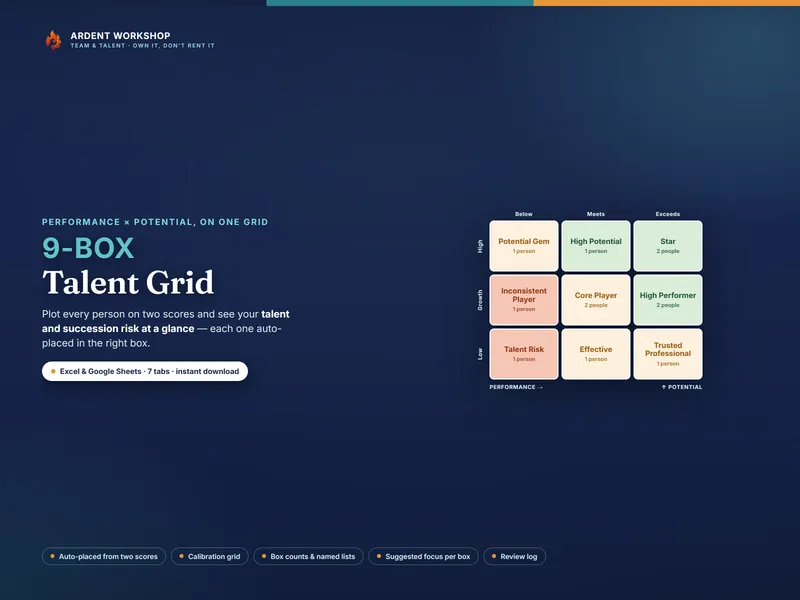
9-Box Talent Grid — Performance & Potential Matrix for Excel & Google Sheets
A 9-box talent grid for Excel & Google Sheets — score performance and potential, auto-place each person, and see succession risk on one grid.
Team & TalentView details