
Interstate moves only — this is not a local-move rule
Everything on this page comes from FMCSA rules for interstate household-goods moves — a shipment crossing a state line — as set out in the agency's Protect Your Move guidance and its booklet Your Rights and Responsibilities When You Move. If your move stays inside one state, these federal rules do not apply; local and in-state moves are governed by your state's own moving regulations instead, and those vary from state to state (some states use their own estimate types). Check which kind of move you are booking before you assume any of this applies.
Binding vs. non-binding vs. not-to-exceed
Movers offer estimates in a few different shapes, and the difference is entirely about what happens if the actual job costs more than expected (FMCSA's own summary is on its binding-estimate page). The Moving Planner & Moving Checklist Workbook tracks your quotes by exactly these three types, so the risk each one carries sits next to its price:
- Binding estimate — a guaranteed price for exactly the services it lists. You pay that amount at delivery. It only rises if you add services, or if impracticable-operations charges apply.
- Non-binding estimate — the mover's approximation, not a guarantee. The final bill is based on the shipment's actual weight and the services actually performed. At delivery, the mover can require you to pay up to 110% of the estimate; anything above that 110% must be deferred and billed later, at least 30 days after delivery.
- Not-to-exceed (sometimes called "binding not-to-exceed") — an option some movers offer, usually described as a cap on the price. This is not a separate federal category the way the first two are — what it guarantees is whatever the mover puts in writing, so get its exact terms in writing before you rely on it.
None of this is about which is "cheaper" — it is about who is holding the risk if the job runs bigger than the estimate. A binding price protects you from that risk; a non-binding price shifts it back onto you — the 110% limit caps only what is due at delivery, and anything above it is still billed later.
The exception inside a binding estimate: impracticable operations
A binding estimate is not truly unconditional. If conditions stop the normal truck from reaching your door — a shuttle to a smaller truck is the usual example — the mover can add impracticable-operations charges. Those are collectible at delivery only up to 15% of everything else due at delivery; any amount beyond that 15% is due within 30 days of you receiving the freight bill, not on the spot (per FMCSA's Protect Your Move guidance). Stairs, elevators, and long carries are usually separate, listed add-on services rather than impracticable-operations charges — ask your mover to itemize which is which before moving day.
Book only a registered interstate mover
A company running interstate household-goods moves must be registered with the FMCSA and carry a USDOT number. You can look that number up before you book — do it before you sign anything, not after a deposit has changed hands.
If something goes wrong: damage claims
You have up to nine months from the delivery date to file a damage claim in writing on an interstate move (see FMCSA's Protect Your Move). The habit that protects that claim starts at delivery: note any visible damage on the delivery receipt before you sign it, so the record of the damage starts the moment your things arrive.
What this looks like in the workbook
The workbook's Quotes tab is built around exactly this distinction: log up to eight mover quotes, mark each one Binding, Non-binding, or Not-to-exceed, and flag whether access risk applies — that is, whether the truck may not reach your door, which exposes you to impracticable-operations charges. For each quote it computes the worst case due at delivery, a risk-adjusted total that adds what a non-binding estimate could be billed later if it runs over, and ranks the quotes within each way of moving (rental truck, container, or full-service movers) by lowest risk-adjusted total — so a binding quote and a non-binding quote are never compared as if they carried the same risk.
The same workbook also runs the countdown of moving tasks against your move date, compares truck-rental, container, and full-service costs side by side, turns a numbered box inventory into printable labels, and tracks the utility stop/start gap at both addresses. If you only need the week-of checklist and box labels, the free Moving Week Countdown checklist covers that part, pre-filled with a worked example, no signup.
Own it, don't rent it
A free, partner-funded moving app has to be paid for somehow, so read its privacy policy for what it shares about your move before you sign up. A workbook you keep has no such trade built in — it is a file you own, and it computes the estimate risk, the cost comparison, and the utility gaps for you.
Related concepts
Once the truck is unloaded, the questions shift from what you owe the mover to what you need to know about the house itself — see what a household operations manual is for keeping that information in one place, and what a utility shutoff is for the systems worth locating in your first week. Still deciding how to move at all? The moving container vs. truck rental cost comparison lays out what each mode makes you pay for beyond the quote. For the rest of the tasks a move creates, the 8-week moving checklist puts them on a schedule — including mail forwarding, the IRS change-of-address form, and your new state's license deadlines — and how to label moving boxes covers the packing end; the guide to managing a parent's downsizing move covers the version with a second household involved.
Templates that implement this
Tools for the move itself, and for settling into the house after it
3 templates
A workbook that tracks your quotes by estimate type, and the binders for what comes after the truck leaves.
- $6.95 Spreadsheet
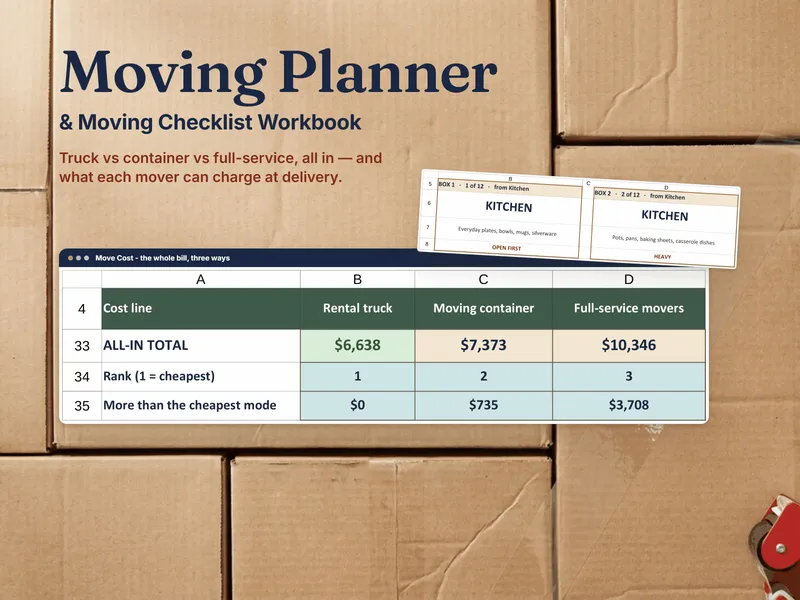
Moving Planner & Moving Checklist Workbook — Mover Quote Worst Case, All-In Move Cost, Utility Gaps & Box Labels (Excel + Google Sheets)
Moving planner for Excel & Google Sheets: what each mover can charge at delivery, truck vs container vs movers all in, utility gaps, and box labels.
Life AdminView details - $24.95 Spreadsheet
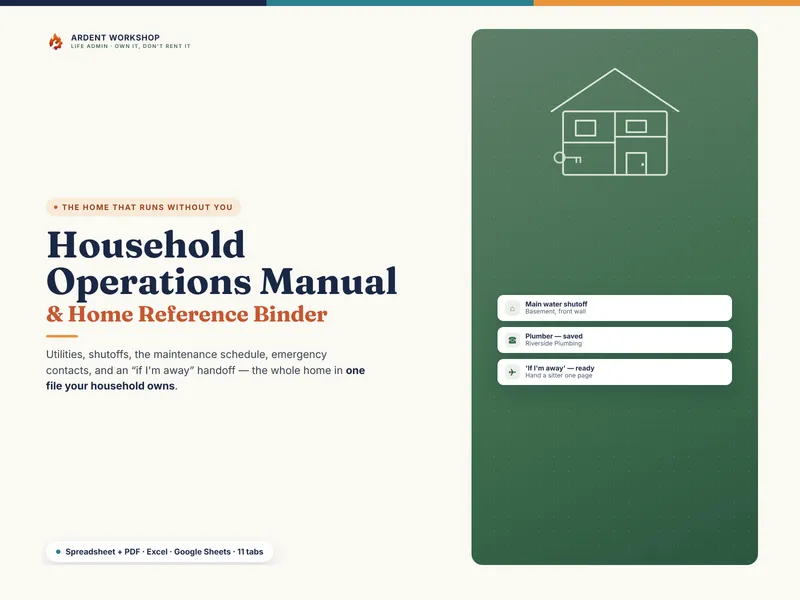
Household Operations Manual & Home Reference Binder — Utilities, Shutoffs, Maintenance, Emergency Contacts & House-Sitter Info (Excel + Google Sheets)
Run your whole home from one file — utilities, shutoffs, the maintenance schedule, emergency contacts, and an 'if I'm away' handoff, all in a file you own.
Life AdminView details - $24.95 Spreadsheet
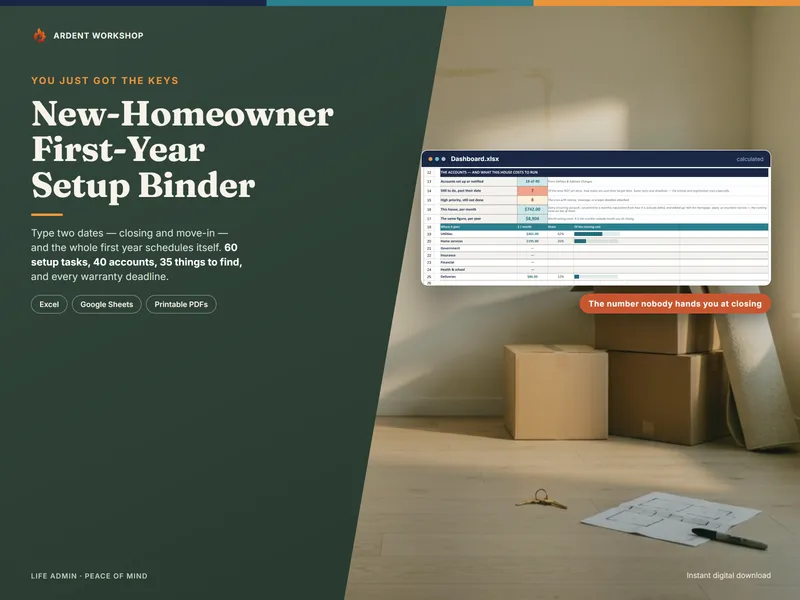
New-Homeowner Move-In & First-Year Setup Binder — 60 Setup Tasks, 40 Account Transfers, Warranty Registration Deadlines, and What the House Costs to Run (Excel + Google Sheets)
Type two dates and the first year in a new house schedules itself: 60 setup tasks, 40 account transfers, warranty deadlines, and the monthly running cost.
Life AdminView details
Frequently asked questions
- Is a binding estimate always the cheaper option?
- Not necessarily. A binding estimate may be quoted higher up front than a non-binding one for the same job. A non-binding estimate can start lower and still end up costing more once the actual weight and services are billed — which is exactly why comparing quotes only by their headline number misses the real cost.
- Can a mover charge more than a binding estimate?
- Only if you add services that were not in the original estimate, or if impracticable-operations charges apply — conditions like a driveway the truck cannot reach, where a shuttle to a smaller truck is the usual example. Those extra charges are collectible at delivery only up to 15% of everything else due; any amount beyond that is due within 30 days of receiving the freight bill.
- What is a not-to-exceed moving estimate?
- It is an option some movers offer, usually described as a price cap on the job. It is not a separate federal category the way binding and non-binding estimates are — what it actually guarantees is whatever the mover writes into your paperwork, so get its exact terms in writing before you rely on it.
- How long do I have to file a damage claim after an interstate move?
- Up to nine months from the delivery date, in writing. Note any visible damage on the delivery receipt before you sign it, so the record of that damage starts at delivery.
- Does a binding estimate apply to a local, in-state move?
- Not under the federal rules. The FMCSA rules on binding and non-binding estimates govern interstate household-goods moves — shipments crossing a state line. A local or in-state move follows your state's own moving regulations instead; some states define their own estimate types, so check your state's rules and get the mover's terms in writing.