Most moving checklists are just long lists — pack the kitchen, forward the mail, change your license — with no way to tell what’s actually due this week. Give every task a lead time instead, and the list turns into a schedule: due date = move day minus that task’s lead time. That’s the whole method behind the Moving Planner & Moving Checklist Workbook, which runs it across 70 curated tasks and flags each one OVERDUE, DUE THIS WEEK, or UPCOMING as your move date approaches. Below is the same backward-planning method, worked by hand from 8 weeks out through the week after you unpack.
Step 1 — Work backward from move day, not forward from today
Pick your move date first — everything else is measured against it. A task like “get mover quotes” means little on its own, but “get mover quotes, due 8 weeks before move day” tells you, this week, whether you’re on schedule or behind. The illustrative list below shows the idea; a real move has more tasks than this, and which ones apply depends on your situation — renting or buying, driving yourself or hiring movers, kids in school, pets, an interstate move or a local one.
| Task | Lead time | Due by |
|---|---|---|
| Get 3+ mover quotes | 56 days | 8 weeks out |
| Book movers or reserve truck/container | 42 days | 6 weeks out |
| Start the numbered box inventory | 28 days | 4 weeks out |
| Set utility stop/start dates | 28 days | 4 weeks out |
| Schedule USPS mail forwarding | 14 days | 2 weeks out |
| Print labels & moving-day run sheet | 14 days | 2 weeks out |
| File IRS Form 8822 (change of address) | 5 days after | after move |
| Update driver's license & registration | varies by state | after move |
Step 2 — 8 weeks out: get mover quotes, and know what you’re comparing
Get at least three quotes, and before you compare their totals, find out which of three types each one is — because the type, not just the number, decides what you actually pay. (For the full rules, see what a binding moving estimate is.)
- Binding estimate — a guaranteed price for exactly the services listed. You pay that amount at delivery, and it rises only if you add services or an impracticable-operations charge applies (see below).
- Non-binding estimate — the mover’s approximation. The final bill is based on actual weight and services, and at delivery the mover can require up to 110% of the estimate; anything above that must be deferred and billed later, at least 30 days after delivery (FMCSA’s binding-estimate page (opens in new tab)).
- Not-to-exceed (sometimes “binding not-to-exceed”) — offered by some movers, but it is not a separate federal category. Get its exact terms in writing before you rely on it.
If your move crosses state lines, the mover has to be registered with the Federal Motor Carrier Safety Administration and carry a USDOT number you can look up before you book; FMCSA’s Protect Your Move (opens in new tab) also has the full “Your Rights and Responsibilities When You Move” booklet.
Put those terms into the comparison before you look at the totals: a lower non-binding quote can end up costing more than a higher binding one once its possible overrun is priced in. The binding-estimate explainer walks through a worked example, plus the impracticable-operations charge (a shuttle when the truck can’t reach your door) that can add to either kind.
Step 3 — 6 weeks out: book, and compare the full cost of each option
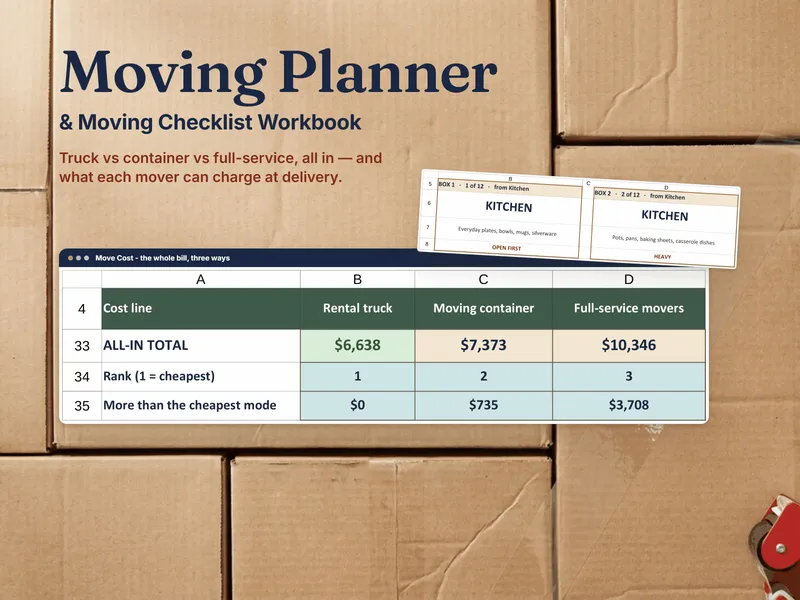
Book while the date you want is still open. Before you commit, put a rental truck, a moving container, and full-service movers side by side on the same cost lines: the quote itself, packing supplies, fuel, tolls, lodging, meals, time off work, storage, and any helpers you’d hire either way. A truck’s fuel line is one-way miles divided by your vehicle’s mpg, times the fuel price; lodging is your driving days minus one night; time off work is the days you’ll be unavailable times your daily take-home pay. The mode that looks cheapest from the headline quote is not always the cheapest once every line is counted — the moving container vs. truck rental cost comparison goes line by line through what each mode leaves you to pay, with a worked example.
Step 4 — 4 weeks out: start the utilities and address schedule, and begin boxing
List every utility and service — power, water, internet, streaming, insurance — with a stop date at the old address and a start date at the new one. Compare the two dates and you get one of: gap at the old home, gap at the new home, gap at both ends, an overlap (with day counts either way), or simply OK. Catching a gap now, while there’s still time to move a date, is the entire point of doing this four weeks out rather than the week of.
At the same time, start a numbered box inventory — one line per box, with the room, a note of what’s in it, its destination room in the new place, and whether it’s fragile or needs to be open first. Everything else follows from this list: printable labels, an “n of N” count per room so you know when a room’s boxes are all accounted for, and the loading order for move day.
Step 5 — 2 weeks out: mail forwarding and the plan
USPS mail forwarding can be scheduled in advance — about two weeks ahead of your move is a sensible target, so it’s active by the time you’re actually gone.
Confirm your movers or truck reservation, finish the box inventory, and print the labels and a moving-day run sheet — the order to load, which boxes are open-first (load them last so they come off first), and who’s doing what.
Step 6 — Move week: load, unload, and don’t sign before you’ve looked
Load the open-first boxes last. On delivery day, work from the run sheet, and before you sign anything, look at your things — note any damage directly on the delivery receipt, and photograph it. Then unpack the open-first boxes — bedding, toiletries, basic tools, chargers — before you touch anything else.
Step 7 — The week after: close out the paperwork
The move itself is done, but the checklist isn’t. Work down a change-of-address list — IRS Form 8822 (the IRS’s own change-of-address form), banks, subscriptions, insurance, voter registration, doctors — and handle your new driver’s license and vehicle registration; check your new state’s DMV for its own deadline, since this varies by state and there’s no single number to give you here. And if anything showed up damaged, don’t let it slide: on an interstate move you generally have up to 9 months from delivery to file a written damage claim (FMCSA Protect Your Move (opens in new tab)), which is exactly why noting the damage on the delivery receipt in Step 6 matters — it’s the record the claim rests on.
Keep it in one file, not a rented app
You can run all of this on paper, and for one move that’s plenty. If you’d rather start from a schedule that’s already built — 70 built-in tasks, each with its own lead time, the mover-quote comparison, the truck-vs-container-vs-movers cost model, box labels, and the utility and address schedule, all in one file — the Moving Planner & Moving Checklist Workbook is built exactly that way, and it hides the tasks that don’t apply to your move once you flag whether you’re renting or buying, driving yourself or hiring movers, moving interstate, or bringing kids or pets along. It’s a file you own and keep — not a free, partner-funded moving app, where it’s worth reading the privacy policy for what your new address is shared with.
Want the free version first? The Moving Week Countdown checklist and box-label sheet covers the final week, pre-filled with a worked example.
For the harder version of this move — sorting a lifetime of belongings, not just boxing a household — see managing a parent’s downsizing move. And once the boxes are actually being packed, how to label moving boxes covers the labeling system this checklist assumes.