You turned down an order last month. Not because you were fully booked — because the thing they wanted needed refrigeration, and your state’s cottage food rules don’t let you sell it. Or the venue wanted an invoice and a copy of a health permit you don’t have. Or you looked at your total for the year, did some quick arithmetic, and realized that at your current pace you’ll bump the revenue cap in October.
So now there’s a browser tab open on a shared-use kitchen twenty minutes away. Say twenty-eight dollars an hour. It looks affordable. It looks like the obvious next step.
Sound familiar? Here’s the part that catches people: renting a commercial kitchen is not a bigger version of the kitchen you have now. It’s a different cost structure with a different shape, and the advertised rate understates it badly. Moving because you feel busy adds a fixed monthly bill without adding a single sale. Moving because a named constraint is blocking revenue you can point to is the case that can pay for itself — and the break-even below is how you check whether yours does.
Should You Rent a Commercial Kitchen? The Short Answer
Rent a commercial kitchen when you can point to a specific limit that is blocking revenue you could otherwise capture, and you can put a dollar figure on it. Stay in your home kitchen when the pressure you’re feeling is workload, ambition, or tiredness — because a rented kitchen makes all three of those worse, not better.
Three constraints account for almost every case where a commercial kitchen genuinely solves the problem:
- A legal ceiling — your state caps cottage food revenue and you’re closing in on it, or the products you want to sell aren’t allowed under a cottage food permit, or the buyer you want requires a permitted facility.
- A capacity ceiling — you have confirmed demand you physically cannot produce at home, and you’ve already exhausted the cheap fixes (a second domestic oven, better batching, a narrower menu).
- A channel ceiling — you want to wholesale to cafés or retailers, and your state’s cottage food program only permits direct-to-consumer sales.
Everything else — you’re exhausted, the family kitchen is chaos, you want to feel like a real business — is real, but it’s not a business case. A rented kitchen adds drive time, load-in time, cleanup deadlines and a monthly bill to an already-full week. If you’re tired now, you’ll be tired and carrying a fixed monthly bill.
What Cottage Food Law Actually Limits (It’s Three Things, Not One)
Cottage food law is the state-level permission to sell certain homemade foods out of an unlicensed home kitchen. Every state and the District of Columbia now has some version of it — the Institute for Justice’s 2022 announcement of its Baking Bad report (opens in new tab) counted nearly 70 separate programs authorizing homemade food sales.
But “cottage food” isn’t one rule. It’s three separate limits stacked on top of each other, and you can hit any one of them without being anywhere near the other two.
1. The revenue cap
Some states cap what you can gross; many don’t. As of the Institute for Justice’s 2022 50-state review (opens in new tab), annual revenue caps existed in 25 states, ranging from $3,000 for selling pickled foods in Virginia to $250,000 in Florida and Wyoming — and those numbers move. Texas raised its cottage food threshold to $150,000 under Senate Bill 541, effective September 1, 2025 (opens in new tab), a change now reflected on the Texas DSHS cottage food production page (opens in new tab). California runs a two-tier system written directly into statute: Health and Safety Code § 113758 (opens in new tab) sets a Class A (direct sales) limit of $75,000 and a Class B (indirect sales, including some retail) limit of $150,000, both “annually adjusted for inflation based on the California Consumer Price Index.”
Two things follow from that. First, check your own state’s current number before you make a decision based on a figure you read somewhere — including this post. Second, the cap is almost always on gross sales, not profit. A baker grossing $70,000 with $28,000 of ingredients is much closer to a $75,000 ceiling than their bank balance suggests.
2. The allowed-foods list
This is the limit that stops bakers who are nowhere near a revenue cap, and it has nothing to do with money. Cottage food programs are built around shelf-stable products — the food-safety shorthand is TCS foods, short for “time/temperature control for safety”: foods whose moisture and acidity let bacteria grow unless they’re held hot or cold. The definition comes from the FDA Food Code (opens in new tab), which is a model code — the FDA’s 2022 edition (opens in new tab) is guidance that states and local agencies choose to adopt, not federal law that binds you directly. Your actual rules come from your state and county.
In practice, this is why the buttercream question, the cheesecake question and the cream-filled question keep coming up. Texas, for example, prohibits cottage food operations from producing meat, poultry, seafood, low-acid canned goods, raw milk products, and ice products including ice cream and gelato (opens in new tab). If the product you’re being asked for sits on your state’s prohibited list, no amount of extra home capacity unlocks it. That’s a genuine legal ceiling.
3. The sales-channel limit
Sales-channel rules vary sharply between states, and a cottage food program can be direct-to-consumer only: farmers markets, your own online storefront, pickup, local delivery. The moment a café wants standing weekly delivery, or a gift shop wants to stock you on a shelf, you may be outside the program regardless of your revenue. Some states allow limited indirect sales — California’s Class B tier exists precisely for this — and others don’t. Ask your county health department where your product and your intended buyer sit before you assume either way.
If you’re not yet sure which side of the line your kitchen sits on, the earlier post on whether your home baking has become a business walks through the signals that usually come first.
Which Ceiling Are You Actually Hitting?
Before you price a single kitchen, name the constraint. This is the whole decision in one table.
| What you’re feeling | The real constraint | Does a rented kitchen fix it? |
|---|---|---|
| I’m going to blow past the cap this year | Legal — revenue | Yes, if the cap is real and near. Verify your state’s current number first. |
| They asked for something I’m not allowed to sell | Legal — allowed foods | Yes. This is the cleanest reason to move. |
| A café wants a standing wholesale order | Legal — channel | Usually yes, depending on your state’s indirect-sales rules. |
| I have orders I physically can’t bake in time | Capacity | Only if demand is confirmed and repeating. Try a second oven and tighter batching first. |
| My family kitchen is chaos and I never stop | Workload | No. Renting adds drive time, setup, and a deadline you can’t extend. |
| I want to look like a real business | Positioning | No. Professional packaging, labeling, and pricing do this for a fraction of the cost. |
| Sales are flat and I want to grow | Demand | No. A bigger kitchen produces more; it does not sell more. |
The last row is the expensive mistake. Renting capacity you can’t fill converts a fixed monthly bill into pure loss — and unlike ingredients, it doesn’t scale down in a slow month.
What Renting a Commercial Kitchen Really Costs Per Hour
Shared-use kitchens usually advertise an hourly rate, and they typically let you rent by the hour, day, or month (opens in new tab), as the University of Florida IFAS Extension describes in its introduction to shared-use kitchens. That advertised rate is real. It is also, once three other layers are added, well short of what an hour in that kitchen costs you — in the example below, roughly half.
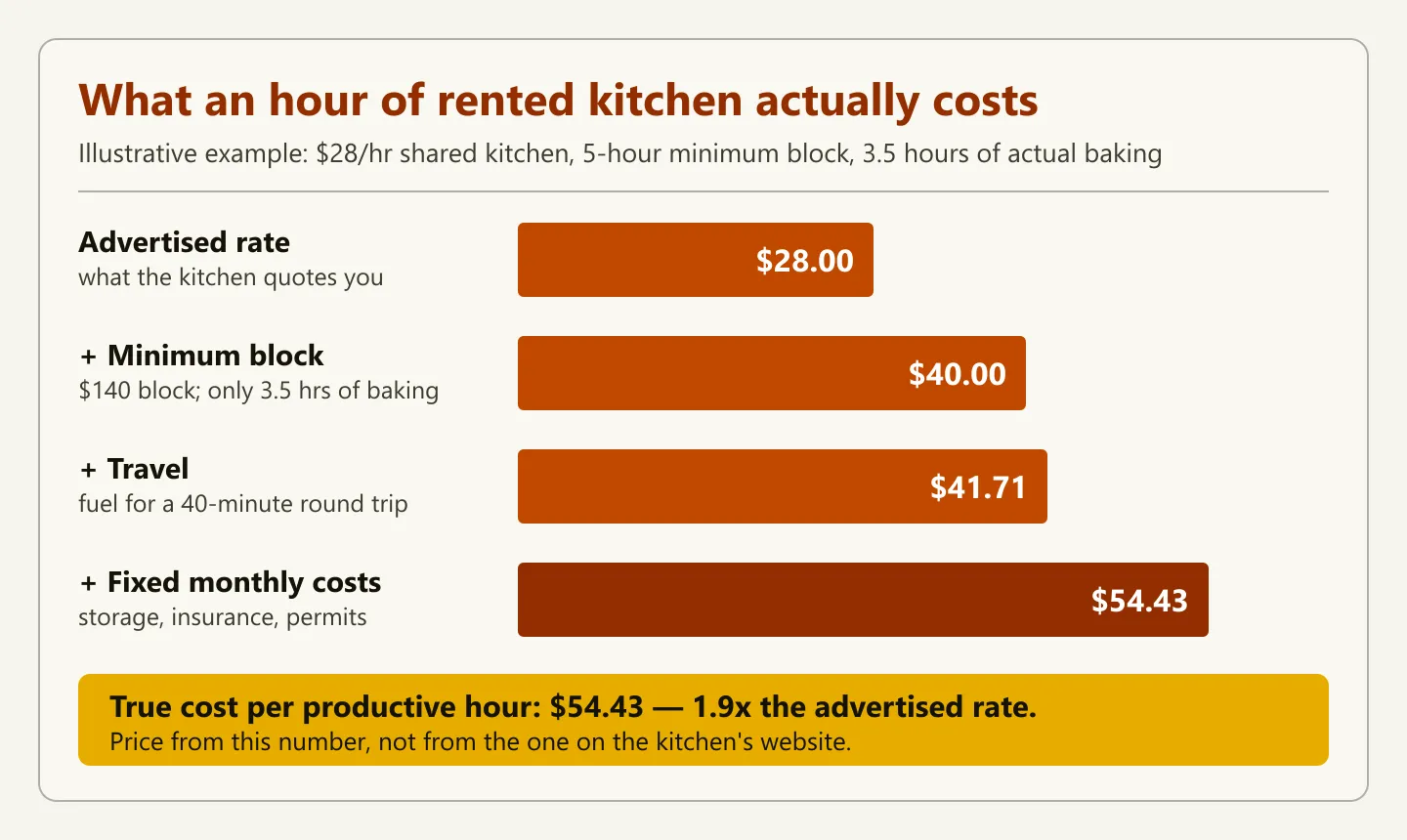
Three things sit between the sticker and the truth. The figures below are illustrative, not quoted rates — plug in your own kitchen’s terms, because rates vary enormously by region and facility.
- Minimum blocks, and the unproductive hours inside them. Kitchens commonly sell time in blocks rather than the exact hours you need: book five, use three and a half, pay for five. And nothing is baking while you load in, preheat, set up, clean down to the facility’s standard and load out — in this example, 1.5 hours of a 5-hour booking. So a $140 block buys 3.5 productive hours, which is $40.00 an hour of actual baking.
- Travel. Fuel, wear, totes and racks — $6.00 a session for a 40-minute round trip, or about $1.71 an hour of baking — plus the unpaid hours you spend driving.
- The monthly fixed layer. Dry and cold storage, general and product liability insurance (expect a certificate naming the facility as an additional insured — ask for the required limits in writing), your permit or license, and a food manager certification if your jurisdiction requires one. Here that’s $95 storage + $58 insurance + $25 permit = $178 a month, with no certification fee in this example — spread across four sessions, that’s about $12.71 an hour. None of it scales down when you bake less.
Stack those up and the advertised rate nearly doubles.
| Layer | Running total per hour |
|---|---|
| Advertised rate | $28.00 |
| + Minimum block | $40.00 |
| + Travel | $41.71 |
| + Fixed monthly costs | $54.43 |
Read that column downward as a running total, not as four numbers to add up — the $140 block already contains the $28 rate, and each row folds in one more layer. The bottom figure is the one that matters: $54.43 per productive hour, 1.9 times the advertised rate — before you’ve bought a single bag of flour. It’s also the number you should be putting into your pricing, not the $28.
Building your own kitchen instead doesn’t dodge this; it front-loads it. UF IFAS Extension, citing a 2018 shared-kitchen industry toolkit, puts the cost of building out a commercial kitchen in an existing space at up to $100–$300 per square foot (opens in new tab) — a figure that has almost certainly risen since. A modest 400-square-foot buildout is a $40,000–$120,000 project before equipment, which is why shared-use kitchens exist at all.
The Break-Even Math: How Much More Do You Have to Sell?
Here’s the step most people skip. The rented kitchen has to pay for itself out of volume you would not otherwise have produced — not volume you’d have made anyway. If you’d sell the same number of units either way, renting is strictly worse by the full monthly cost.
Run it in four steps. Every figure below comes from the illustrative example above — a $28/hr kitchen, 5-hour blocks yielding 3.5 productive hours, and $178 a month of storage, insurance and permits.
-
Measure your true monthly commitment. Rental blocks plus every fixed line. In the example: 4 sessions a month — one a week — × $140 = $560, plus $178 of monthly fixed costs, plus $24 of fuel — $762 a month, whether or not you bake.
-
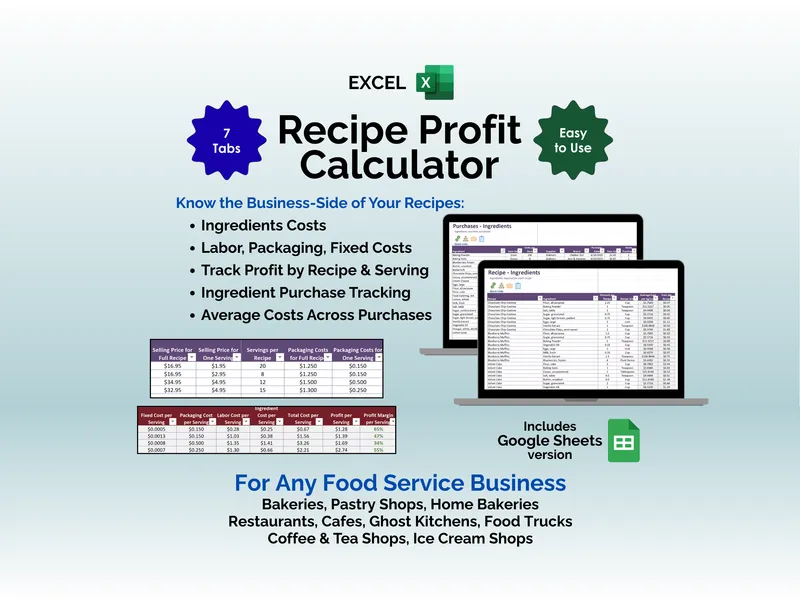
Measure your contribution per unit — price minus ingredients, packaging, and platform or market fees. Note that this number is usually identical in both kitchens, because a rented kitchen changes your capacity, not your recipe cost. If you’ve never separated contribution from revenue, start with how to calculate recipe cost; a recipe profit calculator will turn ingredients, yield and labor into a real per-unit margin rather than a guess.
Say a dozen sells for $24 and costs $9 in ingredients and packaging. Contribution: $15 per dozen.
-
Compare the two kitchens on the same terms. Not “what does the kitchen cost” but “what does each kitchen earn.” Say a domestic oven gets you roughly 8 dozen an hour and you can realistically work 40 kitchen hours a month around your family: a 320-dozen ceiling. In the rented space, say a deck oven and a 20-quart mixer get you 30 dozen an hour × 3.5 productive hours × 4 sessions: a 420-dozen ceiling.
Home vs rented kitchen, same $15/dozen Per month Home Rented Capacity 320 dozen 420 dozen Contribution $15 $15 Kitchen cost $0 $762 Profit at capacity $4,800 $5,538 Profit at 300 $4,500 $3,738 That last row — 300 dozen — is a normal month, below both ceilings. Those two throughput figures are the ones most worth measuring for yourself — they move this table further than the rent does, and yours will not match the example. Note too that this models the kitchens as either/or. If you’d keep baking at home as well, count only the volume that genuinely requires the rented space, which pushes your break-even up rather than down.
-
Find the break-even. Renting wins only when the extra volume you actually sell covers the monthly commitment: $762 ÷ $15 = 51 additional dozen every month, sold, not baked. Below that, the rented kitchen is a net loss no matter how professional it feels.
That last line is the whole post in one sentence. Write your own version of it on a sticky note — “this only works if I sell 51 more dozen a month, every month” — and put it where you’ll see it when the kitchen manager sends the agreement.
Three Tests to Run Before You Sign a Kitchen Agreement
If the math is close, don’t decide on the math alone. Run these three tests over the next four to six weeks.
-
The Named-Constraint Test. Write down the specific orders you turned down in the last 90 days, what each was worth, and which of the three ceilings blocked it. If you can’t fill half a page, or if most entries say “I was too tired,” you have a workload problem, not a kitchen problem. Fix pricing and scheduling first.
-
The Four-Week Test. Before committing, book four one-off sessions at the kitchen you’re considering — ask whether they allow drop-in bookings before you commit to a membership — and track two numbers each time: total hours booked and hours during which product was actually in an oven. That ratio is the single biggest driver of your true hourly cost, and yours will not match the illustrative 3.5-of-5 above. If you can’t fill four consecutive weeks now, a monthly membership won’t magically fill them later.
-
The Price Test. Add your true cost per productive hour to your per-unit cost and see what happens. In the example, $54.43 an hour across 30 dozen an hour adds about $1.81 per dozen. Can your current price absorb that, or do you need to raise? And if you need to raise, will the channel you’re selling into bear it? Wholesale pricing is structurally lower than retail — the buyer needs their own margin on top of yours — which means the wholesale channel a commercial kitchen unlocks often has a thinner margin than the direct sales you already have. What a properly costed price actually looks like is worked through in how to price baked goods.
The Options Between Your Home Kitchen and Your Own Buildout
This decision is rarely binary. There are at least six rungs on the ladder, and it’s easy to jump straight from the first to the last.
| Option | Typical commitment | Best for — and the catch |
|---|---|---|
| Stay cottage food, tighten operations | None | Anyone not pressed against a legal ceiling — but it defers a decision you’ll face anyway |
| Shared-use kitchen, hourly | Pay per session, often a minimum block | Testing demand and one-off large orders — peak hours are often booked out |
| Shared-use kitchen, monthly membership | Flat monthly fee, usually with storage included; ask for the current rate card | Steady weekly production — you pay in slow months too |
| Off-hours rental from an existing kitchen (café, church, school) | Often informal, hourly | Bakers with odd hours and local relationships — permit and insurance questions are murkier, so get them in writing |
| Co-packer | Per-batch minimums | Shelf-stable products with proven demand — minimums are typically well above home-baker volumes |
| Your own buildout or lease | Up to $100–$300 per square foot (opens in new tab), plus equipment and rent | Established businesses with years of demand data — the least reversible commitment on this list |
The middle four rungs exist so you don’t have to bet the business on a guess. Take them in order. A shared-use kitchen booked by the hour is the cheapest experiment available for answering “can I actually fill this?” — and the answer is worth more than the money you’ll spend finding out.
Whichever rung you land on, the labeling, allergen and traceability work follows you: moving into a licensed facility doesn’t remove the need to trace a batch back to its ingredients or to keep allergens straight across products, and label rules usually get stricter once you sell through someone else rather than direct to the customer. The Cottage Food Compliance Pack builds ingredient statements ordered by weight, an allergen matrix, and two-way batch tracing, with label rules for 51 jurisdictions — the paperwork side that a bigger oven doesn’t solve.
What to Ask Before You Sign
Bring this list to the tour. The answers vary far more between facilities than the hourly rates do.
- Are your baking hours actually available? If you need Thursday 4 a.m. to 9 a.m. and that block is permanently taken, the rate is irrelevant.
- What’s the minimum block, and is there a monthly minimum?
- What equipment is shared versus first-come? Specifically: oven type and count, mixer size, proofer, sheet pan racks, cooling space.
- Is storage included, and what kind? Dry, refrigerated, and frozen are usually priced separately and per shelf.
- What insurance do you require? Expect general and product liability, with the facility named as an additional insured. Get the required limits in writing before you shop for a policy.
- Who holds the permit, and does the facility’s license cover my product category? A kitchen licensed for one category may not automatically cover yours.
- Can I sell wholesale out of this facility, and what does the health department require from me specifically?
- What are the cleaning standards, and are there fines? Ask what a violation actually costs.
- What’s the cancellation and rescheduling policy? A sick child on a booked morning is a real event, not a hypothetical.
- How does load-in work? Parking, loading door, stairs, and cart access all convert directly into unproductive minutes.
Score the Decision Instead of Agonizing Over It
The reason this choice drags on for months is that it mixes categories: a legal question, a money question, a capacity question, and a quality-of-life question, all pulling different directions. Held in your head, whichever one you thought about most recently wins.
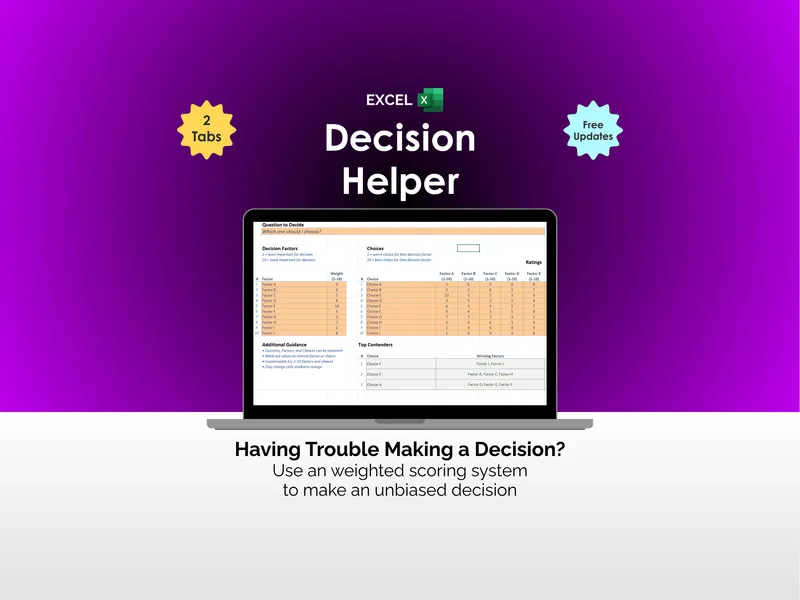
Write them down and weight them instead. Give each factor a weight from 1 to 10 — legal ceiling, monthly cost, drive time, family hours, wholesale access, equipment quality — then score both options against each, always so that a higher number means better: a cheaper month and a shorter drive should both score high. Let the arithmetic hold the comparison for you. That’s exactly what a weighted decision matrix is for, and it’s a sitting-down-once job rather than a project.
Then record why you chose what you chose, and the number you expected to hit — the 51 extra dozen, or whatever your version is. In six months, that note is the difference between knowing whether the move worked and having a feeling about it.
And whichever way you go, the operating structure comes with you. The recipes, the costing, the batch records, the customer list — that’s yours, and it’s the same file whether you’re baking in your kitchen or someone else’s. The Bakery Business Manager ties ingredients, recipe costs, allergens, sales, and profit together across one connected workbook rather than the half-dozen disconnected spreadsheets these jobs usually end up spread across. Rent the kitchen hours if you must; own the system.
And when the operation outgrows a spreadsheet entirely, Ardent Seller (opens in new tab) is the next step — the same kind of tracking run as connected software instead of files.
Sources
- New Report Grades Each State’s Laws for Homemade Food Sales — Institute for Justice, Baking Bad (2022) (opens in new tab)
- Texas Cottage Food Production — Texas Department of State Health Services (opens in new tab)
- Texas Senate Bill 541 (89th Legislature), relating to cottage food production operations (opens in new tab)
- California Health and Safety Code § 113758 — cottage food operation sales limits (opens in new tab)
- FDA Food Code 2022 — U.S. Food and Drug Administration (opens in new tab)
- FDA Releases 2022 Food Code — U.S. Food and Drug Administration (opens in new tab)
- An Introduction to Shared-Use Commercial Kitchens — University of Florida IFAS Extension (FS400) (opens in new tab)
These sources were checked in August 2026, but each figure carries the date of its own source: the Institute for Justice report is from 2022, and California’s $75,000 and $150,000 are the statutory base figures, which § 113758 adjusts annually for inflation — so the operative caps today run higher than the numbers printed in the statute. Caps, allowed-food lists and channel rules are all set at state and county level, so verify your own before deciding.