Picture this: you just pulled a batch of gorgeous lemon lavender cupcakes out of the oven. The buttercream is piped perfectly, the packaging is on point, and your customer is thrilled. You charged $36 for a dozen, and you feel pretty good about it — until you sit down and actually do the math.
Flour, butter, eggs, sugar, lavender extract, cupcake liners, piping bags, the box, the ribbon, the label you printed at home, the two hours you spent baking and decorating, the gas to deliver them. Suddenly that $36 doesn’t look so great.
Here’s the hard truth: it’s easy to underprice baked goods. Not because you don’t care about profit, but because it’s natural to count only the ingredients you can see. The real cost of a recipe goes far beyond what’s in the mixing bowl. (It’s the baking-specific version of why handmade sellers undercharge.)
The short answer: add up everything one item costs you (ingredients, packaging, your labor and overhead), then divide that by one minus the profit margin you want.
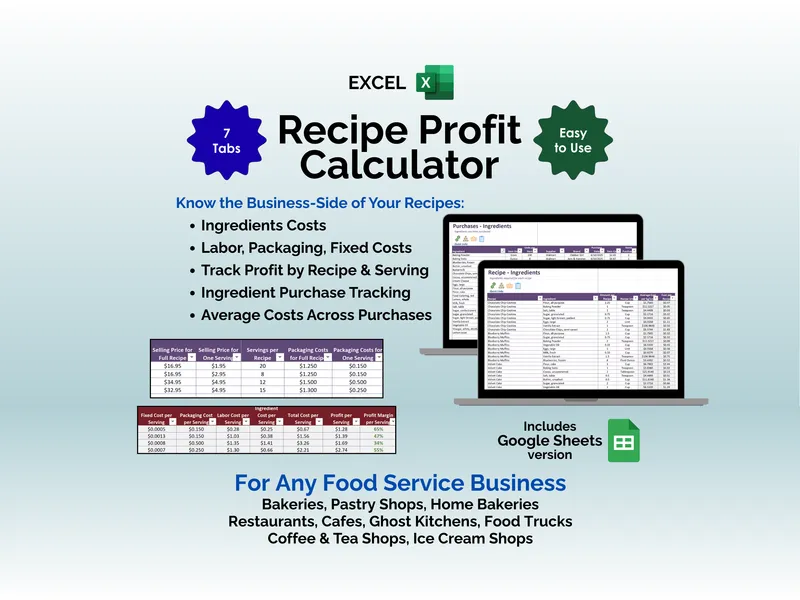
Counting those costs by hand, recipe by recipe, is where most bakers give up. The Recipe Profit Calculator does that part for you: it converts pack sizes into recipe units, divides by yield, adds your labor, and shows the real margin per recipe and per serving. The method matters more than the tool, though, so here it is either way.
Why Most Bakers Get Recipe Costing Wrong
For a baker, recipe costing has to cover the whole finished item, not just the obvious ingredients. It’s a step that’s easy to skip, or to replace with a rough mental estimate that misses half the picture.
The problem isn’t laziness. It’s that baking feels like a creative pursuit, not a manufacturing operation. But the moment you sell your first cake, you are a manufacturer. And a manufacturer that doesn’t know its costs will struggle to stay profitable.
There are three categories of costs that go into every baked good you sell:
- Direct ingredient costs — the flour, sugar, butter, eggs, and flavorings
- Indirect material costs — packaging, labels, liners, boards, and decorating supplies
- Overhead and labor — your time, kitchen utilities, equipment wear, and delivery expenses
The first category is the one everyone counts. The second is easy to miss. The third is the one that most often goes uncounted, and that’s where the money leaks.
How to Calculate Your True Ingredient Costs
Direct ingredient costing means calculating exactly how much of each ingredient goes into one batch — not estimating, not rounding, not guessing. This is the foundation of your pricing, and getting it wrong here means everything downstream is wrong too.
The Unit Cost Method
For every ingredient, you need two numbers:
- Purchase price — what you paid for the package
- Total units in the package — measured in the same unit your recipe uses
Then divide: purchase price divided by total units = cost per unit.
Here’s what this looks like for a basic vanilla cake recipe. The package prices are illustrative, not current shelf prices; use the numbers on your own receipts.
| Ingredient | Package Price | Package Size | Recipe Uses | Cost in Recipe |
|---|---|---|---|---|
| All-purpose flour | $4.29 | 5 lbs (~19 cups) | 3 cups | $0.68 |
| Granulated sugar | $3.49 | 4 lbs (9 cups) | 2 cups | $0.78 |
| Butter | $5.99 | 1 lb (2 cups) | 1 cup | $3.00 |
| Eggs | $4.49 | 12 count | 4 eggs | $1.50 |
| Vanilla extract | $8.99 | 4 oz (24 tsp) | 2 tsp | $0.75 |
| Whole milk | $3.79 | 1 gallon (16 cups) | 1 cup | $0.24 |
| Baking powder | $3.29 | 8.1 oz (~49 tsp) | 2.5 tsp | $0.17 |
| Salt | $1.49 | 26 oz (~120 tsp) | 1 tsp | $0.01 |
| Total | $7.13 |
That $7.13 is your direct ingredient cost for one batch. If the recipe makes 12 cupcakes, each cupcake costs $0.59 in ingredients alone.
Don’t Forget the Frosting
This one is easy to miss. It’s natural to cost out the cake or cupcake base and forget that frosting, fillings, glazes, and toppings are separate costs. A buttercream frosting recipe might add another $3 to $5 per batch (an illustrative figure that depends on your butter price). Fondant, ganache, and specialty decorations can add significantly more.
Always cost the complete finished product, not just the batter.
The Costs Hiding in Plain Sight
Here’s where most pricing falls apart. These are real expenses that come out of your revenue, and ignoring them is the same as giving away money.
Packaging and Presentation
Every item you sell needs packaging. The ranges below are illustrative, so replace them with your own suppliers’ prices:
- Boxes and containers — $0.50-$3.00 per unit depending on size and quality
- Cupcake liners — $0.05-$0.15 each for standard, more for decorative
- Cake boards and drums — $1.00-$4.00 each
- Labels and stickers — $0.10-$0.50 each including printer ink costs
- Ribbon, tissue paper, bags — these add up faster than you think
- Allergen labels — many states’ cottage food laws require labels that list allergens (check your own state’s rules), and they’re easy to forget in costing
A single cupcake that costs $0.59 in ingredients might need a liner ($0.10), a portion of a box ($0.40), a label ($0.15), and tissue paper ($0.05). That’s $0.70 in packaging — more than the ingredients themselves.
Kitchen Overhead
Your kitchen doesn’t run for free, even if it’s your home kitchen:
- Electricity and gas for ovens, mixers, refrigeration
- Water for cleaning (you clean a lot)
- Equipment depreciation — your stand mixer, oven, and tools wear out and need replacing
- Cleaning supplies — dish soap, sanitizer, paper towels
- Cottage food permits or commercial kitchen rental — if applicable in your area
A rough starting allowance for a home baker is 10-15% of ingredient cost (an illustrative rule of thumb, not a measured figure — replace it with your real bills once you have a few months of them). If you rent commercial kitchen space, this number can be much higher and should be calculated precisely from your actual bills.
Your Time Is Not Free
This is the big one, and the cost that’s easiest to leave out.
Say you spend 2 hours baking and decorating a batch of cupcakes, and you’d pay someone else $15 to $20 an hour to do that work (an example rate, not a benchmark; use what the work is worth where you live). That’s $30 to $40 in labor per batch. For a custom cake that takes 6 hours? That’s $90 to $120 in labor alone.
“But I enjoy it” is not a pricing strategy. You can love your work and still deserve to be paid for it. Every hour you spend baking is an hour you can’t spend on something else — that’s the economic concept of opportunity cost, and it’s real whether you acknowledge it or not.
At minimum, assign yourself an hourly rate and track your time. Even if you discount it at first, you need to see the real number.
The Formula for Pricing Baked Goods
Pricing a baked good takes two steps: add up everything one unit costs you, then set the price so a chosen share of it is profit.
Unit cost = ingredients + packaging + labor + overhead (all per unit)
Selling price = unit cost ÷ (1 − target margin)
In words: add up the four per-unit costs, then divide that total by one minus your target margin.
Target margin is the share of the selling price you keep as profit after every cost, labor included. At a 40% margin, 40 cents of every dollar a customer pays is profit. (The profit margin glossary entry covers the definition in more depth.)
Step-by-Step Breakdown
- Cost the ingredients per unit. Use the unit cost method above, for the base and the frosting, then divide the batch total by how many units it yields.
- Add packaging per unit. Liner, box or box share, label, ribbon.
- Add labor per unit. Your hourly rate × hands-on hours, divided by units produced. Count mixing, baking, decorating and packing. Don’t count time the oven or the proof does on its own.
- Add overhead per unit. Your overhead allowance (say 12% of ingredient cost), or your actual kitchen rental and utility costs split across the units.
- Divide by (1 − your target margin). That gives you the selling price.
Labor goes into the cost exactly once, as a wage. The margin is what’s left over after you’ve paid yourself, which is the business’s profit, not a second helping of your hourly rate.
Example: Pricing Those Lemon Lavender Cupcakes
Here’s how the math plays out with illustrative numbers for one dozen cupcakes.
| Cost Category | Per Cupcake |
|---|---|
| Ingredients (base + frosting) | $0.95 |
| Packaging (liner, box portion, label) | $0.70 |
| Labor (2 hrs at $18/hr, divided by 12) | $3.00 |
| Overhead (12% of ingredient cost) | $0.11 |
| Unit cost | $4.76 |
Now pick a margin. The same $4.76 cupcake prices very differently depending on how much profit you want on top:
| Target margin | Price per cupcake | Price per dozen |
|---|---|---|
| 30% | $6.80 | $81.60 |
| 40% | $7.93 | $95.20 |
| 50% | $9.52 | $114.24 |
At a 40% margin, that’s about $8 a cupcake, or $95 a dozen, for a decorated specialty flavor. Of that $95, $36 is your wage and $38 is profit.
If that looks high next to the grocery store, remember that they aren’t selling the same product. And if your market won’t pay it, you have two honest choices: bring the costs down, or accept that this item isn’t profitable at your current scale. Dropping your price without changing anything else isn’t one of them.
That tension, between what it costs to make and what people will pay, is the core challenge of running a food business. Ignoring it doesn’t make it go away.
Pricing for Custom Orders and Wholesale
The formula stays the same across sales channels. What changes is what counts as cost:
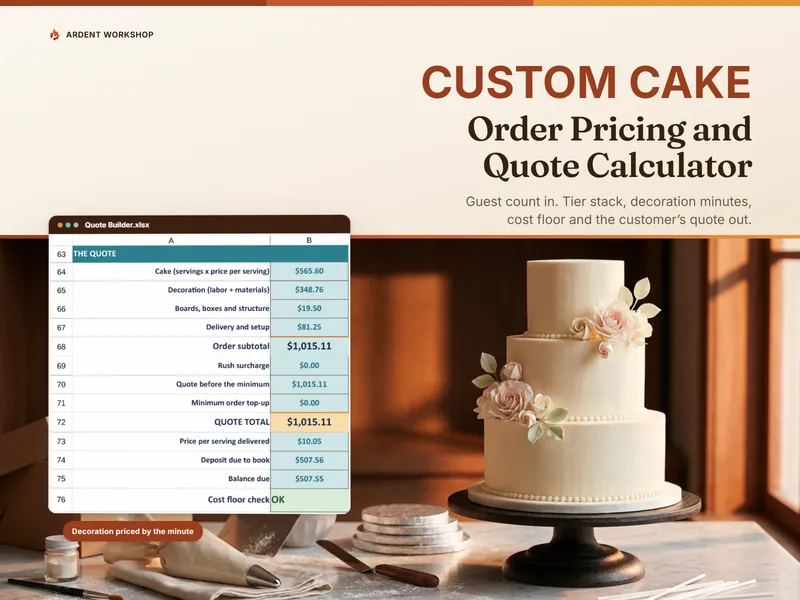
- Custom orders carry labor that never touches the oven: the consultation messages, the sketch, the tasting, the delivery and setup. Count those hours too. The walkthrough on how to price a custom cake prices decoration and delivery line by line.
- Wholesale means the shop marks up your price. If the shop uses keystone pricing (doubling your wholesale price to set its shelf price), your wholesale price still has to cover your full unit cost plus your margin, and double that still has to be a shelf price customers will pay. If it isn’t, the item isn’t a wholesale item.
Is the “3× Ingredient Cost” Rule Right?
The 3× (3x, or three times) ingredient cost rule is the habit of pricing a baked good at three times what its ingredients cost. It’s a common shortcut in home baking, and for anything that takes real hands-on time it loses money.
Run the cupcakes from the example through it:
| Method | Price per cupcake | Profit per cupcake |
|---|---|---|
| 3× ingredients ($0.95 × 3) | $2.85 | A $1.91 loss |
| 3× ingredients and packaging ($1.65 × 3) | $4.95 | $0.19 (a 4% margin) |
| Unit cost ÷ (1 − 40%) | $7.93 | $3.17 (a 40% margin) |
The rule fails for one reason: it multiplies the cheapest cost and ignores the biggest one. In this example labor is $3.00 of a $4.76 unit cost, and the 3× rule never looks at it. The rule only works for something where the ingredients are most of the cost and the labor is trivial. That describes almost nothing a home baker decorates by hand.
Markup and margin also get confused here. A 3× markup on your full unit cost isn’t a 3× margin. It’s a 67% margin, which is a perfectly good price if the market will pay it. The problem with the rule isn’t the 3. It’s what gets multiplied.
How to Track Recipe Costs Without Losing Your Mind
Knowing you should cost your recipes and actually doing it are two different things. The way to make it stick isn’t recalculating every batch — it’s to set up a system once and maintain it.
Build a Master Ingredient Price List
Create a single list of every ingredient you use regularly, with the current cost per unit. Update it monthly or whenever you restock. This is your source of truth — when you cost a new recipe, you pull from this list instead of looking up every price from scratch.
Cost Each Recipe Once, Then Review Quarterly
When you create or adopt a new recipe, sit down and cost it completely using your master list. Save that costing sheet. Then revisit every quarter (or whenever ingredient prices shift significantly) and update.
Use a Dedicated Tool
Trying to track all of this in your head or on random sticky notes is a recipe for losing money. The Recipe Profit Calculator is built specifically for this. Ingredients live in one inventory tab that averages the cost of every purchase you log, so flour bought by the pound converts to cups automatically. Each recipe then layers labor, packaging and fixed costs on top and gives you the cost and margin per recipe and per serving. Log a new bag of flour at a new price and every recipe that uses flour reprices.
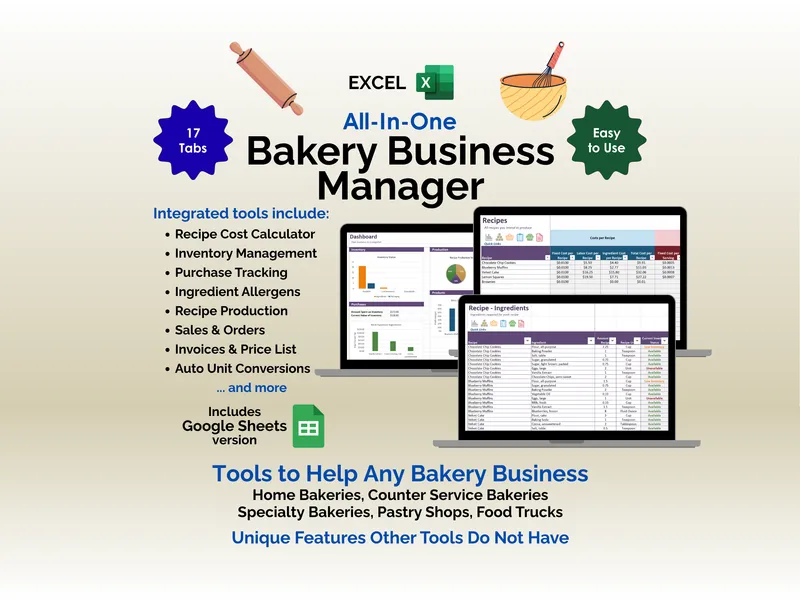
For bakers running the whole business from one file, the Bakery Business Manager goes further, connecting ingredient inventory, recipe costing, sales, invoices and profit in one workbook. When you’re juggling wedding cake orders, weekly farmers market prep, and custom cupcake requests, having everything in one spreadsheet is the difference between chaos and clarity.
Three Pricing Mistakes That Kill Home Bakery Profits
Even with good cost data, bakers still fall into these traps:
1. Matching Competitor Prices Without Knowing Their Costs
That baker down the road selling custom cakes for $50? They might be losing money on every order. They might be using cheaper ingredients. They might not be counting their labor. Someone else’s price tells you nothing about what your price should be. Price from your costs, not from your competition.
2. Offering Too Many Products
Every new product means a new recipe to cost, new ingredients to stock, new packaging to buy, and more complexity to manage. A tight menu of items you’ve mastered, costed precisely and can produce efficiently is far easier to keep profitable. Spread yourself across 30 products and some of them are probably losing money; you just won’t know which ones until you find out which recipes are actually profitable.
3. Not Raising Prices When Costs Rise
Ingredient prices move, and staples like butter, eggs and chocolate can move a lot between restocks. If your ingredient costs climb and your prices don’t, your margin shrinks with every sale, and because labor and packaging don’t move, a small rise in ingredients can take a large bite out of a thin margin. Review your pricing quarterly. It’s not greedy — it’s survival.
What to Do If Your Prices Feel “Too High”
Here’s the reality check nobody wants to hear: if your properly costed price feels too high, one of these things is true:
- Your product is positioned for the wrong market. Specialty baked goods aren’t competing with grocery store prices. Your customer is someone who values handmade, custom, high-quality products. Find them.
- Your costs are too high for your scale. Buying ingredients in bulk, streamlining your processes, and reducing waste can lower per-unit costs significantly.
- The product isn’t viable at your current volume. Some items only become profitable at higher quantities. A custom 3-tier cake might make sense. A single custom cookie might not.
None of these problems are solved by undercharging. They’re solved by understanding your numbers and making strategic decisions.
Start With One Recipe
You don’t have to cost your entire menu today. Start with your best-selling product — the one you make most often. Cost it completely using the framework above. See where you land. Then do the next one, and the next.
The Recipe Profit Calculator speeds this up: once your ingredients are in the inventory tab, every recipe after the first is just quantities and yield. It’s a one-time purchase for Excel and Google Sheets, so it’s yours to keep, with no subscription.
And when your baking business grows to the point where you’re managing dozens of recipes, tracking ingredient inventory, and juggling orders from multiple customers, Ardent Seller (opens in new tab) is the next step. It’s inventory and sales software built for makers and bakers, with ingredient inventory, recipes and production, and sales in one place.
But first: cost that one recipe. Know your real number. Everything else gets easier from there.