What cottage food law actually is
Food sold to the public is normally made in an inspected commercial kitchen under a food-establishment license — a bar high enough that it stops most people selling a tray of cookies at a farmers market. A cottage food law is a carve-out from that bar. It says: for a defined set of low-risk, shelf-stable foods, an individual may cook at home and sell direct, without the commercial kitchen and without the full license.
The name varies — some states call it a "home processor" exemption, a "homemade food" act, a "limited food establishment," or a "home bakery" license — but the shape is the same everywhere: an exemption in exchange for limits.
The five things every cottage food law defines
- Which foods qualify. Almost always the shelf-stable ones: baked goods without cream or custard fillings, jams and jellies, granola, dry mixes, candy, roasted coffee, honey. Anything needing refrigeration to stay safe — cheesecake, cream pies, most meat — is excluded in most states, though a handful now permit some refrigerated items with extra labeling.
- Where you may sell. Direct to the consumer is the common floor: from your home, at farmers markets, at events. Whether you may sell online, ship within the state, place products on a retail shelf, or sell wholesale to a café varies enormously — and shipping across a state line is rarely permitted under a cottage food exemption at all.
- How much you may earn. Many states cap annual cottage food revenue; some set no cap. Where a cap exists it is the thing that decides when you have outgrown the exemption and need a commercial kitchen.
- What you must do before you start. Registration, a permit, a food-handler course, a kitchen inspection — required in some states, none of them in others.
- What must appear on the label. This is the part that applies almost everywhere, and the part people most often get wrong.
The label is the near-universal obligation
Whatever else a state's rule says, it will tell you what has to be printed on the package. Seven elements between them account for nearly every state's list — the ingredient statement, the allergen declaration, your name and address and the state's disclosure sentence turn up almost everywhere; the product name and net quantity on most; and a date or batch code on a minority, though it is the only thing that makes a product traceable whether or not your state names it:
- The product's common or usual name — what a buyer would call it, not only your brand name.
- A full ingredient statement, in descending order of predominance by weight, with the sub-ingredients of compound ingredients in parentheses (21 CFR 101.4).
- An allergen declaration — a "Contains:" statement for any of the nine major food allergens.
- The net quantity — the weight or volume in the package, not counting the packaging.
- Your name and address, or in many states a state-issued registration number in place of a home address.
- The state's home-kitchen disclosure statement — a sentence saying the food was made somewhere that is not inspected. Most states prescribe the exact wording and will not accept a paraphrase; several set a minimum type size for it.
- A date and a batch code — required outright in some states, and in every state the only thing that makes a product traceable if something goes wrong.
The free allergen and label worksheet computes the first three of those from a recipe: it converts cups and ounces to grams, ranks the ingredients heaviest first, and writes the "Contains" line from your own allergen flags.
The nine major food allergens
Federal allergen labeling treats nine foods as a class: milk, eggs, fish, crustacean shellfish, tree nuts, peanuts, wheat, soybeans and sesame. The FASTER Act was signed in 2021 and its sesame labeling requirement took effect on January 1, 2023, which is why labels written before then routinely miss it. Most states expect the same declaration on a cottage food label regardless of how their own rule is worded.
Three catch people out repeatedly. Coconut is no longer a tree nut. FDA listed it as one for over a decade, then removed it — along with ten other nuts — in Edition 5 of its allergen-labeling guidance, published January 6, 2025, cutting the list from 23 to 12. Coconut still has to be named in the ingredient statement; it no longer belongs on the Contains line — and older labels and templates still carry the old flag. Most chocolate chips carry soy lecithin, and plenty of dairy-free chips are run on shared equipment with milk chocolate. And tree nuts, fish and crustacean shellfish must be named by species — "Contains: tree nuts" is not enough when the nut is pecans.
Records: the obligation nobody plans for
Cottage food rules say less about record-keeping than about labels, which creates a false impression that records are optional. They are not optional in the only sense that matters: the day a supplier recalls a lot of flour, or a customer calls to say they reacted to something, you need to be able to answer two questions. What was in it? and which of the things I sold had that in it, and who has them now?
Answering the second one requires three habits, all of which have to have happened before the phone rings: photograph the supplier lot code as stock arrives, print a batch code on every package, and write down which lots went into which batch. That is what turns a bad evening into a lookup.
Cottage food law vs a commercial food license
A cottage food exemption is deliberately a small-scale on-ramp. You trade reach — restricted venues, sometimes a revenue cap, usually no interstate shipping — for not needing a commercial kitchen. A full food-establishment license removes those limits and adds the costs: an inspected commercial space or a rented commissary, a license fee, scheduled inspections, and in most states a certified food-protection manager.
The honest signal that you have outgrown the exemption is usually not the revenue cap. It is wanting to do something the exemption forbids — ship out of state, sell wholesale, or make something that needs refrigeration.
Where to check your own state
Cottage food rules change, sometimes mid-session, and a state page written two years ago can be confidently wrong. Our own Ardent Seller platform publishes a free, maintained 50-state cottage food guide and a free revenue cap tracker, both with links to each state's own agency page. Read your own state's source before you print a run of labels — nothing on this page is legal advice, and the details are exactly where states differ.
Templates that implement this
The record-keeping half, done properly
3 templates
The label and traceability records cottage food law expects you to keep — ingredient statements ordered by weight, a Contains line for the nine major allergens, and a batch and supplier-lot trace that runs both ways.
- $19.95 Spreadsheet

Cottage Food Compliance Pack — Ingredient Label Builder, Allergen Matrix, Batch & Recall Traceability for Home Bakers | Excel, Google Sheets + PDF
Cottage food label workbook: ingredient statements ordered by weight, an allergen matrix, label rules for 51 jurisdictions, and two-way batch tracing.
Operator OSView details - $29.95 Excel
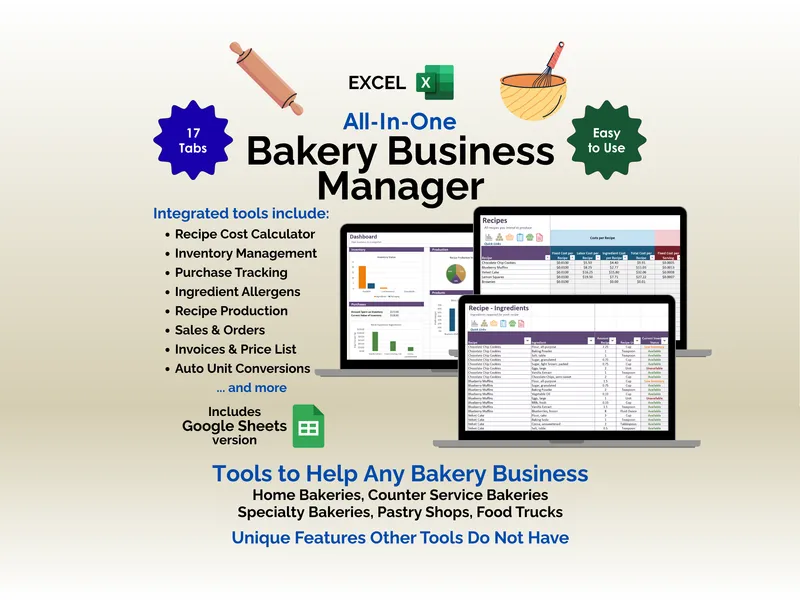
Bakery Business Manager - Excel
Bakery Business Manager is a 17-sheet workbook for home bakers and small bakeries, connecting ingredient inventory, recipe costing, sales, invoices, and profit. Excel and Google Sheets versions are included.
Operator OSView details - $7.95 Excel
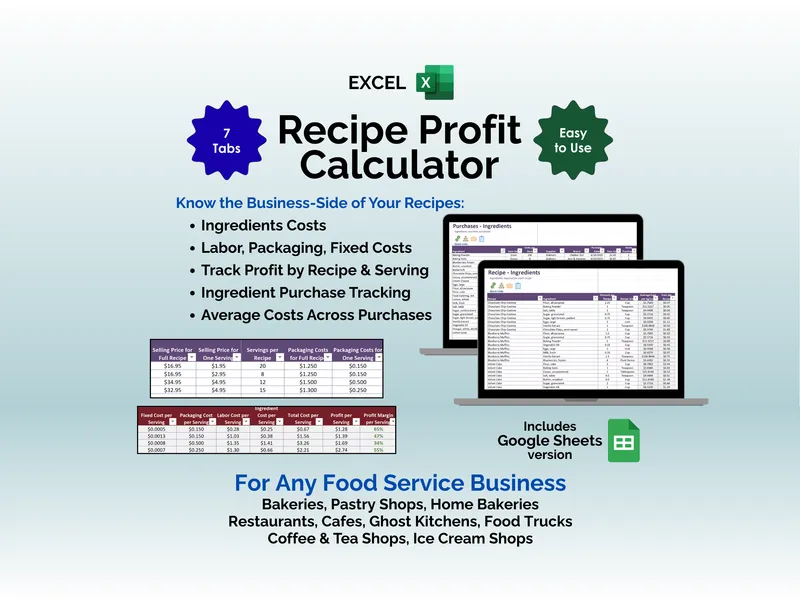
Recipe Profit Calculator - Excel
Pricing cakes by gut feel and hoping it covers cost? This excel recipe profit calculator turns ingredients, yield, and labor into a real margin per recipe and per serving.
Operator OSView details