How to Price Baked Goods to Sell (and Build a Profitable Home Bakery)
How to price baked goods to sell isn’t just a question — it’s the foundation of running a successful home bakery. Whether you’re frosting cupcakes for a farmer’s market or fulfilling special‑order wedding cakes, knowing exactly what your creations cost — and how to price them for profit — is what separates a passion project from a thriving baking business. These practical home bakery business tips will help you transform your favorite recipes into consistent income.
Why Delicious Isn’t Enough
Your kitchen smells like heaven. Friends rave about your brownies. Instagram loves your glossy cake shots. But if you’re thinking about turning your passion into a baking business, here’s the hard truth: delicious isn’t enough. The real secret? Knowing your numbers — because that’s how you turn flour and sugar into sustainable income.
The Hidden Costs That Sneak Up on Home Bakers
It’s not just flour, butter, eggs, and chocolate chips. It’s:
- Packaging supplies
- Electricity or gas
- Delivery fuel
- Your valuable time
Without a recipe cost calculator, these hidden expenses can eat into your profits faster than a plate of warm cookies at a bake sale. Tracking every cost — down to the gram and the minute — lets you:
- Set prices with confidence
- Compete in your local market
- Pay yourself fairly
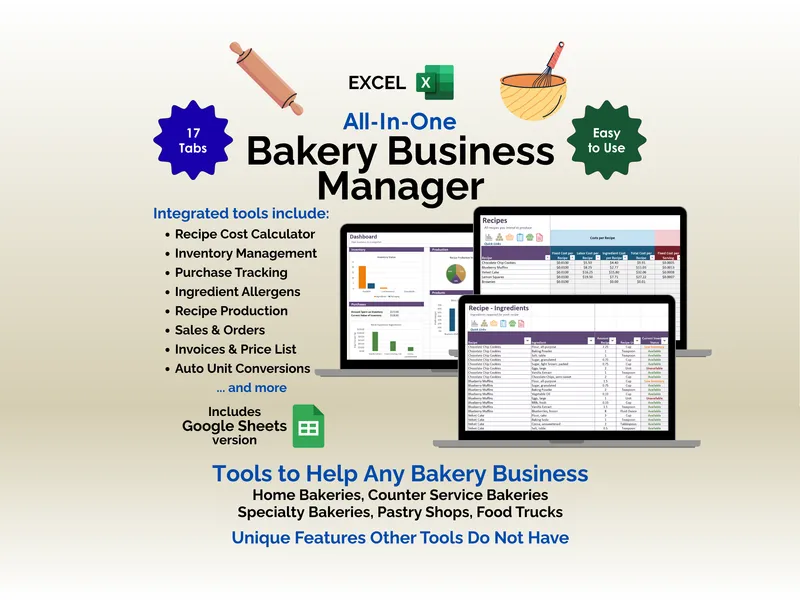
The Bakery Business Manager from Ardent Workshop makes this process simple by combining a recipe cost calculator, inventory tracker, and profit margin dashboard in one Excel workbook — so you can see exactly where your money is going.
Step One: Price Every Ingredient
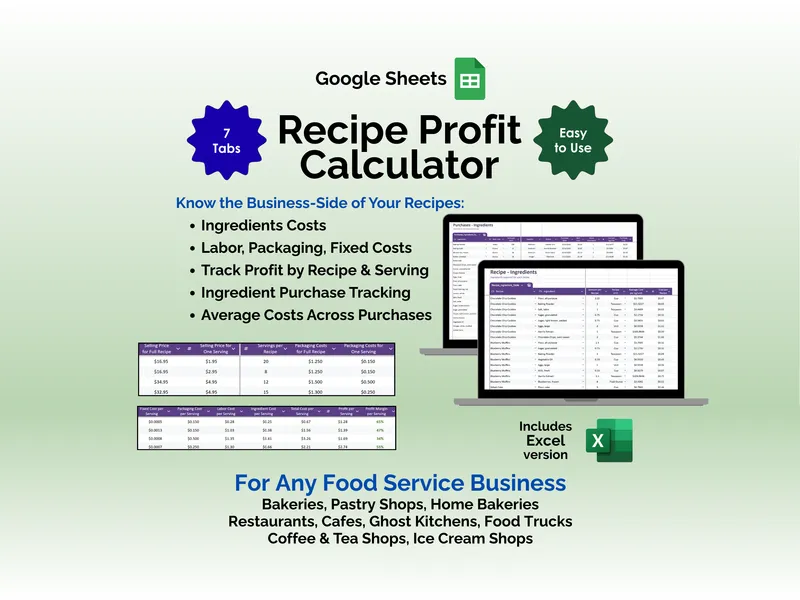
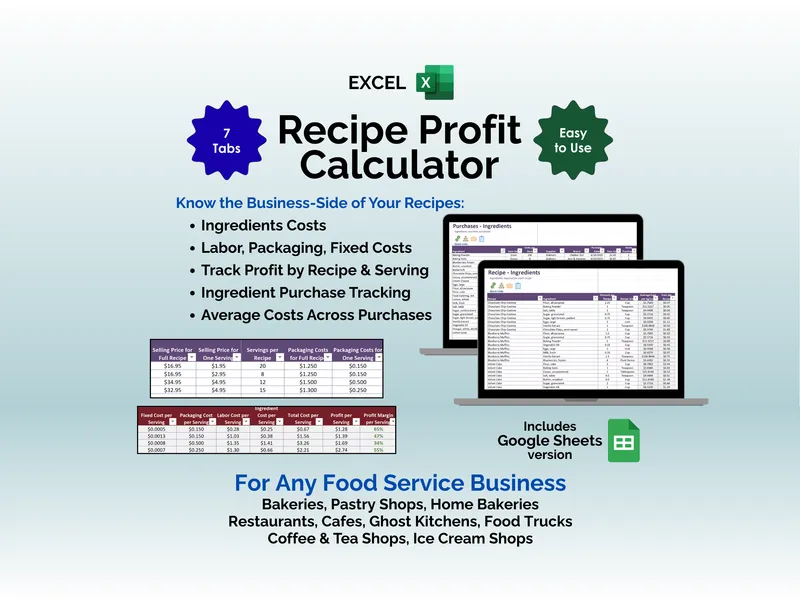
Use a baking cost spreadsheet or ingredient cost tracker to break each recipe into exact costs per batch and per serving.
Factor in:
- Bulk pricing from suppliers
- Seasonal ingredient changes
- Premium upgrades (Belgian chocolate, organic vanilla)
If your chocolate chip cookies cost $0.42 each to make and you sell them for $0.50, you’re barely breaking even — and that’s before packaging and labor. Knowing your per‑unit cost helps you adjust prices for healthy profit margins while staying competitive.
With the Bakery Business Manager, you can enter your ingredient purchases once and let the tool automatically update your recipe costs whenever prices change.
Step Two: Treat Packaging as an Ingredient
Custom cake boxes, cupcake inserts, labels, and ribbon all add up. Many bakers toss these into “miscellaneous” — but buyers pay for presentation as much as flavor.
By counting packaging as a core cost:
- Your profits stay intact
- Premium packaging boosts perceived value
- You can price confidently alongside boutique bakeries
The Bakery Business Manager even includes packaging calculators, so you can factor presentation into your pricing without extra spreadsheets.
Step Three: Pay Yourself for Your Time
Whisking, kneading, baking, decorating, cleaning — it’s all labor. Even if you’re not cutting yourself a paycheck yet, assigning an hourly rate in your recipe cost calculation:
- Protects you from burnout
- Future‑proofs your business for hiring help or expansion
- Gives you a realistic picture of whether your prices support long‑term growth
Your time is one of your most valuable ingredients. Price it accordingly — and track it alongside your other costs in the Bakery Business Manager for a complete profitability picture.
Step Four: Don’t Forget the Extras
Beyond ingredients, packaging, and labor, a thriving home baking business often faces:
- Licensing or cottage food permit fees
- Farmers’ market stall rentals
- Marketing costs (business cards, ads, social media promotions)
- Delivery or courier services
Including these in your pricing ensures you’re covering the true cost of doing business.
A Worked Example: What One Batch of Cookies Really Costs
Steps one through four are easy to nod along to and hard to feel. So here’s the whole thing run end to end on a single batch of 24 chocolate chip cookies.
Every number below is a placeholder. Your flour, your butter, your box supplier, and your time are all different — the point is the method and, more importantly, where the money actually goes.
Ingredients, one batch of 24:
| Ingredient | Cost |
|---|---|
| Flour, 3 cups | $0.45 |
| Butter, 1 lb | $4.20 |
| Sugars (white + brown) | $0.90 |
| Eggs, 2 | $0.60 |
| Chocolate chips, 2 cups | $3.40 |
| Vanilla, baking soda, salt | $0.65 |
| Total ingredients | $10.20 |
$10.20 ÷ 24 = $0.43 per cookie. That’s the number most home bakers stop at — and it’s the number that makes $0.50 a cookie look like a profit.
Now add everything else:
| Cost layer | Math | Per cookie |
|---|---|---|
| Ingredients | $10.20 ÷ 24 | $0.43 |
| Packaging (box, label, ribbon: $1.10/dozen) | $1.10 ÷ 12 | $0.09 |
| Utilities (oven + mixer, ~$0.35/batch) | $0.35 ÷ 24 | $0.02 |
| Labor (75 min at $20/hr = $25.00) | $25.00 ÷ 24 | $1.04 |
| True cost per cookie | $1.58 |
There it is. The ingredients are 27% of the cost. Your time is 66% of it. Selling that cookie at $0.50 doesn’t mean thin margins — it means you’re paying roughly a dollar for the privilege of baking each one, and calling the difference a hobby.
This is the single most common mistake in home bakery pricing, and it’s not carelessness. It’s that labor is the only ingredient you don’t buy at a store, so it’s the only one that never shows up on a receipt.
The batch-size lever
Here’s the good news hiding in that table. Labor doesn’t scale with volume — mixing four batches doesn’t take four times as long as mixing one, and you clean the kitchen once either way.
| 1 batch (24 cookies) | 4 batches (96 cookies) | |
|---|---|---|
| Total session time | 75 min | 150 min |
| Labor cost at $20/hr | $25.00 | $50.00 |
| Labor per cookie | $1.04 | $0.52 |
| Ingredients + packaging + utilities | $0.54 | $0.54 |
| True cost per cookie | $1.58 | $1.06 |
Same recipe, same rate, 33% lower cost per cookie — bought entirely with batch size. This is why a baker who takes a 96-cookie order can quote a price a 24-cookie baker can’t match, and why “minimum order: two dozen” isn’t rudeness. It’s arithmetic.
Run this on your own top three recipes and you’ll usually find one that’s quietly subsidizing the others.
Markup Is Not Margin (and the Difference Costs You Money)
Once you know your true cost, you need a price. This is where a lot of otherwise careful bakers lose money to a vocabulary problem.
- Markup is a percentage added on top of your cost.
- Gross margin is a percentage of your selling price that isn’t cost.
They are not the same number, and mixing them up always errs in the same direction — against you. Mark a $1.00 cookie up by 40% and you sell at $1.40. Your margin isn’t 40%; it’s $0.40 ÷ $1.40 = 28.6%. You thought you had a comfortable cushion and you have a thin one.
The fix is one formula. Don’t multiply your cost — divide it:
Price = true cost ÷ (1 − target margin)
| Target gross margin | Divide your cost by | Same thing as a markup |
|---|---|---|
| 30% | 0.70 | 1.43× cost (+43%) |
| 40% | 0.60 | 1.67× cost (+67%) |
| 50% | 0.50 | 2.00× cost (+100%) |
| 60% | 0.40 | 2.50× cost (+150%) |
Apply it to the four-batch cookie at $1.06 true cost and a 50% target margin: $1.06 ÷ 0.50 = $2.12 per cookie, or about $25 a dozen. That number may feel high the first time you see it. It’s what the cookie costs — you were just paying the difference yourself.
And note what the margin is for. It isn’t profit in your pocket; your labor was already paid inside the cost. The margin covers the extras from step four — permits, stall fees, marketing, delivery — plus failed batches, plus the money to buy a better mixer someday. A 0% margin business pays you an hourly wage and then dies the first time the oven breaks.
Common Questions About Pricing Baked Goods
What hourly rate should I pay myself?
Start with a number you would accept to do this work for someone else’s bakery, and don’t discount it because you enjoy it. Enjoyment isn’t a discount — it’s the reason you chose the job. If your rate makes your prices uncompetitive, that’s real information, and the answer is usually batch size, recipe mix, or a different market — not a lower wage.
How do I price for wholesale versus retail?
Wholesale means a café or shop buys from you and resells at their own markup, so your wholesale price has to leave room for theirs while still clearing your cost. Build the wholesale price off the same true cost with a lower target margin, and only take the order if the volume actually lowers your cost per unit — the batch-size lever above is what makes wholesale possible at all. If a wholesale order doesn’t come with volume, it’s just a discount.
Do I charge for failed batches?
Not on the invoice — but yes, in the margin. Scrapped batches, dropped cakes, and the cookies you ate “for quality control” are a real, recurring cost of production. If you routinely lose a batch in ten, that’s roughly 10% of your output evaporating, and your margin is what absorbs it.
How do I raise prices on existing customers?
Give notice, give a date, and don’t apologize. Raise on new orders first, tie the change to something concrete (“butter and packaging costs”), and resist the urge to explain your whole cost sheet — customers want a price and a reason, not a defense. The bakers who struggle here are usually the ones who waited three years and then had to move 40% at once.
Does this change if I’m operating under a cottage food law?
The costing math doesn’t change at all. What changes is step four: permit fees, allowed products, where you can sell, and labeling requirements vary by state and sometimes by county — and those are real line items, not paperwork. Check your state’s current rules directly rather than trusting a forum post, and put whatever they cost into your overhead.
Final Whisk of Advice
Every successful bakery business is built on more than just talent in the kitchen — it’s built on systems that keep your costs in check and your profits rising. The Bakery Business Manager from Ardent Workshop was designed for home bakers like you, bringing together a recipe cost calculator, inventory tracker, and expense log in one simple Excel tool. By baking these tools into your daily routine, you’ll spend less time on guesswork and more time perfecting the treats your customers love. When you run your bakery with clarity and confidence, the sweetest part isn’t just the cake — it’s the business you’ve built around it.