This isn't really template-versus-platform. Scoring objectives and key results is one thing goal-tracking software happens to include. The mistake is buying the whole per-seat platform when the part you'll actually use — setting a few goals, scoring them, and rolling them up — is something you can own outright.
What each one is for
- An OKR template is a goal-setting tool. Write your objectives and key results, type a start, target, and current value, score each cycle, and see what's on track and what's at risk. It answers “what are our goals, and how are they going?”
- Goal-tracking software is a platform. Automated check-ins, integrations with your work tools, org-wide goal cascades, dashboards, permissions, and reporting — with the scoring usually one part of it. It answers “run goals across our whole company,” at a price to match.
A full explanation of what an OKR is is in the glossary.
When an OKR template is exactly right
- You run OKRs for one team or a small company, not a whole enterprise.
- You're a founder, a team lead, or a small people-ops function.
- You want to set and review goals in a file you control, offline.
- You'd rather own the workbook than rent a platform per person.
- You want the scoring and roll-ups without the subscription.
At this stage a template beats a platform outright for the goal-setting job. The free OKR starter sheet is a no-signup taste that scores your key results, and the templates for HR & team leads hub collects the rest. If this is the first quarter you have set goals for anyone, the New Manager's Starter Kit carries the full workbook alongside the other three things a first year of managing asks for, and there is a shelf for first-time managers.
The signals you may want a full platform
- You're cascading goals across dozens of teams. Org-wide alignment with objectives that link up and down a large hierarchy.
- You need automated check-ins and integrations. Nudges, Slack updates, and goals that sync with your project tools.
- You have a dedicated owner. A platform needs someone to run it; a template needs a team lead and an afternoon.
- Permissions and reporting matter at scale. Fine-grained access and board-level dashboards across the whole company.
Even then, the goals themselves are still just objectives and key results — the platform hosts and distributes them. The template is the thinking; the platform is the plumbing.
Side by side
| What matters | OKR template (owned workbook) | Goal-tracking software |
|---|---|---|
| What it is | A focused OKR-scoring workbook | A broad goal-management platform |
| Cost | One-time, low — you own the file | Ongoing subscription, often per seat |
| Setting & scoring OKRs | The whole point — auto-scored, rolled up | One part of a larger system |
| Automated check-ins & integrations | You update the numbers yourself | Reminders, Slack, and tool syncs |
| Org-wide goal cascade | Best for one team or a small company | Alignment across dozens of teams |
| Setup | Open it and type your goals — an afternoon | Rollout, config, and adoption |
| Data ownership | The file is yours, offline | Hosted in the vendor's platform |
| Best for | A founder or team lead's quarterly OKRs | A whole company running OKRs at scale |
The honest middle ground
Plenty of companies grow into an OKR platform eventually, and that's the right move when aligning goals across a large workforce becomes the job. The mistake is the reverse: buying a per-seat suite to run one team's quarterly goals, when an owned workbook does that part better and costs once.
Run your OKRs either way
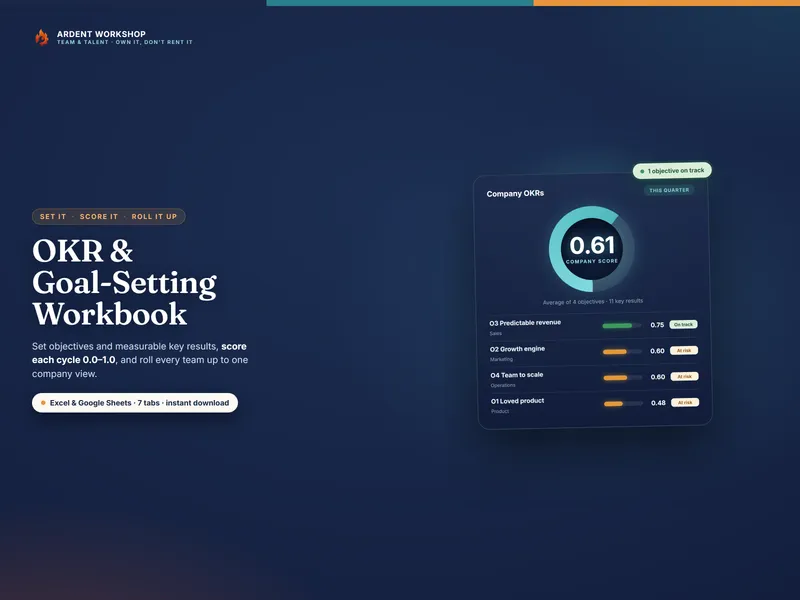
Whichever stack you end up on, the goals themselves are objectives and key results. The OKR & Goal-Setting Workbook scores each key result 0.0–1.0 from three numbers, averages them into an objective score, and rolls every objective up to one company view — one owned file for Excel, Google Sheets, and LibreOffice. Own the workbook; add a platform only when running goals company-wide becomes the job.
Frequently asked questions
- What's the difference between an OKR template and goal-tracking software?
- An OKR template is the artifact: a spreadsheet where you write objectives and key results, type a start, target, and current value, and see each key result scored 0.0 to 1.0, rolled up into an objective and a company score. Goal-tracking (or OKR) software is a platform that does that too, wrapped in check-in reminders, integrations, dashboards, permissions, and an org-wide goal cascade — usually sold as a per-seat subscription. One is a focused file you own; the other is a system you rent. For most small teams the template is the part they actually use, and a spreadsheet delivers it without the platform.
- Can a spreadsheet replace OKR software?
- For the job most small teams actually do — writing a few objectives and key results, scoring them each cycle, rolling them up, and reading what's on track — an owned OKR workbook does it completely. What a spreadsheet doesn't do is send automated check-in nudges, sync goals to your work tools, cascade objectives across dozens of teams, or manage permissions for a large org. If you're rolling OKRs out to a whole company with a dedicated owner, software earns its keep; if you're a founder or a team lead running one set of goals, the template is the right size of tool.
- How much does an OKR template cost vs OKR software?
- An owned OKR workbook is a single low one-time cost — you keep the file, edit it offline, and pay nothing monthly. OKR and goal-tracking software is typically a recurring per-seat subscription, often with an annual contract and a minimum. The subscription pays off when you need the full platform and the whole company is on it; paying per seat just to run one team's quarterly goals is renting far more system than the job needs.
- Do I still get scoring and roll-ups in a spreadsheet?
- Yes — that's the whole point of a built OKR workbook rather than a blank sheet. You type three numbers per key result and it scores the progress 0.0 to 1.0, flags the status, averages the key results into an objective score, and rolls every objective up to a company view with on-track, at-risk, and off-track counts, a confidence read, and a by-team breakdown. The formulas are already built; you just enter your goals and your numbers.