
What happens in a portfolio review
A homeschool portfolio review is a check-in on a student's progress, built from the record a family has already kept rather than from a single test. A reviewer — often a certified teacher or a qualified evaluator, in states that offer this option — looks over a collection of the student's work across the year: samples from each subject, a reading list, and the attendance or instructional-hours record behind them. The reviewer's job is to see whether the student progressed, not to grade each individual piece.
Who conducts a review, and where it applies
Homeschool rules vary by state. Where a portfolio review is an option, who qualifies as a reviewer and how the review is arranged is set by that state, so check your own state's homeschool law or education department for what applies to you.
What goes in a homeschool portfolio
A portfolio built for review is usually more than a stack of worksheets. What a reviewer typically wants to see includes:
- Dated work samples by subject or course — enough from across the year to show progress, not just a finished project from the end of it.
- A reading list — what the student read over the year, often with dates.
- Attendance or instructional-hours records — the days or hours logged behind the work, however the family's state counts them.
- Where each item is filed — a portfolio a reviewer can actually follow needs to say where a sample lives, not just that it exists somewhere in a bin.
- Test or evaluation results, if the family's state or program also asks for those alongside the portfolio.
Keeping a portfolio through the year, so review is a lookup
A portfolio that's assembled the week before a review is a scramble through a year of paper, trying to remember which folder has the spring science samples. A portfolio that's logged as the year goes is a lookup: each sample gets an entry — the date, the subject or course, and where it's filed — the moment it's set aside, so nothing depends on memory later. The difference shows up as a thin subject area: logged consistently, a gap in, say, history samples is visible in October, while there's still time to add to it — not in May, when a review is a week away.
How the binder keeps a portfolio review-ready
The Homeschool Portfolio, Attendance & Transcript Records Binder builds that lookup in. Its Portfolio Index logs every work sample with an ID, the course it belongs to, and where it's filed, as you go. Its Portfolio Coverage tab counts those samples by subject area and by quarter for each learner, so a subject with few or no samples logged shows up on its own — before a review, not during one. The same file keeps the attendance and hours record, the Reading List, and the Tests & Evaluations log a portfolio review may ask for, for up to 6 learners.
Portfolio review or standardized testing?
Where a state lets a family choose, a portfolio review and standardized testing are two different ways to show the same thing: that a student is progressing. A test is a single assessment on a single day; a portfolio review looks at a body of work built across the whole year. Both still need records kept consistently through the year to be ready when the time comes. See homeschool portfolio review vs standardized testing for how the two compare on what each shows, the records each needs, and the timing.
Own the record, whether or not a review is required
Even in a state with no portfolio-review requirement at all, the family that kept dated samples, a reading list, and an hours record through the year is the one with an answer ready if a review, an evaluation, or a college ever asks for one. Keeping it guarantees nothing about how a reviewer or college will read it, but it means there is something to show. That record is worth keeping as a file the family owns, not a login in someone else's app: no account to maintain, nothing that stops working if a subscription lapses, and one file that holds the record for up to 6 learners.
Where to start
Try the logging habit first with the free Homeschool Attendance & Hours Log — a one-learner, one-tab log for days and hours, pre-filled with a worked example so you can see it before you log a day of your own. No signup. For the full record — portfolio, attendance, hours-to-credits and a one-page transcript, for up to 6 learners — see the Homeschool Portfolio, Attendance & Transcript Records Binder, or browse every template for homeschool families. Still deciding whether to homeschool at all? The School-Path Decision Helper scores public, charter, private, hybrid and homeschool side by side against the priorities you weight.
Templates that implement this
Keep the records a portfolio review asks for
3 templates
A records workbook that indexes portfolio work samples by subject as you log them, keeps attendance and hours alongside the portfolio, and turns logged hours into a one-page transcript — one file for up to 6 learners, no state's rules assumed.
- $19.95 Spreadsheet
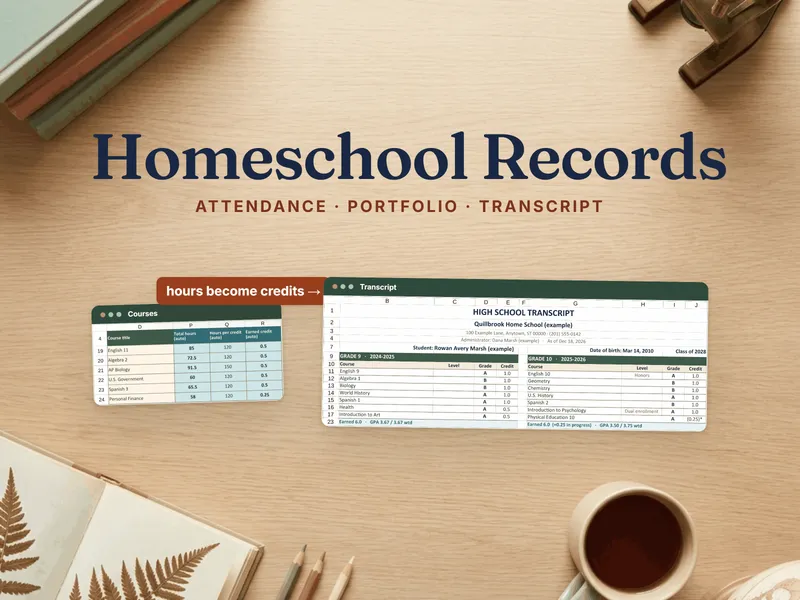
Homeschool Portfolio, Attendance & Transcript Records Binder — Hours to Credits, GPA, Transcript & Portfolio for Every Child (Excel + Google Sheets)
A homeschool records workbook for Excel & Google Sheets — attendance, hours, portfolio and a one-page transcript, with logged hours turned into credits.
Life AdminView details - $14.95 Spreadsheet

School-Path Decision Helper — Weighted Scorecard to Compare Public, Charter, Private, Hybrid & Homeschool (Excel & Google Sheets)
Compare public, charter, private, hybrid & homeschool with a weighted scorecard that prices a parent's forgone pay and the hours each path really takes.
Big DecisionsView details - $19.95 Spreadsheet

Back-to-School Family Organizer & Records Workbook — School Forms, Supply Lists, Activities & Key Dates in One File (Excel + Google Sheets)
A back-to-school organizer for Excel & Google Sheets — every child's forms, supply lists, activity fees & dates in one file, with what's overdue flagged.
Life AdminView details
Frequently asked questions
- What does a portfolio reviewer actually look at?
- Dated work samples across subjects, a reading list, and attendance or hours records, so the reviewer can see that a student made progress over the year — not a single test score on a single day. Where a state also asks for standardized test results or specific reporting, the reviewer may look at those too.
- Who conducts a homeschool portfolio review?
- Often a certified teacher or a qualified evaluator, in states that offer a portfolio review as one way to show a student's progress. Exactly who qualifies to review a portfolio, and how the review is arranged, is set by each state — check your own state's homeschool law or education department for what applies to you.
- Is a portfolio review required for every homeschooler?
- No — homeschool requirements vary by state, and not every state asks for a portfolio review at all. Some states offer more than one way to show progress, for example an evaluation of a portfolio or a standardized test, and let the family choose. Check your own state's rules rather than assuming one applies.
- How is a portfolio review different from standardized testing?
- A portfolio review looks at a body of work built across the whole year — samples, a reading list, records — while standardized testing is a single test on a single day. Where a state lets a family choose between the two, both still need records kept consistently through the year; the difference is what gets handed over at the end of it.
- How do I keep a portfolio ready without scrambling before a review?
- Log each work sample as you go — the date, the subject or course, and where it's filed — instead of collecting a folder to sort through later. Checking in every so often for a subject with few or no samples logged catches a gap while there's still time to add to it, rather than at review time.