A financial affidavit looks like a budget. It has lines for rent, groceries and car payments, a box for your paycheck, and a total at the bottom. That resemblance makes it easy to fill one out the way you would a budget: from memory, in an evening, rounding as you go.
Filling one out well comes down to five moves: get the right form, convert your pay to a monthly figure, average income that changes, spread annual bills across twelve months, and list every asset next to the loan against it. It takes that much care because the affidavit isn’t a budget. It’s a sworn reconstruction of the last year of your financial life, converted into monthly figures, and the other side can test every line of it against your bank statements. (For the full definition and how it differs from financial disclosure, see what a financial affidavit is.)
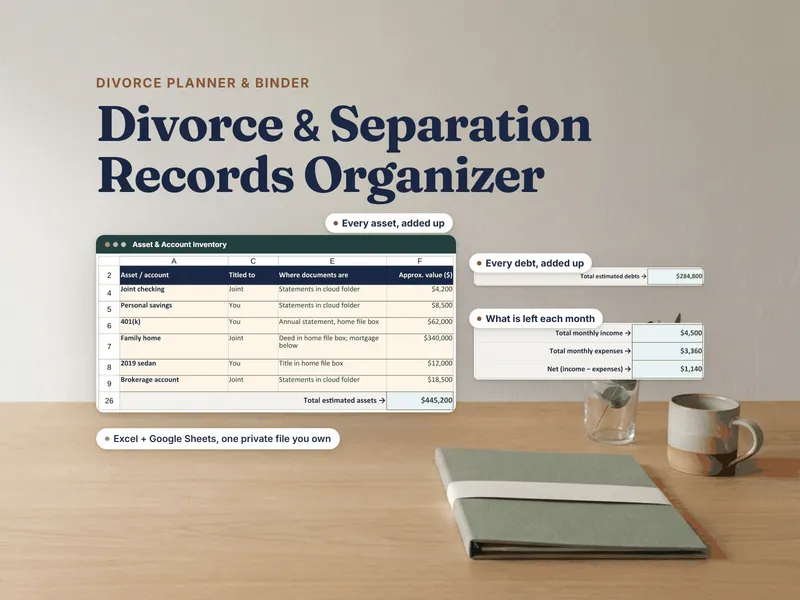
So learning how to fill out a financial affidavit is mostly about learning the arithmetic the form doesn’t show you. Most of that arithmetic happens before you touch the form, in four lists: income, monthly expenses, assets and debts. The Divorce / Separation Records Organizer holds those four lists in one private file and totals them as you go, so the numbers are ready when the form is. The method below works on paper too, though, so here it is either way.
Where each number on a financial affidavit comes from
Every financial affidavit asks the same four questions, however the form is laid out. The fields differ by state, but the structure doesn’t:
| Section | What it wants | Where the number comes from | The trap |
|---|---|---|---|
| Income | What you earn, as a monthly figure | Pay stubs, tax returns, deposits | Converting pay periods to months wrong |
| Monthly expenses | What your household costs each month | Bank and card statements, bills | Leaving out bills you pay once or twice a year |
| Assets | What you own, and what it’s worth | Account statements, estimates | Showing a house or car without the loan against it |
| Debts | What you owe, and in whose name | Loan and card statements | Forgetting debts in only one name |
Two real forms show how much the layout varies. California uses the Income and Expense Declaration, form FL-150 (PDF) (opens in new tab), currently the revision dated September 1, 2024. Florida uses the Family Law Financial Affidavit (Short Form), 12.902(b) (PDF) (opens in new tab), whose instructions (revision dated October 2021) say it is for people whose individual gross income is under $50,000 a year. Higher earners in Florida use a separate long form.
Get the right form before you calculate anything
The first step in filling out a financial affidavit is confirming which form your court wants, which version, and when it’s due. Each state, and sometimes each court, uses its own form, and forms are revised. A number you worked out for the wrong form may be in the wrong unit or cover the wrong period.
Deadlines are real, too. Florida’s short-form instructions (PDF) (opens in new tab) say a copy must be filed with the court and served on the other party within 45 days of being served with the petition, if it wasn’t served with your initial papers. Your court’s self-help center is the place to get the current form and its instructions.
How to convert your pay to a monthly figure
A financial affidavit is completed in monthly amounts. Florida’s instructions say so outright: if you’re paid on any schedule that isn’t monthly, “you must convert those amounts.” Most of their conversions go through a yearly figure first:
| How you’re paid | The conversion |
|---|---|
| Hourly | Hourly rate × hours per week × 52 ÷ 12 |
| Weekly | Weekly amount × 52 ÷ 12 |
| Every two weeks (bi-weekly) | Bi-weekly amount × 26 ÷ 12 |
| Twice a month (semi-monthly) | Semi-monthly amount × 2 |
| Monthly | No conversion |
How to convert bi-weekly pay (26 paydays, not 24)
Multiply bi-weekly pay by 26 and divide by 12, not by 2, because a year has 26 bi-weekly paydays. Being paid every two weeks feels like being paid twice a month, which is why the shortcut is so tempting.
Here’s the worked example. Say your gross pay is $1,850 every two weeks:
- Wrong: $1,850 × 2 = $3,700 a month
- Right: $1,850 × 26 = $48,100 a year, ÷ 12 = $4,008.33 a month
The shortcut understates your income by $308.33 a month, which is $3,700 a year: two whole paychecks gone from a sworn document. And because those numbers come straight from pay stubs, it’s an easy error for the other side to spot.
That same yearly figure tells you which form to use. In Florida, $48,100 of individual gross income is under the $50,000 line, so this person would generally use the short form (Florida’s short-form instructions (PDF) (opens in new tab) list a few exceptions, such as when both parties have waived the affidavit in a simplified dissolution).
How to report income that changes month to month
Irregular income (commission, overtime, tips, freelance work, a side business) is reported as an average, not as your best month or your worst. California’s FL-150 (PDF) (opens in new tab) spells out the method: “add up all the income you received in each category in the last 12 months and divide the total by 12.” The form also asks for last month in a separate column, so the court sees both the average and where you are now.
California’s form separates out three things people tend to blur together:
- One-time money. A lottery win, an inheritance or any other one-time receipt in the last 12 months gets its own line, with the source and amount. Because the form reports it separately, keep it out of your monthly average.
- A change in income. If your financial situation changed significantly over the last 12 months, the form asks you to say why. A 12-month average that no longer reflects your life is better explained than left to look like a mistake.
- Self-employment. If you own a business, California asks you to attach a profit and loss statement for the last two years or a Schedule C from your last federal return.
Gross or net? Usually both. California’s salary line asks for wages “gross, before taxes,” with deductions listed separately. Florida’s short form opens with “present monthly gross income” and works down to a “total present monthly net income.” Have your gross pay and every deduction from your pay stubs in front of you.
How to turn annual bills into monthly expenses
Expenses are easy to understate, and not because anyone is hiding anything. A first draft tends to list what leaves your account every month and miss everything that leaves once or twice a year. Florida’s instructions say expenses “may be converted in the same manner” as income, so an annual bill becomes a monthly figure by dividing by 12.
Here’s a worked example of four bills that rarely show up on a first draft:
| Bill | How it’s paid | Annual cost | Monthly figure |
|---|---|---|---|
| Car insurance | $780 every six months | $1,560 | $130 |
| Property tax (not escrowed) | $3,600 once a year | $3,600 | $300 |
| Holiday and birthday gifts | Spread across the year | $900 | $75 |
| Pet vaccinations and checkup | $420 once a year | $420 | $35 |
| Total | All four bills | $6,480 | $540 |
That’s $540 a month of real household cost that a “what came out last month” draft leaves off entirely. Pull twelve months of statements and look at every month, not only the last one. A bill that shows up once a year can only be found that way. (If you’re not sure which statements you still have, how long to keep documents covers what’s normally around.)
If you share children’s costs with the other parent, keep those receipts organized separately. How to split extraordinary expenses with a co-parent walks through the netting.
Florida’s and California’s forms both let you say when a number isn’t what you pay today. Florida’s instructions say that in a dissolution case, if your listed expenses “do not reflect what you actually pay currently,” you should write “estimate” next to each estimated amount. California’s FL-150 has you mark whether the expense figures are estimated, actual, or proposed needs. Saying which is which is honest, and it stops a reasonable projection from being read as an inflated one.
What a monthly deficit on the form means
A monthly deficit means your listed expenses are higher than your net income, and it can be fine as long as you can explain every dollar of it. Florida’s form puts monthly net income and monthly expenses side by side and asks for the surplus or the deficit. Separations are expensive, and a deficit can last a while. What draws questions is the unexplained kind: an affidavit that shows $1,000 a month more going out than coming in, with no savings being drawn down and no new debt, invites the question of where the money is coming from.
What value to put on assets and debts
Assets go on at what they’re worth today, and every loan against them has to appear somewhere. Where it appears depends on the form. California’s FL-150 nets it out on the asset line itself for real estate and other property: “estimate fair market value minus the debts you owe.” Florida’s short form lists assets and liabilities in two separate sections, so the house goes in one and the mortgage in the other. Either way, a house shown with no mortgage anywhere on the form overstates what you own.
A few practical rules make this section faster and safer:
- Use statement balances for accounts. Bank, brokerage and retirement accounts take the balance from your most recent statement, and that statement is the document behind the number.
- Estimate, and say it’s an estimate, for everything else. Vehicles, furniture and collections don’t come with a statement. A reasoned estimate is fine. Presenting it as an appraisal isn’t.
- List every debt, including the ones in one name. A credit card or loan in only one spouse’s name is still a debt someone has to account for. Note whose name it’s in.
- Mark ownership only where the form asks you to. Florida’s short form has a “nonmarital” column, to be used only in a dissolution case and only for items you believe belong to one of you. Whether something is marital or separate is a legal question. The form records your position. It doesn’t decide it.
- Never write full account numbers. Florida’s short form says to list only the last four digits of account numbers, and California’s tells you to black out your Social Security number on the pay stubs you attach and the tax return you bring to the hearing.
The five financial affidavit mistakes the other side checks first
Once it’s served, the other side compares your affidavit with the paper behind it. These are the five mismatches that are easiest to find:
- Bi-weekly pay multiplied by 2. It understates income by two paychecks a year, and the pay stubs prove it.
- Annual and semi-annual bills left out. Insurance, property tax, registrations and annual fees go missing because the last month’s statement doesn’t show them.
- Expenses that don’t match the statements. A grocery figure of $400 next to bank statements averaging $900 reads as careless at best. Build each expense line from twelve months of statements, not from memory.
- An income change with no explanation. If last month is far from the 12-month average, say why on the form. California’s FL-150 has a line for it.
- Assets without their loans, and debts left off. A house with no mortgage anywhere on the form, or a card balance in one name that never appears, makes the whole asset section look unreliable.
What these have in common: every one is caught by laying the affidavit next to the records. That’s the case for building it from the records in the first place.
Common questions about filling out a financial affidavit
Is a financial affidavit the same in every state?
No. Each state, and sometimes each court, uses its own form, so the first job is getting the current version from your court’s self-help center. California’s FL-150 and Florida’s 12.902(b) ask for the same four kinds of information in different layouts.
Should I use gross or net income on a financial affidavit?
Usually both: the forms start from gross income and then work down through deductions to a net figure, so you need your gross pay and every deduction from your pay stubs.
What if some of my expenses are estimates?
Say so on the form. Florida’s instructions tell you to write “estimate” next to any amount that isn’t what you actually pay now, and California’s form has you mark whether expenses are estimated, actual, or proposed needs.
Do I put full account numbers on a financial affidavit?
Generally no. Florida’s short form asks for only the last four digits of account numbers, and California’s form tells you to black out your Social Security number on the pay stubs you attach and the tax return you bring to the hearing.
Build the numbers before you open the form
The form is the last step, not the first. Gather twelve months of statements, convert every pay period and every bill to a monthly figure, list what you own net of what you owe, and the affidavit becomes a transcription job instead of an all-nighter. For the gathering itself, how to organize your records for a separation walks through it step by step, and the free Separation Document Checklist is a printable list of what to collect.
The Divorce / Separation Records Organizer was built for exactly this. Its asset and debt inventories total themselves, its monthly budget nets income against expenses, and it keeps a who-owes-whom balance for shared bills, all in one file you own and keep in an account only you control. It’s not the affidavit and it doesn’t fill one in. It gets your asset, debt, income and expense totals ready before you sit down with the form; the gross-to-net deductions and 12-month averages are still yours to work out from your pay stubs and statements.