What a financial affidavit lists
The precise fields differ by state and court, but nearly every financial affidavit asks for the same four things — the same four an organized records file already holds:
- Income — your pay and any other income (self-employment, rental, benefits), usually monthly and often with recent pay stubs and tax returns attached as proof.
- Monthly expenses — a realistic budget of what your household actually costs each month: housing, utilities, food, transportation, insurance, childcare, debt payments, and the rest.
- Assets — everything of value and every account: bank and retirement accounts, investments, real estate, vehicles, and business interests, with an approximate value and who each is titled to.
- Debts and liabilities — every balance you owe: the mortgage, loans, credit cards, and any other debt, and whose name each is in.
Because it is sworn, the numbers have to be complete and honest — a court and the other party's attorney can test them. That's why gathering the records behind each figure, early, matters so much.
Financial affidavit vs. financial disclosure
A financial affidavit or declaration may summarize finances, while disclosure can also require exchanging supporting records. Signing under oath, signing under penalty of perjury, notarization, service and filing are distinct requirements; use the current form instructions for your court.
For example, California Courts' divorce disclosure guide distinguishes sharing financial information with a spouse from filing proof of disclosure with the court. That is a California example, not a national filing rule. Do not upload an entire private financial packet merely because it was prepared for disclosure.
How to prepare for one
You can't fill in the official form until you have the numbers — and the numbers come from your own records. The practical preparation is the same regardless of which state's form you'll use:
- Gather records you are authorized to access for the periods the applicable form or disclosure rules require, such as tax returns, pay records and account statements.
- Inventory your assets and debts, with an approximate value or balance and who each is titled to.
- Build a realistic monthly budget of income versus expenses.
- Keep working records secure and avoid unnecessary sensitive identifiers in an organizer. Follow court instructions for required disclosures and permitted redactions; do not omit a required field based on a generic privacy tip.
That preparation is exactly what the free Separation Document Checklist walks you through, and what the Divorce / Separation Records Organizer is built to hold — asset and debt inventories that total themselves, and a monthly income-and-expense budget, in one place. It's a records organizer, not the affidavit itself. For a step-by-step method, see how to organize your records for a separation, or compare a records organizer vs a divorce app.
A financial affidavit is a legal document — this is not legal advice
This page explains a common term so you can prepare with confidence; it is not legal, financial, or tax advice, and it does not tell you what to put on a court form or how your case should be decided. The affidavit is an official document with real legal consequences for signing it, and the requirements vary by state — always get the correct form and guidance from your court's self-help center or your own attorney. Organizing your records in advance simply makes that step faster and less stressful.
Templates that implement this
Gather what a financial affidavit asks for
3 templates
A records organizer that pulls your assets, debts, income, and monthly expenses into one private file — and totals them — so the numbers are ready when the form is.
- $24.95 Spreadsheet

Divorce & Separation Records Organizer — Assets, Debts, Income & Documents in One File (Excel + Google Sheets)
A divorce & separation records organizer for Excel & Google Sheets — your assets, debts, income & documents in one private file, totals done for you.
Life AdminView details - $29.95 Spreadsheet
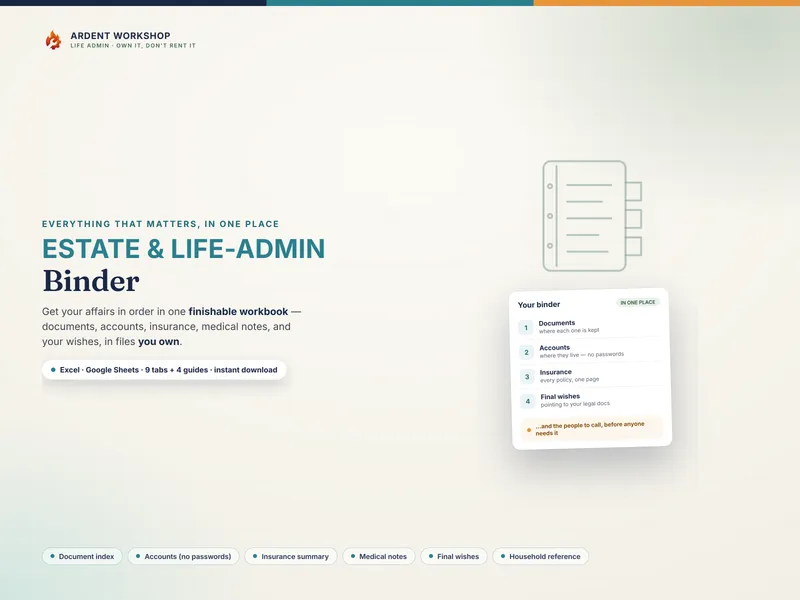
Estate & Life-Admin Binder — Important Documents, Accounts, Insurance & Final Wishes Organizer (Excel + Google Sheets)
An estate & life-admin binder for Excel & Google Sheets — organize important documents, accounts, insurance, and final wishes in one file you own.
Life AdminView details - $24.95 Spreadsheet
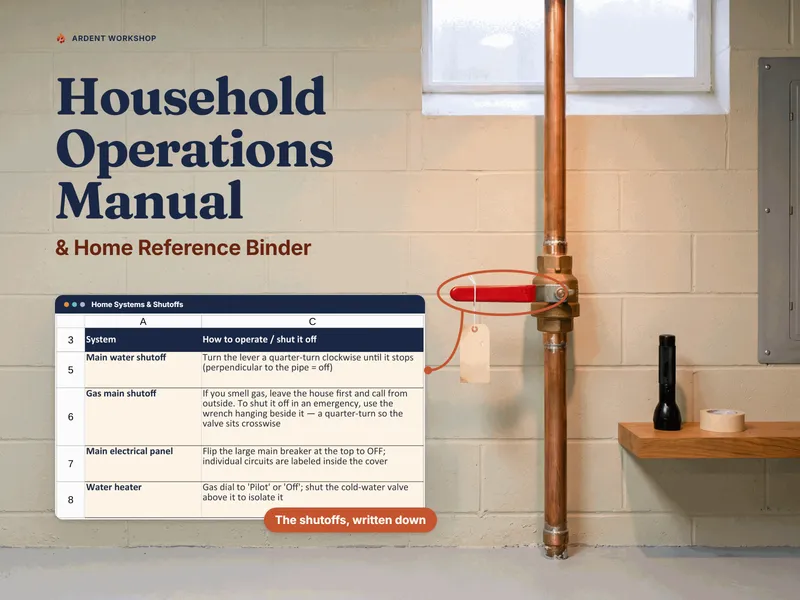
Household Operations Manual & Home Reference Binder — Utilities, Shutoffs, Maintenance, Emergency Contacts & House-Sitter Info (Excel, Google Sheets & Word)
Household operations manual for Excel, Google Sheets & Word: shutoffs, a maintenance schedule that computes what's due, and a house-sitter packet.
Life AdminView details