The message is often a photo of a receipt and one line: “Braces deposit. You owe me half.” It looks like simple arithmetic. It almost never is.
Behind that one line sit four decisions that nobody wrote next to the receipt: whether braces are a shared expense under your agreement, whether “half” is even the right percentage, whether the other parent had to agree before the deposit was paid, and how long you have to ask. Get any one of them wrong, or split the bill before insurance has paid its part, and a $1,200 deposit turns into a three-week argument.
The short answer: subtract what insurance or anyone else paid, multiply the out-of-pocket cost by the other parent’s agreed percentage for that category, send one written request with the paperwork, and log the repayment against that expense. The seven steps below spell it out.
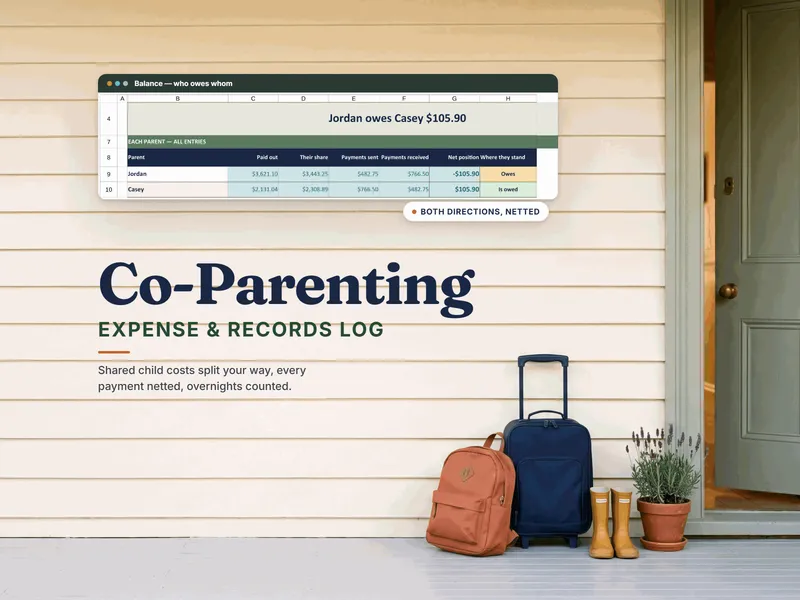
Splitting extraordinary expenses with a co-parent is a records problem before it is a money problem. Each receipt needs its rule written next to it, and every payment needs to land against the right receipt. That bookkeeping is exactly what the Co-Parenting Expense & Records Log does: you log the expense, it applies the split you agreed for that category and child, and it keeps one running figure for who owes whom. The method below works with or without it.
Start from the agreement, not the receipt
Every split starts from the document that created it: the parenting plan, court order or written agreement that names which child-related costs the parents share outside base child support. If you are still working out which of your own costs count, start with what counts as an extraordinary expense, which covers the definition and the common categories. This post covers the part after that: how the money actually gets split, requested and repaid between two homes.
What the rules actually say: two real examples
There is no single rule. The split is set by your own agreement and by the rules where you live. Two published rule sets show the shape most of them share.
Canada. Section 7 of the Federal Child Support Guidelines (opens in new tab) lets a court order a contribution toward a defined list: childcare needed for work, illness, disability or education; the child’s share of health and dental insurance premiums; health-related costs that exceed insurance reimbursement by at least $100 a year; extraordinary primary, secondary and post-secondary education costs; and extraordinary extracurricular activities. The guiding principle, in the regulation’s words, is that “the expense is shared by the spouses in proportion to their respective incomes”, and the court has to take into account subsidies, benefits and tax credits tied to the expense.
Pennsylvania. Pennsylvania Rule of Civil Procedure 1910.16-6 (opens in new tab) allocates additional expenses by each parent’s share of the combined monthly net income. For medical costs it covers “annual unreimbursed medical expenses in excess of $250 per person”, and the parent asking for a share must provide documentation “promptly upon receipt, but not later than March 31st of the year following the calendar year” in which the final bill arrived. A court may decline to allocate an expense if documentation is not provided on time. Childcare costs are reduced by the federal child care tax credit available to the eligible parent, whether or not it is claimed, before they are allocated. The same rule separately covers reasonable private school and summer camp costs, and other reasonable educational, extracurricular and developmental expenses.
| Question | Canada (Federal Guidelines s.7) | Pennsylvania (Rule 1910.16-6) |
|---|---|---|
| How is it split? | In proportion to each parent’s income | By each parent’s share of combined net income |
| Is there a threshold for medical costs? | At least $100 a year beyond insurance | Over $250 per person per year, unreimbursed |
| Do credits and subsidies count? | Yes, they must be taken into account | Yes, for childcare (the federal child care tax credit) |
| Is there a paperwork deadline? | Not set in s.7 | March 31 of the following year for medical costs |
Two lessons are worth checking against your own rules. In both of these rule sets the default is proportional to income, not 50/50. And paperwork has a clock: under at least one rule set, a late receipt can mean no reimbursement at all.
The four decisions behind every extraordinary expense split
In a “you owe me half” text, the arithmetic is the last step, and the easiest one. Every split rests on four decisions, and most disputes come from one of them never having been made.
- Which costs count. Your agreement names categories. A cost outside them is not a shared expense; it is a request, and the other parent can say no.
- The percentage. Often proportional to income, sometimes a flat split, sometimes different per category, and occasionally different for one child. A family can have medical at 60/40, activities at 50/50 and one child’s therapy at 70/30, all at once.
- Consent. Some agreements require the other parent’s agreement before a non-emergency extraordinary expense, often above a set dollar amount. Skipping that step is a common reason a legitimate cost goes unpaid.
- The clock. When the request has to be sent, and when payment is due after it. Some agreements set both; some local rules set the first.
Write all four down once, in one place, and most of the arguments never start. Write down only the percentage, and you will relitigate the other three on every receipt.
How to split an extraordinary expense with a co-parent, step by step
Splitting an extraordinary expense takes seven steps. Once the four decisions are written down, they take a few minutes per receipt.
- Check that the expense is covered. Find the category in your parenting plan, order or written agreement. If the cost does not fall under a category the agreement names, it is not a shared expense yet; it is a request.
- Get consent first if the agreement requires it. If the agreement requires the other parent’s agreement before a non-emergency expense, ask in writing before you pay, with the cost and the date it is due. A text that says “Okay” is a record. A phone call is a memory.
- Pay and keep the paperwork. Keep the receipt or invoice, and for anything medical, the insurer’s explanation of benefits showing what insurance paid.
- Subtract what someone else paid. Take insurance payments, reimbursements and any subsidy or credit tied to the expense off the total before splitting. You split the out-of-pocket cost, not the sticker price. If insurance has not paid yet, wait for the explanation of benefits or mark the request as an estimate.
- Apply the agreed percentage. Multiply the out-of-pocket cost by the other parent’s percentage for that category, or for that child if the agreement sets a per-child split.
- Send one written reimbursement request. Send the expense, the out-of-pocket amount, the rule you applied, the amount requested and a copy of the paperwork, in one message, within any deadline your agreement or local rules set. The full checklist is further down.
- Record the payment against the expense. When money comes back, log it against the specific expense it pays, including partial payments, so the running balance stays true.
Steps 4 and 7 are where hand-kept records drift. Step 4 is skipped when the bill arrives before the insurer pays. Step 7 breaks when a $300 transfer covers parts of two expenses and nobody writes down which.
A worked example: one month, three receipts, one balance
Here is how the method plays out with illustrative numbers. Two parents, Parent A and Parent B, have an agreement (invented for this example) that splits medical costs and childcare 60/40, with Parent A paying 60%, and activities 50/50.
| Expense | Paid by | Total | Insurance paid | Out of pocket | Rule (A share / B share) | Other parent’s share |
|---|---|---|---|---|---|---|
| Orthodontic treatment | B | $4,800 | $1,500 | $3,300 | Medical 60% / 40% | A owes B $1,980 |
| Soccer season fee | A | $380 | $0 | $380 | Activities 50% / 50% | B owes A $190 |
| After-school care | A | $640 | $0 | $640 | Childcare 60% / 40% | B owes A $256 |
Now net it. Parent A owes $1,980. Parent B owes $190 + $256 = $446. The single figure is $1,534, owed by Parent A to Parent B. One transfer settles the month instead of three, and both parents can see where it came from.
Two things the table makes visible:
- Skipping step 4 overstates the claim by $900. Splitting the $4,800 sticker price at 60% asks Parent A for $2,880 instead of $1,980. That is a real dispute, caused by timing rather than bad faith.
- One flat percentage would have been wrong twice. At 50/50 across the board, the orthodontics share drops by $330 and the childcare share rises by $64. A single “split it in half” note cannot hold an agreement that sets different rules per category.
What to put in a reimbursement request
A reimbursement request is the one message that turns a receipt into money owed. Make it complete enough that the other parent can check it without asking a single question back.
- What it was, and which child it was for
- The date it was paid or billed
- The total, what insurance or anyone else paid, and the out-of-pocket amount
- The rule applied: the category and the percentage from your agreement
- The amount you are asking for, in dollars
- Proof: the receipt, invoice or explanation of benefits
- Consent, if it was required: the date the other parent agreed
- When payment is due, if your agreement sets a deadline
Put together, the orthodontics row from the worked example becomes one message. Replace the bracketed items with your own details:
Orthodontic treatment for [child], paid [date]: $4,800 total, insurance paid $1,500, out of pocket $3,300. Medical is split 60/40 under our agreement, so your share is $1,980. Invoice and explanation of benefits attached. Payment is due by [date in our agreement].
Keep the tone flat and the message short. A request that reads like a record gets paid faster than one that reads like a complaint. If you also need to keep the paperwork for years, how long to keep documents covers which records are worth holding onto.
Five mistakes that turn a receipt into an argument
- Splitting before insurance pays. The request goes out on the full bill, the insurer pays three weeks later, and now there is a refund to argue about. Wait for the explanation of benefits, or send the request marked as an estimate.
- Treating payment-app memos as the record. “Soccer + dentist” on a $300 transfer does not say how much went to each. Log every payment against the expense it pays.
- Mixing base support and extras. If routine clothing is covered by base support, a back-to-school haul is not an extraordinary expense unless the agreement says it is. Claiming it anyway costs credibility on the claims that are real.
- Paying first, asking second. If consent is required, a non-emergency expense paid before asking is the one most likely to be refused, however reasonable it was.
- Saving receipts for the end of the year. A shoebox in January is a reconstruction project, and under rules like Pennsylvania’s, a late request can mean no reimbursement at all. Send requests as costs happen, and keep a running balance.
Where to keep the record
Wherever the record lives, it needs the four columns the method depends on: the category, the rule that applied, what was paid out of pocket, and which payment settled it. A group chat holds none of them in a findable way. Whether a co-parenting app or a shared spreadsheet fits your family better is covered in spreadsheet vs co-parenting app.
The Co-Parenting Expense & Records Log is built around those four columns. Each category carries its own percentage, with an optional override per child, and every payment, partial or on account, nets into one line that says who owes whom. It is a one-time purchase for Excel and Google Sheets, with no app account and no renewal. If you want to try the arithmetic first, the free Co-Parenting Shared Expense Ledger handles one agreed split and a running balance.
The same netting logic shows up anywhere two households share one cost. How two families split a nanny share is the childcare version of it, with a payroll on top.
Common Questions About Splitting Extraordinary Expenses
Do I have to pay half of an activity I never agreed to?
It depends on what your agreement says about consent. Some agreements require the other parent’s agreement before a non-emergency extraordinary expense, and a cost that skipped that step is the one most likely to be disputed. If your agreement is silent, the question goes back to the agreement or to whoever can interpret it, not to the group chat.
Is a 50/50 split always fair?
Not necessarily, and neither Canada’s federal guidelines nor Pennsylvania’s rule defaults to it. Canada’s guidelines share these costs in proportion to each parent’s income, and Pennsylvania’s rule shares most of them by each parent’s share of combined net income, so a parent with 60% of the combined income pays 60% of the expense.
Can extraordinary expenses be paid through regular child support?
Sometimes. Some orders fold a predictable extra, such as regular childcare, into the monthly payment, while irregular costs are reimbursed as they happen. Which one applies to you is set by your order or agreement.