Step 1 — Set up a private, secure home for the file first
Before you gather a single statement, decide where the file will live — because during a separation, privacy is safety. Assume that anything on a shared computer, a joint email account, or the family cloud plan can be seen by the other party. So start with a home only you control: a personal cloud account with a new, strong password and two-factor sign-in the other party has never had.
If you shared passwords as a couple, change the ones for your own accounts — email first, then banking — and set account recovery to a phone number and email only you can reach. If you’re still living in the same home, a locked box or a bag you keep with you can be safer than any shelf. This one step makes every step after it safe.
Step 2 — Gather your own copies of the records — early
A separation runs on documents, and access to shared accounts can change fast. So gather your own copies early, while it’s still easy:
- Tax returns — the last three years.
- Pay stubs — recent ones, for both parties if you can.
- Statements — twelve months from every account: bank, credit cards, loans, and retirement.
Save them to your private folder from Step 1. Gathering while you still have easy access means you’re not stuck later if a login changes. The free Separation Document Checklist is exactly this list if you want a printable to work through.
Step 3 — Inventory what you own and what you owe
Now turn the pile into a picture. Make two lists:
- What you own — every asset and account, with an approximate value and who it’s titled to (you, them, or joint). Bank and retirement accounts, investments, real estate, vehicles, business interests.
- What you owe — every debt and balance, and whose name each is in. The mortgage, auto loans, credit cards, student and personal loans.
Together, these two inventories are the financial foundation a mediator or a financial affidavit asks for. A running total of each — the assets you own and the debts you owe — shows where you actually stand, which is hard to see when it’s scattered across accounts.
Step 4 — Build a monthly income-and-expense budget
Next, the monthly reality. Lay out your income and your regular expenses one line at a time — housing, utilities, food, transportation, insurance, childcare, debt payments — and total each. Seeing income against expenses in one place tells you what a month actually costs, and it’s the same budget a financial affidavit asks you to prepare.
This is far easier to build calmly, in advance, than to reconstruct under a filing deadline. An estimate you enter today beats a perfect number you never get to.
Step 5 — Track shared expenses and where your documents live
Two more pieces keep the picture complete:
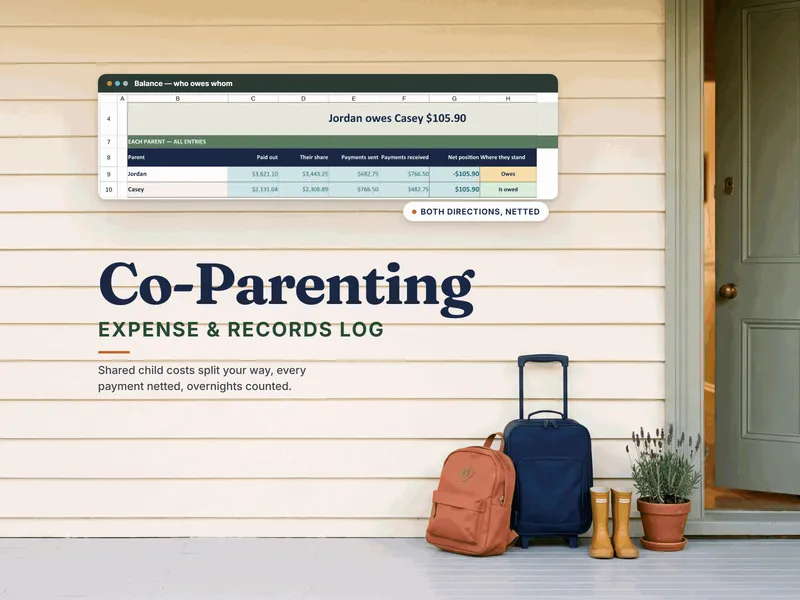
- Shared expenses. When you and the other party split a cost — a child’s medical bill, an activity fee — log who fronted it and each person’s share. A running balance of who owes whom turns a common source of friction into a simple record. If you’ll be sharing children’s costs for years after the separation, the free Co-Parenting Shared Expense Ledger runs that balance at one agreed split, and the Co-Parenting Expense, Schedule & Communication Records Log handles a different split per category or child, partial repayments, and overnights.
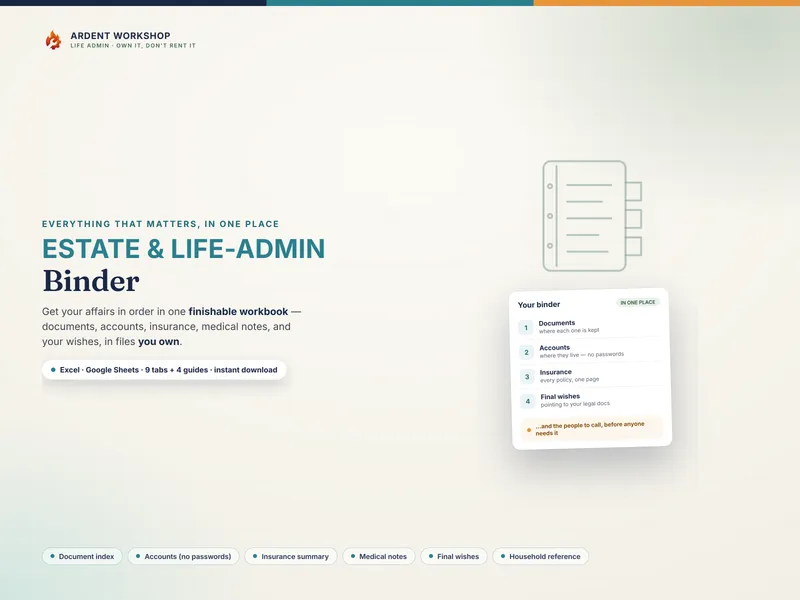
- Where your documents live. Keep an index of each key document, where it is, and whether you’ve gathered your own copy. Record locations, never full account numbers — the index points to the documents; it doesn’t copy their secrets onto the page.
Step 6 — Keep it current and follow the one privacy rule
A separation moves — a balance changes, a payment is made, a schedule shifts. Tie a quick update to something already on your calendar: after each mediation session, attorney call, or month-end, update the numbers and re-date what you confirmed, so you (and your attorney) always know a page can be trusted.
And through all of it, hold the one rule: record the facts and where documents live — never passwords, PINs, or full account numbers — and keep the file in an account only you control. That’s what keeps a complete financial picture both useful to you and closed to everyone you haven’t chosen.
The Divorce / Separation Records Organizer is built to hold all six steps in one private file you own — asset and debt inventories that total themselves, a monthly budget, a shared-bill balance, a documents index, and a co-parenting reference. This is a record-organizing approach, not legal, financial, or tax advice, and not a court form or a substitute for one — rely on your own attorney, mediator, or financial professional for advice and for anything filed with a court.