You know the chart. It goes up on the fridge in the first week of September. Twenty-four squares, one per book, ruled out with a good pen. Everyone signs it.
For about eleven days, it works. There’s competitive shelf-raiding. Someone finishes a graphic novel in a single sitting and colors in a square with real ceremony. You think: this is the year we actually do this.
Then a Tuesday happens — practice runs late, there’s a project due, bedtime collapses — and nobody colors anything in. Then another Tuesday. By mid-October the chart is still on the fridge, still showing eleven good days in September, having quietly turned into a monument to them.
If that’s happened in your house more than once, the problem isn’t your family’s willpower. It’s what the chart was counting.
The short version: minutes are the one unit a household can actually put on a calendar — so a family reading challenge that survives the school year counts minutes read, not books finished.
Why Family Reading Challenges Fall Apart by October
Family reading challenges usually fall apart because of what they count. A finished book is an outcome nobody controls on a school night. Reading time is the one part of it anyone can actually schedule — and it’s the part the chart ignores.
A book is a lumpy unit of measurement. A kid working through a 300-page novel might spend three weeks on it, reading honestly every night, and the chart shows nothing the entire time. Three weeks of real effort, zero feedback. Meanwhile a sibling churning through short graphic novels fills in five squares and looks like the household champion. The chart isn’t measuring reading. It’s measuring book length and reading speed, which are the two things a reader has the least say over.
Then the school year does what the school year does, and reading for pleasure is one of the first things to get squeezed. Zoom out and the trend line is already unmistakable. In 2023, only 14 percent of 13-year-olds said they read for fun almost every day — 13 percentage points lower than in 2012, and the lowest figure recorded in any assessment year (NAEP long-term trend results (opens in new tab)). Adults aren’t modeling much better: Americans aged 15 and older averaged roughly 15 to 16 minutes a day reading for personal interest between 2017 and 2023, down from more than 19 minutes a day in 2013–2015 (National Endowment for the Arts analysis of the American Time Use Survey (opens in new tab)).
Both numbers point the same direction, and the same analysis sets them against a contrast worth sitting with: across 2013 to 2023, Americans watched between 2 hours 40 minutes and 2 hours 51 minutes of TV on any given day (National Endowment for the Arts analysis of the American Time Use Survey (opens in new tab)). The time exists somewhere in the day. It just isn’t landing on reading by default — which makes this a calendar problem, and calendar problems don’t respond to charts.
A Reading Challenge Is a Scheduling Problem, Not a Motivation Problem
A family reading challenge is a shared, time-boxed reading commitment that every person in the household tracks in one visible place. Notice what’s not in that definition: inspiration, discipline, or a prize.
The problem usually isn’t motivation. It’s that nobody has twenty protected minutes, or anything they actually want to read waiting for them when those minutes arrive.
Think about how the rest of the household already works. Nobody sets a “practice piano more” goal — they book a lesson on Thursday at four and everything else routes around it. Nobody sets a “keep the kitchen cleaner” goal that works; they assign the dishes. It’s the same principle behind a family chore system that actually sticks: the thing that survives is the thing with a slot and an owner, not the thing with the most enthusiasm behind it in week one.
A reading challenge is the same kind of object. Treat it like a schedule and it lasts until December. Treat it like a motivational campaign and you get the version above, the one that stalls out somewhere in the second week.
Count Minutes, Not Books
Count minutes. Set one daily minute target for the whole household, and let the tally record the minutes each person actually logged — not a checkmark for the nights they cleared the bar. The target is the line everyone is aiming at; the number in the cell is what really happened. Finished books become the trophy shelf, not the scoreboard.
The difference matters most on the bad weeks, which are the weeks that decide whether a challenge survives:
| Unit | What it actually measures | What happens on a hard week | Best used for |
|---|---|---|---|
| Books finished | Reading speed and book length as much as effort | Reads as zero for weeks at a time, even when everyone read every night | The year-end wrap-up, not the weekly streak |
| Pages | Length only — a graphic-novel page and a chapter-book page aren’t the same thing | Honest, but not comparable between two readers | One reader competing against their own last month |
| Minutes | The time someone chose to spend reading | Shrinks honestly — ten minutes instead of twenty — instead of collapsing to zero | The school-year scoreboard |
| Prompts or bingo squares | Range and variety, not volume | Moves slowly, but low pressure keeps a stalled reader curious | Restarting a reader who’s stuck |
The quiet advantage of minutes is that a bad week still scores. Ten minutes on a Tuesday is a 50 percent day, not a failure, and a household that can post a partial win on its worst night is a household that’s still playing in November.
The advantage of prompts is different: they solve what should I read next, which is often the real bottleneck once a reader is past picture books. A prompt like “a book someone in this house has already read” or “something published before you were born” gives a reader a direction instead of a shelf — and if you need a list to steal from, there’s a whole set of reading challenge prompt ideas to start with.
Use minutes as the scoreboard and prompts as the menu. They’re solving two different problems.
How to Set Up a Family Reading Challenge in One Evening
Setup is one sitting — about 30 minutes at the kitchen table. Do it once, in August or the first week of September, before the school calendar fills in. Landing here mid-year works exactly the same way; pick the next natural stretch instead, since January to spring break has the same shape as September to winter break.
- Pick one number everyone shares. Twenty minutes a day is the default worth starting from. One number for the whole house, from the first-grader to the adult — the reasoning behind twenty is in the questions below.
- Put it on the calendar, not just the fridge. Name the slot: 8:10 to 8:30, after the dishes, before screens come back. A challenge with a time attached survives; a challenge with only a chart attached does not. If the slot collides with a fixed activity two nights a week, move the slot rather than hoping those nights go differently.
- Stock the shelf three deep before day one. Every reader starts with three books waiting. A common way this ends, and one that gets less attention than boredom: a reader finishes something on a Wednesday, has nothing to start on Thursday, and never comes back. If the pile is thin, raid the library list or the summer 2026 books worth reading that nobody got to.
- Decide what counts, out loud, before anyone argues. Audiobooks, graphic novels, re-reads, magazines, the strategy guide for a video game, a parent reading aloud to two kids at once — being read to should count for the readers who need it to. Rule on all of it in one conversation and write the ruling down next to the tally. A mid-season argument is usually a rules argument nobody had in August.
- Track it in one place everyone can see. Draw one row per reader and one column per day, write the minutes in the cell, and total each row at the end of the week. One shared record beats five private logs, because the whole point of a household challenge is that other people can see your row.
That’s the entire build. Five decisions, one evening, and the challenge now has a slot, a supply, a rulebook, and a scoreboard.
What to Do When It Slips (Because It Will)
Most family challenges hit a bad fortnight sooner or later. The ones that survive have a plan for it that isn’t guilt:
- Lower the number, don’t extend the streak. Drop to ten minutes for two weeks and leave the count alone.
- Let a book be abandoned. A reader stuck 60 pages into something they hate isn’t reading — they’re avoiding the challenge. Give everyone a standing right to quit a book, no explanation required.
- Restock before you re-motivate. Resistance that looks like boredom with reading is often boredom with the specific pile. Change the pile first and find out.
- Give it a season, not a year. September through winter break is a finishable stretch with a natural finish line. A twelve-month challenge asks a household to be consistent through the holidays, the flu, and spring sports.
- Add a “read to someone” option. It rescues the youngest reader, the reluctant reader, and the adult who’s too fried to hold a plot at 9 p.m., all in one move.
Keep the Tally Where Everyone Can See It
A shared tally works for the same reason the fridge chart in the opening worked at all — visibility — and it fails for the reason that chart failed: it stopped showing anyone a win they could earn tonight.
So put it where the household already stands still. The side of the fridge, the inside of a cupboard door, a printout on the hall table, or a file someone opens on the kitchen laptop while the dishwasher runs. A week on it should be readable in three seconds: five rows of numbers, a couple of tens among the twenties, nobody at zero for four days running. That’s the whole diagnostic.
If You’d Rather Run It on a Spreadsheet
Keep the visible grid either way — that stays on the fridge or the cupboard door, because it’s the part that does the work. A spreadsheet is the per-reader record behind it: more detail than a wall chart can hold, and the thing you compare at the end of a season.
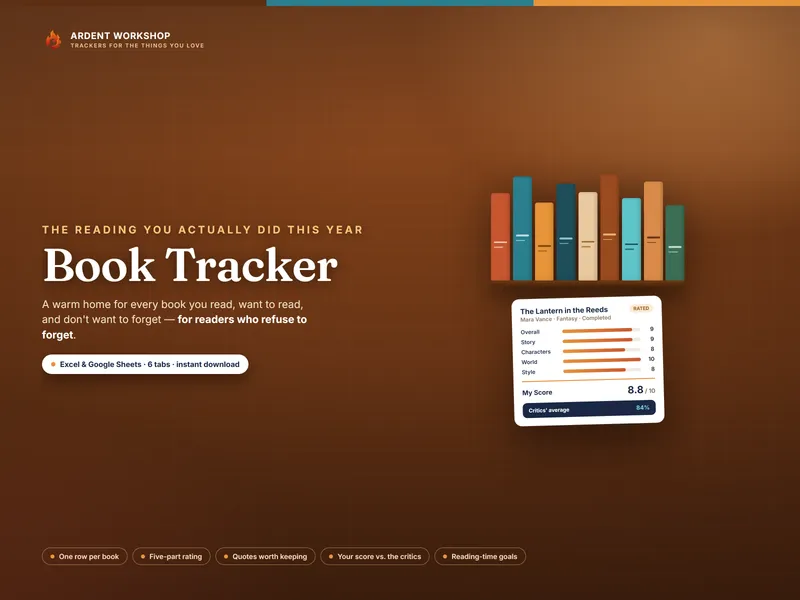
Since this post’s scoreboard is minutes, start with the Book Tracker — its reading journal logs minutes against weekly and monthly goals, alongside a per-book log for the trophy shelf. Then use the Reading Challenge and TBR Tracker as the menu rather than the scoreboard: a to-read queue so nobody hits a Thursday with nothing to start, 30 curated prompts that count themselves as they’re marked done, and a Wrap-Up that turns the season into one screenshot worth showing the kid who thinks they “didn’t read much.”
Two things to know before you buy. Both are built around one reader, so a household runs one copy per person rather than one grid with everyone’s row on it — which is exactly why the wall chart stays. And the free starters below log books, not minutes, so they show you the file shape rather than the method.
Free one-tab versions, no signup:
- Free Book Tracker starter — a reading log, one row per book.
- Free Reading Challenge and TBR starter — a to-read list with a handful of prompts.
Paid or free, they’re ordinary spreadsheet files you keep. No account for a nine-year-old, no subscription that renews in a year you’ve stopped using it, and next September you copy last year’s file and clear it out instead of ruling out a new chart.
Common Questions About Family Reading Challenges
Do Audiobooks Count for a Reading Challenge?
That’s your household’s call, but decide it before the season starts rather than mid-argument. A challenge scored in minutes makes the generous answer easy: an audiobook, a graphic novel, a re-read, and a parent reading aloud to two kids at once are all time spent with a story, so all of them count unless you have a specific reason to rule otherwise.
How Many Minutes a Day Should a Family Reading Challenge Be?
Twenty minutes a day is the default worth starting from, applied to everyone in the house. It sits modestly above the 15 to 16 minutes a day that Americans aged 15 and older averaged reading for personal interest between 2017 and 2023 (National Endowment for the Arts analysis of the American Time Use Survey (opens in new tab)), it’s short enough that a tired eight-year-old can finish it, and it’s small enough that a bad night produces a ten-minute half-score instead of a zero.
What If We Miss a Week of the Reading Challenge?
Lower the number rather than restarting the count. Dropping to ten minutes for two weeks rebuilds the habit, where declaring a broken streak just teaches the household that the tally is a scoreboard for failure. A challenge is meant to survive its bad fortnights, not to be perfect.
The Takeaway
Count what your household can actually control. Books finished are a result — they depend on page counts, reading speed, and how heavy the week was. Minutes read are a decision, made once a night, by each person, and they’re the only unit that still scores something on the evening everything runs late.
Pick a number. Give it a slot. Stock the shelf three deep. Settle the rules out loud. Put the tally somewhere everyone walks past. That’s the whole challenge, and it’s the version that’s still going in December.