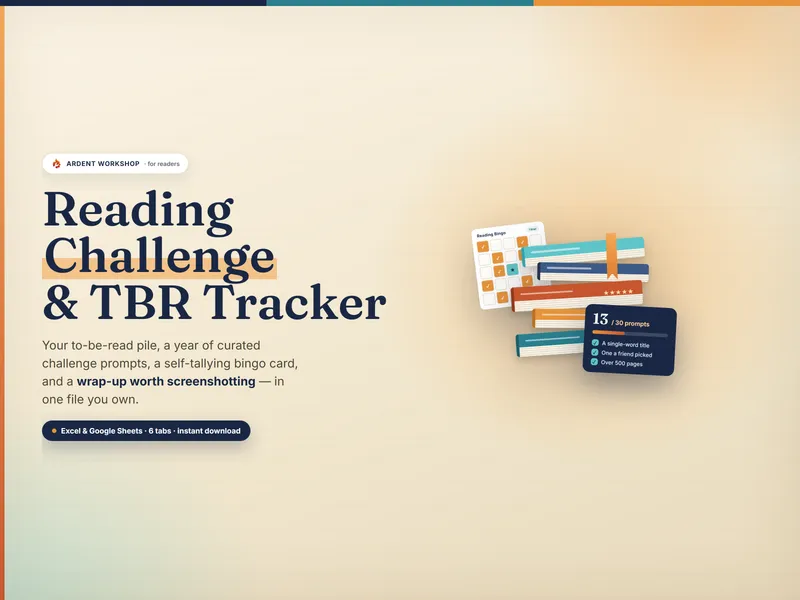
Popular prompts to steal: a book with a single-word title, a book a friend told you to read, a book you bought and never got to, a book from a genre you rarely pick up, a book set somewhere you’ve never been, and a re-read of an old favorite. The full list — 30-plus ideas grouped by theme — is just below.
What is a reading challenge?
A reading challenge is a short list of prompts — small, open-ended descriptions of a book to read — that you fill over a season or a year. Instead of “read 40 books,” a challenge says read a book with a single-word title, a book a friend told you to read, a book you bought and never got to. The point isn’t the number; it’s that the prompts nudge you a little wider than the three authors and one genre you’d default to, and they turn “what should I read next?” into a fun little puzzle.
The best challenges are a mix of easy and stretch: some prompts you can already fill from the pile on your nightstand, and a few that push you somewhere new. And they’re forgiving — you skip what doesn’t fit and never apologize for it.
Reading-challenge prompt ideas, by theme
Steal freely. Pick 12 for a season or 24–30 for a year, mixing across the themes so the challenge stays interesting.
By the book itself
- A book with a single-word title
- A book with a color in the title
- A book over 500 pages
- A book you can finish in a weekend
- A book with a map inside
- A book published this year
- A book published before you were born
- A standalone novel
- A book that’s part of a series
- A book of poetry or a short-story collection
By where it came from
- A book a friend told you to read
- A book recommended by a bookseller or librarian
- A book from a “best of the year” list
- A book you borrowed from the library
- A book you bought and never got to
- A book you chose entirely for its cover
- A book picked at random from your shelf
To stretch your range
- A book by an author you’ve never read
- A book by a debut author
- A book from a genre you rarely pick up
- A book translated from another language
- A book set somewhere you’ve never been
- A nonfiction book on something new to you
- A book with a non-human narrator or point of view
By how it makes you feel
- A book that made you laugh out loud
- A book that made you cry
- A cozy comfort read
- A book you couldn’t put down
- A re-read of an old favorite
- A book that became a movie or show — read before you watch
How to run your own reading challenge
1. Pick a goal that fits your year
Decide how long and how big. A 12-prompt season is a friendly first challenge; a 24-to-30-prompt year is a full one. Choose a size you can actually keep — a challenge you finish beats a heroic one you abandon in March.
2. Choose a mix of easy and stretch prompts
Pick some prompts you can already fill from your shelf and a few that push you wider. That balance is what makes a challenge feel doable on day one and still interesting by December.
3. Read first, match prompts later
Here’s the trick that keeps it fun: don’t hunt for a book to fit a prompt. Read what you want, then look at your list and see which prompt it happens to answer. A single translated 600-page debut you read on a trip might fill four prompts at once — use it where it means the most and save the others.
4. Track your progress as you go
Note the book you read next to each prompt and mark it done. Do that and your progress is a glance, and your finished list quietly becomes your reading record for the year — the thing you’ll actually want to look back on.
5. Skip any prompt that doesn’t fit
Any prompt that doesn’t suit your year gets marked skipped, no guilt. Finishing twenty of thirty is a great reading year. The number is encouragement, not a grade — the goal is a slightly more adventurous shelf, not a scoreboard.
6. Wrap up and share your year
At the end of the season, tally what you read: the books you loved, the prompts you filled, the stack you’re proudest of. That recap — the “here’s my reading year” screenshot — is half the fun of a challenge in the first place.
Try it free, or run the whole year in one file
Want to start without a spreadsheet to build? The free Reading Challenge & TBR Starter is a single tab where you list your stack, tick off finishes, and try five prompts — no signup.
And if you want the whole thing counted for you, the Reading Challenge & TBR Tracker has 30 curated prompts that tally themselves, a 5×5 reading-bingo card, a prioritized to-be-read queue, and a Wrap-Up dashboard built to screenshot — one workbook you own, in Excel or Google Sheets, with no account and no monthly fee. It’s the structure between a blank spreadsheet and a rented reading app: you keep the file for good.