You can memorize every ranking on the internet and still finish seventh. The draft is not a test of who read the most; it is a room of other people making predictable mistakes in a predictable order, and the manager who knows which mistake is coming next gets a free round of value every time.
The eight types of fantasy football managers are the Spreadsheet Sicko, the Trade Shark, the Commissioner Who Also Plays, the Sentimentalist, the Waiver Wire Insomniac, the Homer, the Vibes Drafter, and the Ghost — and each one has a draft-day pattern you can price in before the first pick.
Fantasy football is not a small hobby. The Fantasy Sports & Gaming Association reports that 62.5 million people played fantasy sports across the USA and Canada in 2022 (opens in new tab). Home leagues are typically ten or twelve teams, which means the types below aren’t a thought experiment — you’ll recognize most of them from your own league, and you already know which of your friends is which.
This is a scouting report on the people, not the players.
The 8 Types of Fantasy Football Managers at a Glance
| Type | How to spot them | On draft day | How to beat them |
|---|---|---|---|
| 1. The Spreadsheet Sicko | Explains their tiers if you make eye contact | Drafts strictly by their own tiers | Buy the players their model likes and the group chat mocks |
| 2. The Trade Shark | Offers arrive before the draft ends | Hoards depth to sell later | Make every offer wait an hour before you answer |
| 3. The Commissioner Who Also Plays | Answers rules questions mid-pick | Distracted early, sharp late | Ask for the ruling before it benefits anyone |
| 4. The Sentimentalist | Still mentions a 2023 title | Keeps and reaches for old favorites | Sell them the aging name, buy the boring one |
| 5. The Waiver Wire Insomniac | Knows when waivers process, to the minute | Drafts thin, plans to churn | Draft the handcuffs they’ll need in October |
| 6. The Homer | Team colors in the profile picture | Reaches early for their own team, every year | Let them reach, then take the player they skipped |
| 7. The Vibes Drafter | Asks “is he good?” about a top-five pick | Autodrafts by name recognition | Never tilt when they beat you anyway |
| 8. The Ghost | Slow to join the group chat | Autopicks, then stops setting lineups | Ratify an abandoned-team clause in August |
Two questions sort all eight: how much homework does this person do, and does their damage land on your matchup or on the whole league?
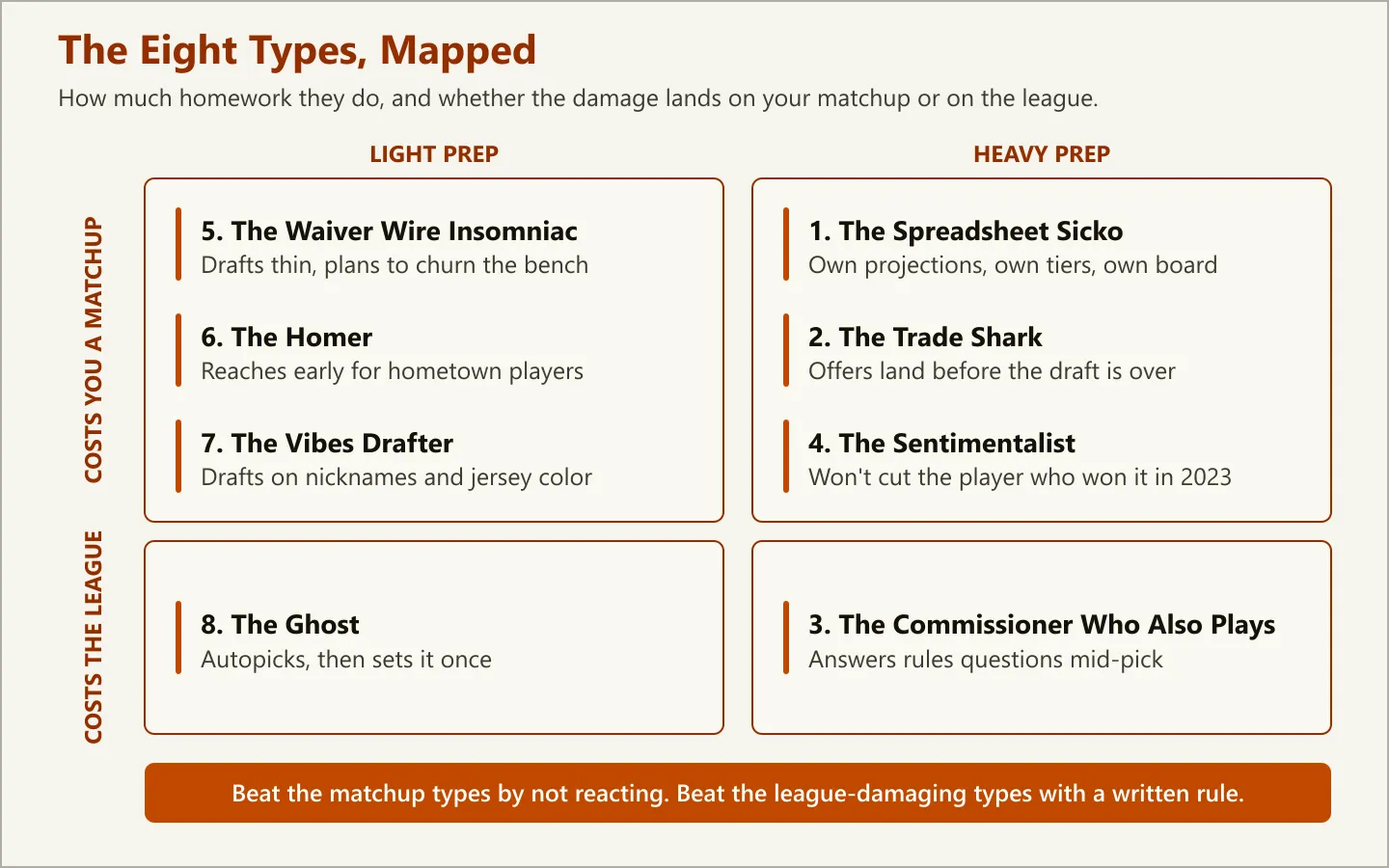
Six of the eight cost you a matchup and nothing more. Under light prep: the Waiver Wire Insomniac, the Homer, and the Vibes Drafter. Under heavy prep: the Spreadsheet Sicko, the Trade Shark, and the Sentimentalist. All six are beaten the same way — by refusing to react to them. Sometimes that means a trade, sometimes it means the pick you take because they didn’t, and sometimes it just means not tilting.
The other two cost the league itself. The Ghost does it with light prep and the Commissioner Who Also Plays does it with heavy prep, and neither is beaten by a better roster alone. The damage that matters is structural, so the only counter to that half is a rule everyone agreed to before the season started.
1. The Spreadsheet Sicko
Verdict: the most dangerous fantasy manager in your league, and the easiest to trade with.
- How to spot them: They have opinions about scoring settings. They noticed the half-point-per-reception change before you announced it. Somewhere there is a workbook with a projections tab, a tiers tab, and a value-over-replacement column they will explain if you make eye contact.
- What they do on draft day: They draft their board, not the room. When a name falls past their tier break, they take it instantly and look pleased.
- How to beat them: Their board is their strength and their leash. A model gives a player one number; a league gives that player a reputation. Buy the players their model likes and the group chat mocks — the Sicko will happily trade you one, because to them it is a fair-value swap and to everyone else it looks like you got robbed. Wait a week. It ages well.
Underrated detail: the Sicko is usually the fairest trade partner in the league, because they are negotiating against a number instead of against you.
2. The Trade Shark
Verdict: the fantasy manager who is not actually cheating, and that is exactly the problem.
- How to spot them: The first offer lands before the draft is over. By week two you have received four. Two are insulting, one is confusing, and one is genuinely good, which is how the pattern works.
- What they do on draft day: They draft surplus on purpose — an extra running back, a second tight end — because their real strategy is the trade market, not the roster.
- How to beat them: Slow down and make the league’s process do the work. Never accept a trade in the first hour it arrives; volume pressure is the entire technique. Then check that your league has an actual veto method written down — a commissioner veto, a league vote with a stated threshold, or no veto at all except for collusion — three of the five methods leagues commonly pick from. Any of them works. Having none is what turns a shark into a league-ending argument.
The Shark is also the type most likely to expose that your league has no rules, only customs. When the first genuinely lopsided trade lands in week six, “we’ve always just kind of handled it” is not a rule.
3. The Commissioner Who Also Plays
Verdict: the fantasy manager whose conflict of interest everyone tolerates until the week it matters.
- How to spot them: They are answering a scoring-settings question while on the clock. They also created the league, collect the dues, and are the only person who knows the payout split.
- What they do on draft day: Distracted for the first four rounds, then noticeably sharp in the middle rounds once the admin questions stop.
- How to beat them: Two moves, both legal and both polite. First, take advantage of the early distraction — the commissioner is the manager most likely to let a tier break pass in rounds two and three. Second, and far more valuable: ask for the rules interpretation you’ll need before it is worth anything to anybody. A ruling requested in August is a fair ruling. The same ruling requested in week 13 is a fight.
This is not a character flaw. It is a structural problem with commissioners playing in their own leagues, and it is solved with paper rather than trust. A league that has decided in advance what the commissioner may not decide alone — vetoes involving their own team, rulings on their own trades, payout adjustments — never has to relitigate it in December. That, along with a fill-in constitution, the dues-to-payout arithmetic, and 24 common disputes worked through with the reasoning shown, is what the Fantasy League Commissioner Kit exists to hand a commissioner before the season, not during it.
4. The Sentimentalist
Verdict: the fantasy manager who stays loyal to players who stopped deserving it two seasons ago.
- How to spot them: They can tell you the exact week in 2023 that won them the title, and they still have that player. In a keeper league, they have kept him twice — and the only homework they do is on the players they already own.
- What they do on draft day: They reach for their guys, they refuse to draft the players who once beat them, and they will not take an obvious value if it means cutting a name they like.
- How to beat them: Sell the past to them and buy the present from them. The Sentimentalist systematically overpays for the aging version of a player they remember at his peak, and underrates a younger player with a boring name. Offer that swap straight up. It is not a trick; you are both buying what you actually want.
Editorial aside, and a genuine one: the Sentimentalist is usually the reason the league still exists ten years in. Beat them on the field. Do not talk them out of it.
5. The Waiver Wire Insomniac
Verdict: the fantasy manager who wins the week and loses the season.
- How to spot them: They know when waivers process to the minute. Their roster on Wednesday looks nothing like it did on Sunday.
- What they do on draft day: They draft thin on purpose — starters plus lottery tickets, no depth — because their plan is to rebuild the bench every Tuesday.
- How to beat them: Draft the handcuffs and the boring depth they skipped. The Insomniac’s plan works right up until two of their starters are hurt in the same week and the wire is empty because everyone else just claimed it. Their whole strategy assumes the market stays liquid in October. It rarely does.
Counter-move for the trade market, too: they are the most eager buyer in the league for any player who just had one loud week, and the cheapest seller of anyone who had a quiet one. That is a repeatable edge, not a one-time trick.
6. The Homer
Verdict: the fantasy manager who drafts their hometown team, predictably enough to plan around.
- How to spot them: Team colors somewhere in the profile. Home-team jersey on draft night. Genuinely believes their team’s third receiver is a breakout candidate, every single year.
- What they do on draft day: They reach one to two rounds early for players from one team, and they refuse to draft the division rival entirely.
- How to beat them: This is the most exploitable pattern in a home league, because it is knowable in advance. Write down, before the draft, the three or four players the Homer will reach for. Then simply do not compete for those names — and take note of the good player who slides because the Homer spent a pick on sentiment. In a twelve-team league, two Homers reaching early is two chances that a player you rated higher slides toward your pick.
The counterintuitive part: never point this out during the draft. A Homer who realizes they are being read starts drafting normally, and you lose a free edge that renews every August.
7. The Vibes Drafter
Verdict: the fantasy manager most likely to embarrass everyone by winning.
- How to spot them: They ask, sincerely, whether a top-five pick is any good. They drafted a player last year because they liked the nickname. They will finish either first or twelfth, and there is no way to know which.
- What they do on draft day: Name recognition, jersey color, a tip from a coworker, and whatever the autodraft queue suggests when they step away.
- How to beat them: Mechanically, they are easy — they take name-brand players a round late and skip positional scarcity entirely, so the value they leave is real. Psychologically, they are the hardest matchup in the league, because when they beat you in week 9 with a lineup assembled by feel, the temptation to make a panicked trade is enormous. The counter is not tactical. It is refusing to change a good process because of one bad week.
Every league needs a Vibes Drafter. They are proof that the whole enterprise is a game, and they keep the group chat honest about how much of this is luck.
8. The Ghost
Verdict: the only fantasy manager on this list who damages the league rather than just losing.
- How to spot them: Slow to join the group chat. Slow to pay dues. Missing on draft night with an apology text that arrives during round four.
- What they do on draft day: They autopick, which is fine. Then they set that lineup once, which is not — because by week six they are starting players on a bye, and by week ten their opponents are getting free wins that decide who makes the playoffs.
- How to beat them: You do not beat a Ghost. You prevent one, and only in advance. A league needs an abandoned-team clause agreed before the season: what counts as abandonment, how many weeks of an illegal or bye-week lineup triggers it, who takes over the roster, and what happens to the dues. Ratify it in August and it is housekeeping. Propose it in week nine, when everyone can already see whose playoff odds it changes, and it is a fight the league may not survive.
If it helps: this is one of the quieter ways a ten-year league stops re-forming. Not drama, not a bad trade — a season where two teams stopped setting lineups and the championship felt unearned.
The One Thing That Beats All Eight Types
Look back at the counters and you’ll notice several of them are not fantasy football advice at all. Sell the Sentimentalist an aging name; that is strategy. Write down who can undo a trade and what happens when someone walks away from their team; that is governance, and it is the part a home league most easily ends up running on vibes and a group chat.
A league constitution is simply the set of decisions your league will otherwise make in the worst possible moment — mid-argument, with money and a playoff spot on the table, and with the person who benefits doing the deciding. Written in August it costs an hour. Written in December it costs the league.
The five clauses worth settling before the draft, in rough order of how much damage they do when missing — and if you want the long version, we have a walkthrough on how to write a fantasy league constitution:
- The abandoned team. What triggers it, who takes over, what happens to the dues.
- What the commissioner may not decide alone. Anything involving their own roster, plus schedule and payout changes.
- The veto method. A commissioner veto, a league vote with a stated threshold, a committee of uninvolved managers, or no veto at all except for collusion. Any of them works; having none does not.
- What counts as collusion — as opposed to a trade you merely dislike. These are different things, and leagues that never separated them tend to veto the second one.
- How the rules get changed. A stated majority, a stated deadline, and a rule that changes take effect next season.
Money deserves the same treatment. Dues, deadline, and the exact payout split belong in writing before anyone has drafted a team they love — and if the league is one of several hobbies quietly drawing on the same budget, it’s worth a look at how to track what a hobby actually costs you across a year.
That is the whole reason we built the Fantasy League Commissioner Kit as printable, fillable paperwork rather than an app: a fill-in constitution with those clauses, a wall draft board with the snake direction already printed, a dues-and-payout ledger with the payout arithmetic already computed for eight common league-size-and-dues combinations, a precedent log so this year’s ruling settles next year’s argument, and a rulings library covering 24 disputes every league eventually has — each with the two or three defensible ways to call it and what that call commits you to next time. It is sport-neutral, it has no player names in it, and it does not expire when your platform changes its interface. You own it; you are not renting it.
Draft night itself is the easy part — and if you’re hosting, it’s a party with a guest list, a food order, and a schedule like any other, which is what the Party Planner handles when you’d rather spend the evening drafting than counting chairs. The same goes for the rest of the season: our take on watch party etiquette applies almost perfectly to a room of people watching four games at once.
Which One Are You?
Go back to the table and map above and find the type you’d admit you are. If it is one of the six that only cost you a matchup, the branch depends on your prep. Heavy prep — the Spreadsheet Sicko, the Trade Shark — and your leak usually isn’t the draft; it is the in-season decisions you make between Tuesday and Sunday. Light prep — the Homer, the Vibes Drafter — and your leak is the opposite: you’re probably leaving value on the board in rounds three through eight and making it up on luck. Two of the six break that pattern, and their own sections say how: the Sentimentalist’s leak really is the draft, and the Waiver Wire Insomniac’s is October depth.
If the type you’d admit to is one of the two that cost the league itself, neither of those is your problem. The Ghost and the playing commissioner are governance problems, not roster problems, and no amount of draft prep fixes the structural half — which is why a whole step of the checklist below is about paper.
Either way, the honest upgrade is not another projection source — it is checking whether your process is any good. Writing down what you expect before the season and grading it afterward is what a decision journal and outcome tracker is for: it scores the reasoning the day you commit, then measures how overconfident you turned out to be once the results are in.
Your Pre-Draft Hour
Before your draft, do these four things. They take about an hour combined:
- Name the rest of the league. Write out every other manager and assign each a type from the table above. Most will be obvious.
- List the reaches. For each Homer and Sentimentalist, write the two or three specific players they will take early. Do not compete for those names.
- Settle the five rules. The abandoned team, what the commissioner cannot decide alone, the veto method, what counts as collusion, and how the rules get changed. Get a yes in the group chat and paste it somewhere permanent.
- Set the money terms in writing. Dues amount, deadline, and the exact payout split, before anyone has drafted a team they love.
Where to start: the five rules in step three. Everything else on this list wins you a game. Those win you a league that still exists in five years.