Here’s what you’ll have in five minutes: a simple rule for every item on your dorm list, sorted into buy now, buy there, or skip — so you don’t arrive with a car full of stuff that won’t fit, or a room with nowhere to sit.
Dorm shopping goes wrong in one of two directions. Either you panic-buy everything in July and show up with three storage bins for a room the size of a parking space, or you buy nothing and spend your first week paying gas-station prices for a trash can. Back-to-college spending has climbed to as much as $94 billion in a single year, averaging well over $1,300 per shopper (National Retail Federation (opens in new tab)) — and a big chunk of that is dorm gear bought in a hurry. A two-minute triage fixes it.
The Three Buckets
The whole system is three questions. Run every item through them before you spend a dollar.
- Buy now — you need it night one, it’s sized or personal to you, or it’s genuinely cheaper at home. Pack it in the car.
- Buy there — it’s bulky, heavy, a consumable, or something your roommate might also bring. Get it near campus or order it for store pickup after you arrive.
- Skip (for now) — it’s banned by housing, aspirational, or something you can wait to buy until you actually need it.
That’s it. The hard part is just being honest about which bucket each thing belongs in.
The 5-Minute Triage Table
Here’s how the most common dorm items sort out. Use it as a starting point, then add your own.
| Item | Bucket | Why |
|---|---|---|
| Twin XL sheets & mattress topper | Buy now | Dorm beds are extra-long twin — you need them night one, and they’re personal |
| Your pillow & a good blanket | Buy now | Sized to you, cheaper at home, and you’ll sleep better |
| Shower caddy & flip-flops | Buy now | Day-one shared-bathroom essential, and tiny to pack |
| Surge-protected power strip | Buy now | Outlets are scarce — just confirm it meets the housing rules |
| Mini fridge & microwave | Buy there | Bulky and usually shared with a roommate — coordinate first |
| Storage bins & bed risers | Buy there | Buy after you’ve measured the actual room |
| Fan, rug, full-length mirror | Buy there | Heavy, awkward, and cheap at any store near campus |
| Detergent, toiletries, snacks | Buy there | Consumables — no reason to haul a semester’s supply |
| Printer | Skip (for now) | Campus printing is cheaper; buy only if you confirm you need one |
| Candles, halogen lamps, hot plates | Skip | Almost always banned — check the prohibited-items list |
| Full cookware set & iron | Skip (for now) | Most first-years never touch them; wait until you do |
The pattern: bulky and shared goes in the “there” pile, personal and day-one goes in the car, and everything aspirational waits.
What the Triage Actually Saves You
The buckets sound obvious until you see what skipping them costs. Below is the same shopping list run two ways — once by a family who bought everything in July, once after a ten-minute triage and one text to the roommate.
These are placeholder prices, not quotes. Swap in whatever your store charges; the point is the shape of the gap, not the totals.
| Item | Bought in July, untriaged | After triage | Difference |
|---|---|---|---|
| Mini fridge | Both roommates bring one — $130 × 2 = $260 | One fridge, cost split — $65 each | −$195 |
| Microwave | Two arrive — $70 × 2 = $140 | One, split — $35 each | −$105 |
| Storage bins | 5 bins bought blind — $60 | 2 bins that fit under the actual bed — $24 | −$36 |
| Printer | Bought “just in case” — $90 | Skipped; used campus printing | −$90 |
| Cookware set + iron | Bought — $75 | Skipped until needed | −$75 |
| Halogen lamp | Bought, banned, past the return window — $35 | Never bought | −$35 |
| Total on these six lines | $660 | $124 | −$536 |
Nothing on that list is an extravagance. Every line is a reasonable thing a first-year might need. The savings come entirely from sequence — measuring before buying, texting before duplicating, and checking the rules before paying.
Notice where the money actually leaks. It isn’t the price of any single item. It’s the duplicates (one fridge became two), the guesses (five bins for a room you’ve never seen), and the returns you didn’t make in time. All three are triage failures, not budget failures.
4 Quick Checks Before You Spend
Run these once, up front. They prevent the most expensive dorm-shopping mistakes.
- Pull up your housing’s prohibited-items list. Every school bans something — candles, extension cords, certain appliances. Buying a banned item is a guaranteed return trip.
- Text your roommate. One fridge, one microwave, one rug, one TV. Decide who brings what before either of you buys a duplicate.
- Confirm the bed size. It’s almost always Twin XL, not regular twin. Standard sheets won’t fit, and that’s the single most common day-one scramble.
- Set a number. Pick a dorm budget before you walk into a store — it’s the difference between $200 and $600 on the same list.
When the Three Buckets Get Complicated
The triage covers most people. A few situations bend it, and it’s worth knowing which one you’re in before you start filling a cart.
- You’re flying, not driving. Your buy now column shrinks to whatever survives a checked bag: sheets, pillow (vacuum-bagged), toiletries, chargers, a week of clothes. Everything else — including things that would normally be “buy now” — moves to buy there or gets shipped to arrive after you do. Order for in-store pickup near campus rather than shipping to the dorm mailroom during the one week it’s buried in packages.
- Your roommate assignment lands late. Some schools don’t pair people until August. Build a solo-safe list: buy nothing from the shared category (fridge, microwave, rug, TV) until you have a name and a phone number. If the assignment never comes in time, buy the shared items there, after move-in — that’s what bucket two is for.
- Suite-style bathroom instead of a communal hall bath. The shower caddy and flip-flops drop from day-one essential to optional. Check your housing assignment’s bathroom type before you buy the caddy, not after.
- You’re an international student. Plug shape and voltage make buy there the default for anything with a cord. Ship or carry only what’s personal and sized to you.
- Early move-in — athletes, band, orientation staff. You arrive before the stores near campus get restocked and before your roommate does. Push a few items back into buy now, especially bedding and a fan, and accept that you’ll be shopping alone.
- Hand-me-downs from a sibling. Confirm the bed size at their school versus yours before you inherit sheets. Twin XL is common but not universal, and a set that fit one dorm may not fit yours.
Common Dorm Shopping Questions
When should I actually start shopping?
Start the list as soon as your housing assignment posts, because that’s when you learn the bed size, the bathroom type, and the prohibited-items rules. Start buying only after you’ve texted your roommate. The list is free; the buying is where the mistakes get expensive.
Should I buy a mini fridge or rent one?
Many schools partner with a rental service that delivers a fridge (often bundled with a microwave) to your room before move-in. It’s usually more expensive than buying over four years and cheaper over one — so the honest answer depends on whether you’ll want it again next year and whether you have somewhere to store it over the summer. If you’re not sure, renting year one is the reversible choice.
Twin XL or regular twin?
Twin XL — an extra-long twin, five inches longer than a standard twin. It’s the near-universal dorm bed size, and standard twin sheets will not stay on it. Confirm on your housing page anyway; a handful of schools use full beds in certain halls, and finding out at 9 p.m. on move-in day is the worst possible time.
My roommate and I both bought the same thing. Now what?
Return whichever one is still in the box, today, before the return window closes. That window is short and move-in week is chaotic — this is the single most common way a duplicate turns into a permanent expense. If neither can go back, one of you takes it home at Thanksgiving rather than living around it all semester.
Is a printer really not worth it?
For most first-years, campus printing costs less than ink over a semester and takes up none of your desk. Buy one only after you’ve hit a real friction point — a lab that requires physical handouts, a printing allowance you blow through by October. That’s the 48-hour rule applied to a whole semester.
Bonus Level: The 48-Hour Rule
For anything not on your buy now list, wait until 48 hours after move-in. Once you’ve seen the actual room, met your roommate, and walked the dorm, half the things you “needed” turn out to be clutter — and the things you genuinely missed become obvious. The room tells you what it needs better than any checklist can.
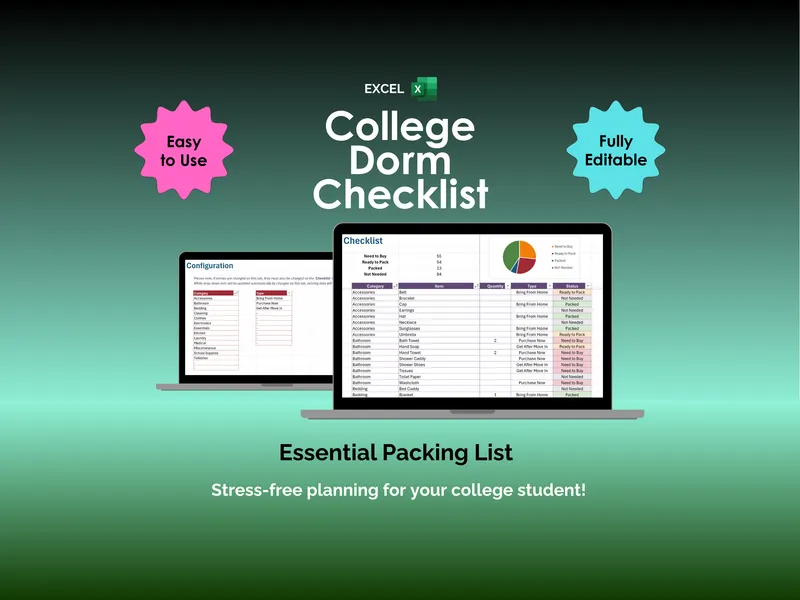
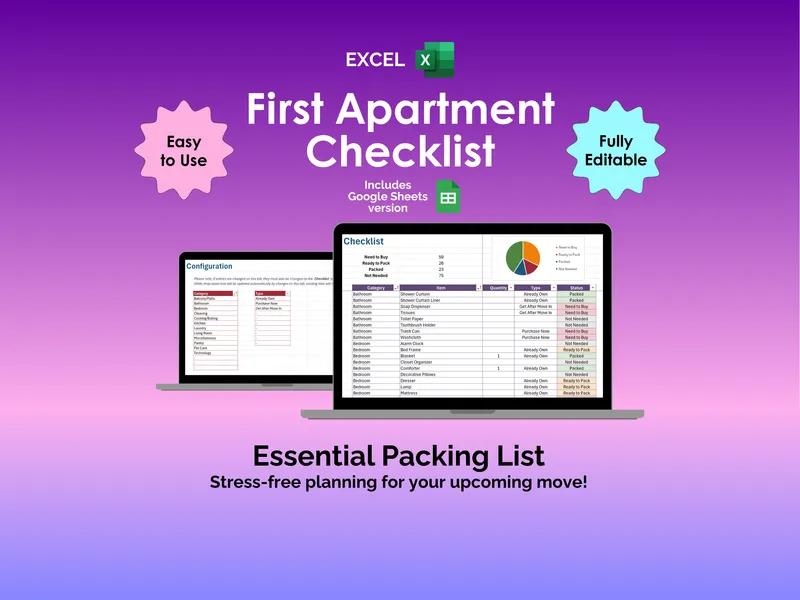
If you want the full version of that day-one list — pre-sorted, roommate-coordinated, and budgeted — the College Dorm Checklist does the triage for you and tracks what’s bought versus still needed. Moving into an off-campus apartment instead? The First Apartment Checklist covers the bigger-ticket version of the same decisions. And to keep the spending from quietly creeping past your number, a simple Bill Tracker makes the dorm budget real instead of a vague intention.
For the bigger picture before you go, see our guide to your first year of college life and what a year of college actually costs in 2026.
The takeaway: sort before you shop. Buy now what’s personal and needed day one, buy there what’s bulky or shared, and skip what’s aspirational — and you’ll spend less, pack lighter, and walk into a room that actually fits everything you brought.