Where the grading scale comes from
Record grading is a convention, not a regulation. Collectors, shops, and mail-order dealers have used broadly the same ladder of grades for decades, and Goldmine — the record-collecting magazine and its long-running line of price guides — is what turned it into the common language of the hobby, by printing the same definitions in front of the same buyers year after year. It publishes that grading guide free on goldminemag.com. There is no licensing body, no certificate, and no authority that can overrule a seller's opinion of their own record. The scale works because everybody uses the same words, not because anybody enforces them.
Two consequences follow, and both matter more than the definitions themselves. First, grading is done by eye — a seller inspects the record under a bright light and forms a judgment. Second, grades are opinions, and opinions vary. A cautious dealer's VG+ can be a generous seller's NM. Where a photograph is available, look at it; where a return policy is available, read it.
The grades, from best to worst
The ladder has six rungs in common use, and a couple of variants you will see quoted alongside them:
- Mint (M). Absolutely perfect — never played, no flaw of any kind. Careful sellers use it sparingly, and many will not use it at all for a record that has left its shrink wrap.
- Near Mint (NM or M−). The practical top of the scale, and the grade printed price guides quote against. The disc looks unplayed and glossy, the labels are clean and unmarked by spindle scuffs or writing, and the sleeve is sharp with no ring wear or seam splits.
- Very Good Plus (VG+), sometimes written EX. Played, and it shows — a few light marks that do not affect the sound, faint sleeve wear at the corners or the seams. This is what a well-cared-for record from a good home actually looks like.
- Very Good (VG). Obvious surface noise in quiet passages, visible scuffs, a sleeve with real wear — ring wear, a small seam split, maybe a name on the back. It plays through without skipping, which is the line VG holds.
- Good (G) and Good Plus (G+). A confusing pair of names: in record grading, "Good" is not good. The record plays all the way through without skipping, but with steady surface noise, and the sleeve may be split, taped, or heavily worn. A filler copy to hold the slot until a better one turns up.
- Poor (P) and Fair (F). Cracked, warped past playing, badly scratched, or with a sleeve barely holding together. Bought for the art, the rarity, or nothing at all.
You will also see Still Sealed (SS) — a record never opened, still in its factory shrink wrap. Sellers quote it alongside the grades, but it is really a description rather than one of them — nobody can grade what nobody has seen, and shrink wrap can be and is reapplied. A sealed record is worth what a buyer and a seller agree it is worth, and the sensible ones account for the risk.
Media and sleeve are graded separately
A record is two things a buyer cares about — the disc and the cover — and they wear out independently. A disc kept in an inner sleeve and played on a good deck can be near-mint inside a jacket that spent thirty years pressed against a radiator. So grades are quoted as a pair, media first: VG+/VG means a Very Good Plus record in a Very Good sleeve.
When a listing quotes only one grade, it is usually the media — but not always, which is exactly why the convention exists. Ask.
How grading decides the price
The reason collectors argue about grades is that the money moves with them, and it moves steeply. Prices are quoted for a Near Mint copy and stepped down from there: as a rule of thumb, a Very Good Plus copy is worth roughly half of near-mint, a Very Good copy roughly a quarter, a Good or Good Plus copy a small fraction of it, and a Poor or Fair copy close to nothing. Mint is the deliberate exception — Goldmine's guide declines to set a percentage for it at all, and says it is best negotiated between buyer and seller.
Treat every one of those figures as a rule of thumb rather than a published price list. Different guides and different dealers quote slightly different steps, and no percentage survives contact with a record somebody badly wants. The shape is the part worth keeping: two grades down from near mint is not a small discount, it is most of the value. A record you would happily pay $80 for in near-mint condition is, at VG, around a $20 record — and paying $80 for it is not a slightly bad deal, it is a fourfold overpayment.
How to grade a record yourself
- Use a bright, raking light. Tilt the disc against the light rather than looking straight down at it. Hairlines and scuffs only show at an angle.
- Grade from the worst feature, not the best. One deep scratch sets the grade, however clean the rest of the side is. This single habit is what separates a trusted seller from a disputed one.
- Grade the sleeve on its own terms. Ring wear, seam splits, corner bumps, writing, price stickers, and water staining — each pushes the sleeve grade down independently of the disc.
- Play-grade when it matters. A mark you can see is not always a mark you can hear, and a mark you cannot see sometimes is. For anything valuable, the honest grade is the one you heard.
- When in doubt, grade down. A buyer who receives a record better than described comes back. One who receives it worse does not.
What the runout groove tells you
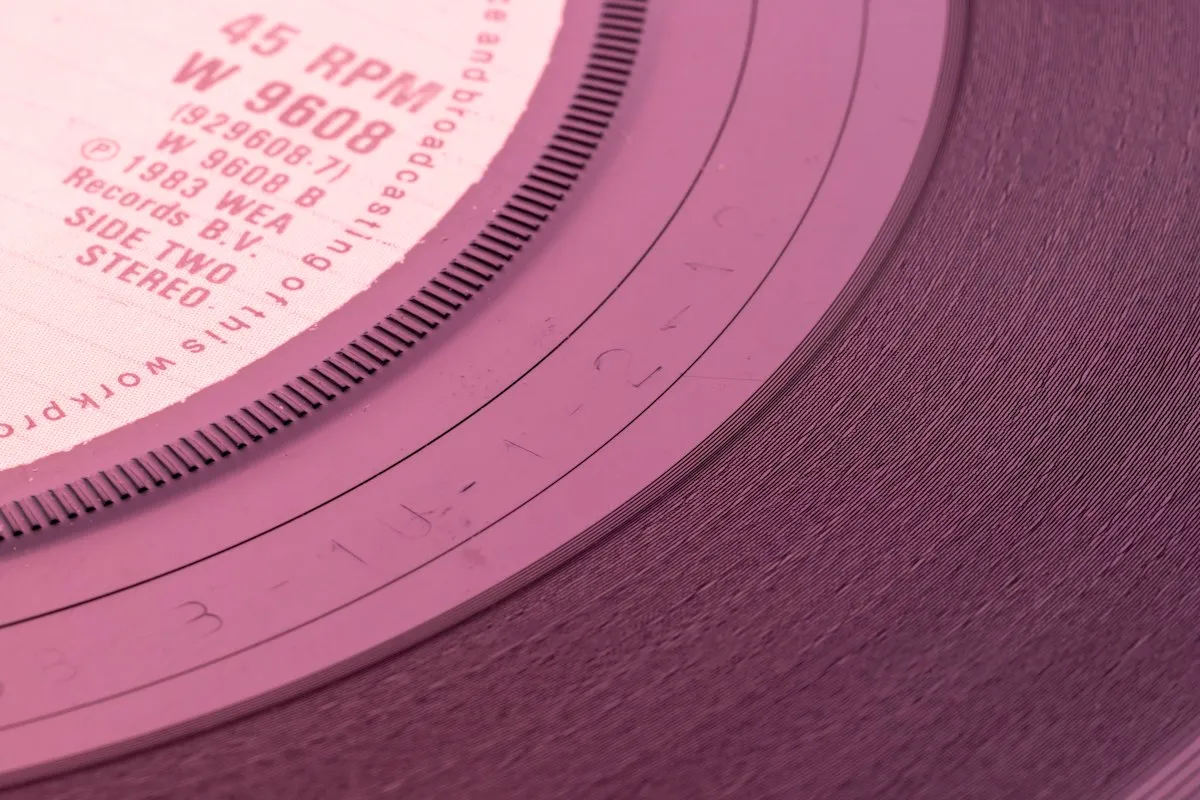
Condition is only half of what sets a record's value; which pressing you are holding is the other half. The runout groove — the blank band of vinyl between the last track and the label — carries a stamped or etched matrix number, and often initials, symbols, or a plant code. Together with the catalog number on the label and the sleeve, that is how collectors tell a first pressing from a reissue that looks identical across the room. It is worth checking before you grade, because a near-mint reissue and a near-mint original are not the same record and not the same money.
Why collectors track condition, not just titles
A list of what you own tells you whether to buy a record. A list of what you own and the condition it is in tells you what your shelf is worth, which copies are worth upgrading, and whether the one in the crate in front of you is a bargain or a trap. The fields that make that work are few:
- Media grade and sleeve grade — separately, because they move separately.
- A near-mint reference value — what you believe a clean copy is worth, which is the number every other figure steps down from.
- Pressing and variant — first pressing, reissue, colored vinyl, and the catalog number that proves which.
- What you paid and where — so a gain or loss is a fact rather than a feeling.
The free vinyl collection starter is one tab that gets the habit going — a row per record with a Have or Want flag — and the full Vinyl & Music Collection Tracker adds the part this page is about: separate media and sleeve grades, an editable multiplier table, a grade-adjusted value per record, and a wantlist that turns an asking price into a verdict against a ceiling you set before you were standing over the crate.
Neither is an appraisal or a price guide. Both do arithmetic on the numbers you type in, using multipliers you can change — which is the honest way to price a shelf you know better than any database does. And the method is the workbook's own: it multiplies a media factor by a sleeve factor, and the sleeve factors, along with its sealed and mint premiums, are its own starting point rather than part of the collector convention above. Every one of them is an ordinary cell you can change.
Related templates and concepts
To track the listening rather than the objects, see the Music Tracker, or the Concert & Live-Show Log for the gigs. Collecting more than records? Browse the full Trackers catalog, or start with what a media backlog is.
Templates that implement this
Grade your shelf, and price it
4 templates
Catalog what you own at the condition it is actually in — and see what that condition is worth on your own numbers.
- $6.95 Spreadsheet
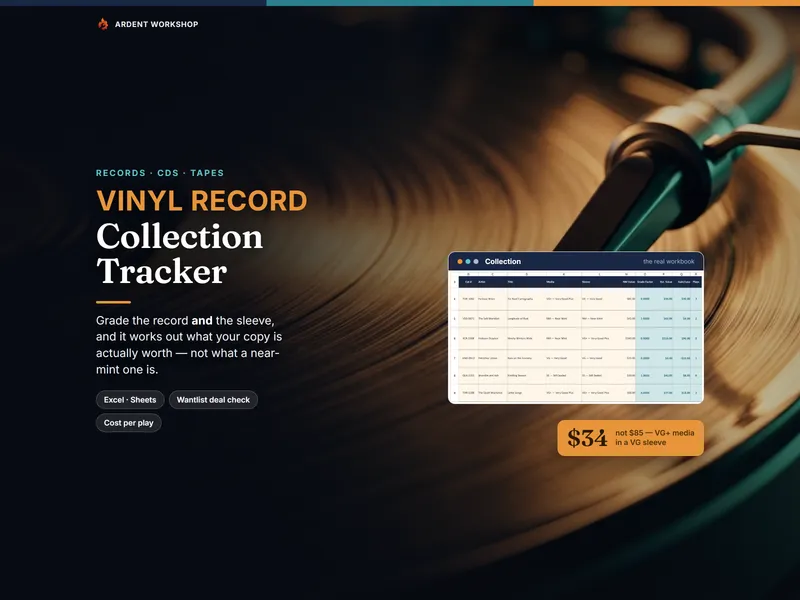
Vinyl & Music Collection Tracker - Condition Grading, Wantlist Deal Check (Excel + Sheets)
A vinyl record collection tracker for Excel and Google Sheets. Grade media and sleeve separately for a real value, and price any copy against your ceiling.
TrackersView details - $5.95 Excel

Music Tracker - Excel
It's Friday night and a new Beyonce album just dropped — this excel music tracker captures the moment in an album listening spreadsheet with 11 tabs for everything you hear.
TrackersView details - $5.95 Spreadsheet

Concert & Live-Show Log — Track Every Concert, Setlist, Wishlist & Spending (Excel + Google Sheets)
A concert tracker for Excel & Google Sheets — log every show's date, venue, setlist, and cost, rate the night, and see your whole live-music year.
TrackersView details - $6.95 Spreadsheet

Set Collection & Build Tracker for LEGO® Sets — Excel & Google Sheets
A LEGO set collection tracker for Excel & Google Sheets — catalog every set, compute cost per piece and gain/loss, and count what's still sealed.
TrackersView details