You know the card. It sits in a top-loader, in a box on a high shelf, and every time you look at it you think the same thing: that one’s a ten.
Here is the hard truth. Since 2018, roughly 90% of ultra-modern sports cards and modern trading card games have graded PSA 8 or higher, according to PSA’s published breakdown of how its grades are distributed (opens in new tab). An 8 is not a trophy. On a modern card, an 8 is the middle of the pack.
And the flaw most likely to cap your card was decided by a cutting machine in a factory, years before anyone opened the pack.
The trading card grading scale is a 1-to-10 condition rating assigned by a third-party company that inspects a card, seals it in a tamper-evident holder, and prints the number on the label. Ten is the top. It is less a report card on how carefully you stored something than a description of how one piece of cardboard came off one press — which is why learning it properly pays. Once you can read it, you can look at a card and call its grade within about a point, and decide whether it is worth sending at all. (For what grading is as a service — who the companies are, what you get back — start with our explainer on what card grading is.)
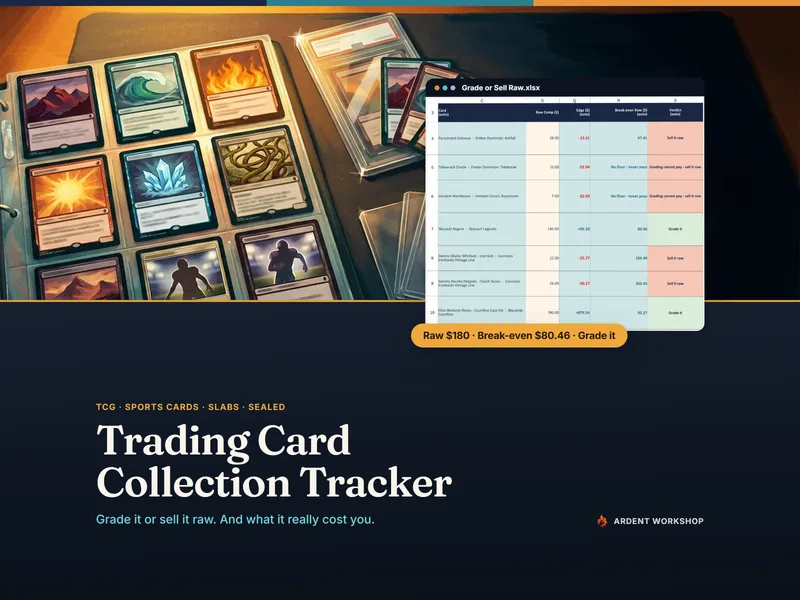
That decision is a records problem before it is a grading problem. You cannot tell which cards clear the fee if you do not know what you own, what you paid for it, and what it is worth raw today. The Trading Card Game & Sports Card Collection Tracker exists to build exactly that shortlist. The method below works on a legal pad too, so here it is either way.
What the trading card grading scale actually is
The trading card grading scale runs from 1 to 10, and it rates condition and nothing else. It is not an appraisal: the number says nothing about how rare or wanted a card is, only about its physical condition measured against the day it was printed. A common card can be a 10 and a famous one a 2.
Every major grader — Professional Sports Authenticator (PSA), Beckett Grading Services (BGS) and Certified Guaranty Company (CGC) Cards — judges the same four things:
- Centering — how evenly the image sits inside the borders
- Corners — sharpness, fraying, rounding, dings
- Edges — chipping, roughness, notching, layering
- Surface — print spots, scratches, gloss, creases, staining
Two things follow from that list, and both catch people out.
- Three of the four are wear. One is manufacturing. Corners, edges and surface record what happened to the card after it left the factory. Centering records what happened inside it. You can protect the first three. You can do nothing at all about the fourth.
- The weakest category tends to dominate. A card is rarely graded better than its worst leg, so three immaculate categories do not rescue one bad one. Beckett describes the overall grade as an accumulation of the four characteristics rather than an average of them.
All three companies also issue half grades, with one exception worth knowing: PSA adds a half point inside every number from 1 to 10 except 9.5, its 2008 half-grade announcement explains (opens in new tab), on the reasoning that Mint 9 and Gem Mint 10 already sit next to each other. To earn the half point, PSA says a card generally needs centering five to ten percentage points better than the tolerance for its grade.
A grade is not a verdict on how well you kept the card. It is mostly a verdict on how well the printer cut it.
What each grade means, 10 down to 1
Here is PSA’s own description of what each number permits, condensed. Read it as a ladder of allowances: each rung down adds one more thing the card is allowed to have wrong with it.
| Grade | What the card is allowed to have |
|---|---|
| 10 | Virtually perfect. Four perfectly sharp corners, sharp focus, full original gloss, free of staining. Centering within roughly 55/45 on the front and 75/25 on the reverse. |
| 9 | Nearly perfect, with exactly one minor flaw — a minor printing imperfection, or very slight off-centering. |
| 8 | May pass for a 9 at a glance. The slightest fraying on one or two corners, a minor printing imperfection, or very slightly off-center. |
| 7 | Surface wear such as minor fraying, or a small printing blemish. May be off-centered. |
| 6 | More visible surface wear or a printing defect that does not spoil the appeal: more visible fraying, rounding of corners, or a light scratch. |
| 5 | Minor rounding of the corners, more visible surface wear or printing defects. |
| 4 | More visible surface wear, or several light scratches. May be more noticeably off-center. |
| 3 | Apparent surface wear and rounded corners. Borders may be yellowed or discolored, and creasing may show. |
| 2 | Obvious surface wear, accelerated rounding, chipping, several creases, or more apparent off-centering. |
| 1 | Major creasing, missing pieces, extreme discoloration, noticeable warping or other destructive defects. |
Two footnotes on the bottom of that ladder. PSA split (opens in new tab) the old single 1 into Poor 1 and Fair 1.5, which matters more than it sounds — on a genuinely scarce vintage card, half a point at the bottom of the scale is real money. And a low grade is not automatically a reason not to grade: PSA notes that any card can be worth grading regardless of condition, on rarity, scarcity or sentiment alone.
The distribution is where the reality check lives. PSA’s published grade-distribution figures (opens in new tab) put roughly 90% of ultra-modern sports cards (2017 onward) and modern trading card games (2003 onward) at 8 or better, roughly 80% of modern sports cards (1986–2016) at 8 or better, and roughly 80% of vintage trading card game cards (pre-2003) at 7 or better. PSA describes these percentages as approximate and grades each card on its own merits rather than against the population.
Read that as a bar, not a comfort. On a modern card, an 8 is where the crowd is. On a pre-2003 trading card game card, an 8 is genuinely above average. The cohorts are not interchangeable: a 1986–2002 sports card falls inside PSA’s modern-sport band instead, where an 8 is the edge of the top four-fifths rather than a distinction.
Gem Mint means 10 at one company and 9.5 at another
This is the most expensive misunderstanding in the hobby, and it is a vocabulary problem rather than a grading one. The three big companies use overlapping names on different numbers.
| Grade | PSA | BGS (Beckett) | CGC Cards |
|---|---|---|---|
| 10 | Gem Mint | Pristine | Pristine and Gem Mint (two separate tens) |
| 9.5 | — | Gem Mint | Mint+ |
| 9 | Mint | Mint | Mint |
| 8 | NM-MT | Near Mint/Mint | NM/Mint |
| 7 | NM | Near Mint | Near Mint |
| 6 | EX-MT | Excellent Mint | Ex/NM |
| 5 | EX | Excellent | Excellent |
| 4 | VG-EX | Very Good/Excellent | VG/Ex |
| 3 | VG | Very Good | Very Good |
| 2 | Good | Good | Good |
| 1.5 | Fair | unnamed | Fair |
| 1 | Poor | Poor | Poor |
Below 9 the three ladders agree almost completely: Near Mint is a 7 everywhere, Very Good a 3, Poor a 1. All of the divergence sits at the top of the scale — which is exactly where the money is.
So Gem Mint is a 10 at PSA, a 10 at CGC, and a 9.5 at Beckett. And CGC issues two different tens: a Pristine 10 and a Gem Mint 10 on its published grading scale (opens in new tab), where Pristine is reserved for cards that are flawless under 10x magnification with 50/50 centering, and Gem Mint 10 is a card that scored a 10 overall but missed Pristine on one criterion.
The practical consequence: never buy or sell on the word. Buy on the company plus the number. A listing that says only “Gem Mint” has told you almost nothing.
Centering is the grade you cannot fix
Centering is written as a ratio — 55/45, 60/40, 70/30 — describing how the border space splits from one side of the card to the other. 50/50 is dead center. 60/40 means one border is half again as wide as the one opposite it. The ratio is measured separately for the front and the back, and the front is the one that usually does the damage.
Here is why it deserves its own section: it is the only one of the four criteria that was already decided before the card reached you. Beckett’s published grading scale (opens in new tab) makes the ladder unusually explicit.
| BGS grade | Front centering must be |
|---|---|
| Pristine 10 | 50/50 all around |
| Gem Mint 9.5 | 50/50 one way, 55/45 the other |
| Mint 9 | 55/45 both ways |
| Near Mint/Mint 8 | 60/40 both ways or better |
| Near Mint 7 | 65/35 both ways or better |
| Excellent Mint 6 | 70/30 both ways or better |
| Excellent 5 | 75/25 both ways or better |
| Very Good/Excellent 4 | 80/20 both ways or better |
| Very Good 3 | 85/15 both ways or better |
| Good 2 | 90/10 both ways or better |
| Poor 1 | 100/0, or cut so far off that the image runs past the edge |
Line that up with PSA, which allows a Gem Mint 10 up to roughly 55/45 on the front and 75/25 on the reverse (opens in new tab), and with CGC (opens in new tab), whose Mint 9 requires 60/40 on the front and 90/10 on the back for sports and non-sports cards. The companies differ at the margins, but the shape is identical: centering degrades in fixed steps. Both reserve a narrow eye-appeal variance at the grader’s discretion — PSA says so explicitly, and Beckett calls its scale general guidelines rather than rules — but that is a margin, not a way back.
There is a second manufacturing defect on the same list worth learning to spot. Diamond cutting is a card cut slightly out of square, so the borders taper from one end to the other. Beckett (opens in new tab) tolerates very slight diamond cutting at 7, slight at 6 and 5, moderate at 4 and 3, noticeable at 2, and heavy only at 1. Like centering, it happened at the factory, and like centering it caps you.
The takeaway for a shortlist is blunt. Check centering first, with a ruler, before you check anything else. A card with perfect corners and 70/30 centering is a 6 at Beckett no matter how carefully you stored it, and no amount of hoping changes that. It is also the fastest way to cut a submission pile in half.
Subgrades: what a single number hides
Beckett prints one number plus four subgrades — centering, corners, edges and surface — on every label, so a buyer can see which category held the card back. A PSA label carries the single number.
That transparency creates the hobby’s most famous tier. A BGS card that earns 10 in all four subgrades gets a special black label (opens in new tab), announced by Beckett in 2014, instead of the standard one. Beckett restricts it to modern cards; it is not available on the vintage Beckett Vintage Grading (BVG) scale for 1980 and older. A Pristine 10 with three 10s and one 9.5 is still a Pristine 10 — but it is not a black label, and the two do not trade alike.
Which to choose is a real trade-off rather than a right answer:
- Subgrades help a strong card. If the card is excellent in every category, four visible 10s prove it in a way a bare number cannot.
- Subgrades hurt a lopsided card. If centering is the weak leg, a printed 7 beside three 9.5s tells every future buyer exactly where the card is compromised.
What happens when a card comes back with no number at all
Some submissions return in a sleeve with a code instead of a grade, and this is the outcome most likely to cost you money for nothing. PSA publishes nine no-grade reasons (opens in new tab):
- N1 — Evidence of trimming. An edge that appears cut: hooked, unusually sharp for the issue, off-tone, or wavy.
- N2 — Evidence of restoration. Paper stock built up, such as ripped corners rebuilt to look new.
- N3 — Evidence of recoloration. Color artificially improved.
- N4 — Questionable authenticity. The card appears counterfeit, or an autograph is judged not genuine.
- N5 — Altered stock. Paper restoration, crease or wrinkle pressing, scratch removal, enhanced gloss, or a foreign substance applied to the surface.
- N6 — Minimum size requirement. The card is significantly undersized against factory specifications.
- N7 — Evidence of cleaning. Whitener used on borders, or a solution used to remove wax, candy, gum or tobacco stains.
- N8 — Miscut. The factory cut is abnormal for the issue, so the card’s edges deviate from their intended appearance.
- N9 — Don’t Grade. PSA does not grade, or cannot encapsulate, the issue at all — oversized cards, or an obscure issue.
Notice what is not on that list. Damage does not stop a card being graded — a creased, rounded, stained card still receives a 1. Alteration does, because the grade is a statement about an original card. PSA states plainly that it will not grade cards showing evidence of trimming, recoloring, restoration, tampering, or questionable authenticity.
And the part that stings: for most of those codes you are charged the grading fee anyway. PSA notes the applicable fee still applies for the trimming, restoration, recoloration, altered-stock and cleaning codes, and for questionable authenticity in every case. Three are fee-free: the minimum-size and miscut codes — and then only if the card is not afterwards encapsulated as Authentic — plus N9, where PSA will not encapsulate the issue at all. Several of the alteration codes can instead be encapsulated as “Authentic Altered” if you asked for that as your minimum grade on the submission form.
There is a smaller version of the same trap. PSA also applies qualifiers — a card with writing, ink or pencil marks, or the impression left by writing, is designated MK for Marks. A qualified grade is a real grade, but it does not trade like an unqualified one.
The three questions to answer before you pay a grading fee
Grading is a paid service with a per-card cost, published in tiers against the card’s declared value, and the break-even arithmetic behind it is set out in our explainer on what card grading is. (PSA’s trading card grading service levels (opens in new tab) are published this way). The fee is only part of the outlay: add shipping in both directions, insurance, and supplies.
So run three questions, in this order, and stop at the first no.
- What is the card worth raw? Look up completed sales — actual sold prices for the same year, manufacturer, set, player or character, card number and parallel, over the last three to six months. Not asking prices.
- What grade will it realistically get? Measure centering first. Then be honest about the corners under a bright light. Assume the middle of the distribution rather than the top: on a modern card, that means an 8 or a 9.
- What is the spread? Find completed sales at the grade you actually expect. The spread that matters is the graded price at your realistic grade minus the raw price, and it has to beat the fee, both shipping legs and the insurance combined.
Here is how the arithmetic runs, with illustrative numbers rather than real market prices:
That shape is the whole problem with grading mid-value modern cards. The premium is concentrated at the top of the scale, and the grades are concentrated one or two rungs below it. Which is why the honest answer for most cards in most boxes is: don’t.
Three cases where the answer flips to yes:
- The card is genuinely scarce. Vintage, low print run, or a key rookie. Here even a 3 or a 4 has a real market, and authentication carries value independent of condition.
- You are selling, not keeping. A slab travels better, settles condition disputes before they start, and is easier to price.
- The centering is exceptional. If you measured 50/50 and the corners hold up, you are looking at the one card in the box where the top grade is actually live.
If you are working through a shelf rather than a single card, the sequence is catalog, then measure, then shortlist. Our guide to cataloging a collection you’ve been building for years covers the first step, and if the exercise turns into a clear-out, downsizing a collection covers what to do with everything that does not make the shortlist.
Common questions about card grades
What is a good grade for a trading card?
For a card printed in the last twenty years, a good grade is a 9 or better. Since 2018, roughly 90% of ultra-modern sports cards and modern trading card games have graded PSA 8 or higher, so an 8 on a modern card is the middle of the distribution rather than the top of it. For a pre-2003 trading card game card the bar drops: about 80% of those grade PSA 7 or higher, which makes an 8 genuinely above average and a 9 scarce.
Does a 10 from one company equal a 10 from another?
No, and the labels actively mislead. CGC issues two different tens — a Pristine 10 and a Gem Mint 10 — and reserves Pristine for cards that are flawless under 10x magnification with 50/50 centering. Beckett puts Pristine at 10 and Gem Mint at 9.5. PSA’s Gem Mint is a 10. So a card described only as Gem Mint could be a BGS 9.5 or a PSA 10, and a Pristine 10 from CGC is a stricter card than a Gem Mint 10 from the same company.
Why did my card come back without a number?
PSA publishes nine no-grade codes, and the reasons are mostly alteration rather than damage: evidence of trimming, restoration, recoloration, questionable authenticity, altered stock, a card below the minimum size, evidence of cleaning, miscut cards, and a catch-all for issues PSA will not encapsulate at all. Damage does not stop a card being graded — a creased, rounded, stained card still gets a 1. Alteration does, because a grade is a statement about an original card.
What grade should I assume when I run the numbers?
Assume the middle of the distribution rather than the top. On a modern card that means an 8 or a 9, because roughly 90% of ultra-modern sports cards and modern trading card games grade PSA 8 or higher, while the large premiums sit at 10 — the outcome you are least likely to get. Running the arithmetic on the grade you hope for rather than the grade you will probably receive is the most common way a submission loses money.
Which cards in your box are actually worth grading
The grading scale rewards knowing your own collection more than it rewards hoping. The cards worth sending are the ones where you already know the raw price, the realistic grade and the spread — and that is a records question you can answer in an afternoon, for free, before spending a cent on fees.
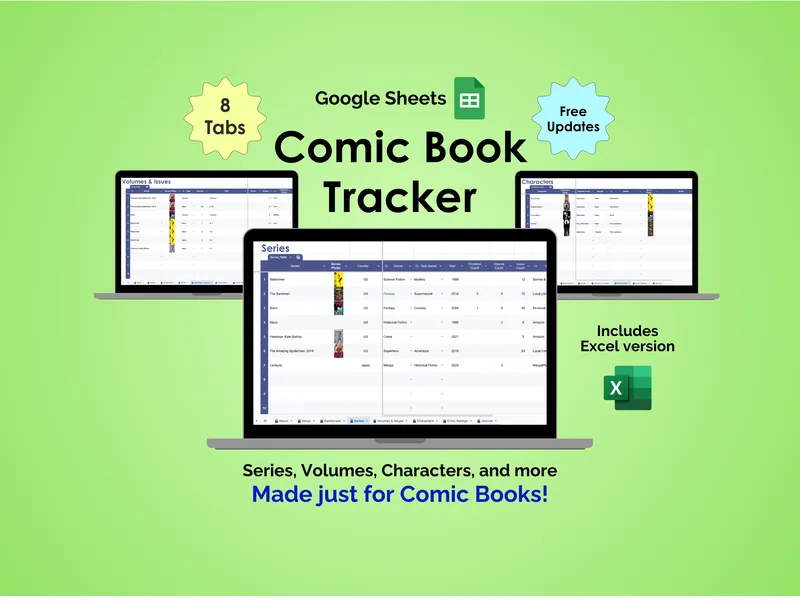
Work the shelf, not the shoebox. Measure centering with a ruler, write down what each card is worth raw, and let the shortlist be short. The Trading Card Game & Sports Card Collection Tracker keeps that record for a whole collection — condition notes, what you paid, current value, and a grading shortlist in one file you own outright rather than rent by the month. Collectors working in other categories can do the same with the Comic Book Tracker for Google Sheets or the Sneaker Collection Tracker, where third-party grading follows the same logic on its own vocabulary — see sneaker condition grading and record grading.
The card in the top-loader might be a ten. Now you can check before you pay to find out.
Sources
- PSA — Getting Started With Grading (opens in new tab), for the 10-point scale, the description of each grade, and the distribution of grades issued since 2018
- PSA — Grading Standards (opens in new tab), for the Gem Mint 10 definition and centering tolerance, the N1–N9 no-grade codes, the ungradable-card policy, and the MK qualifier
- PSA — Introducing PSA Half Grades (opens in new tab), for how half grades work and the 9.5 exception
- Beckett — Grading Scale (opens in new tab), for the BGS grade names and per-grade centering tolerances
- Beckett — Introducing BGS Black (opens in new tab), for the black label’s four-subgrade requirement
- CGC Cards — Grading Scale (opens in new tab), for the Pristine 10 and Gem Mint 10 distinction and the CGC grade names
- PSA — Trading Card Grading Services (opens in new tab), for how grading is priced in tiers against declared value