It is the second Saturday in March. There is a bank export open on one monitor with 214 rows on it, a shoebox of receipts that did not survive the summer, and a text thread with a plumber that is now the only surviving record of what he fixed in August. Somewhere in there is a duplex that made money last year, and the job is to prove it.
So you start inventing categories. “Repairs” for anything involving a tool. “Misc property” for anything you cannot place. “Home Depot” becomes a category, because at 11pm it feels like one.
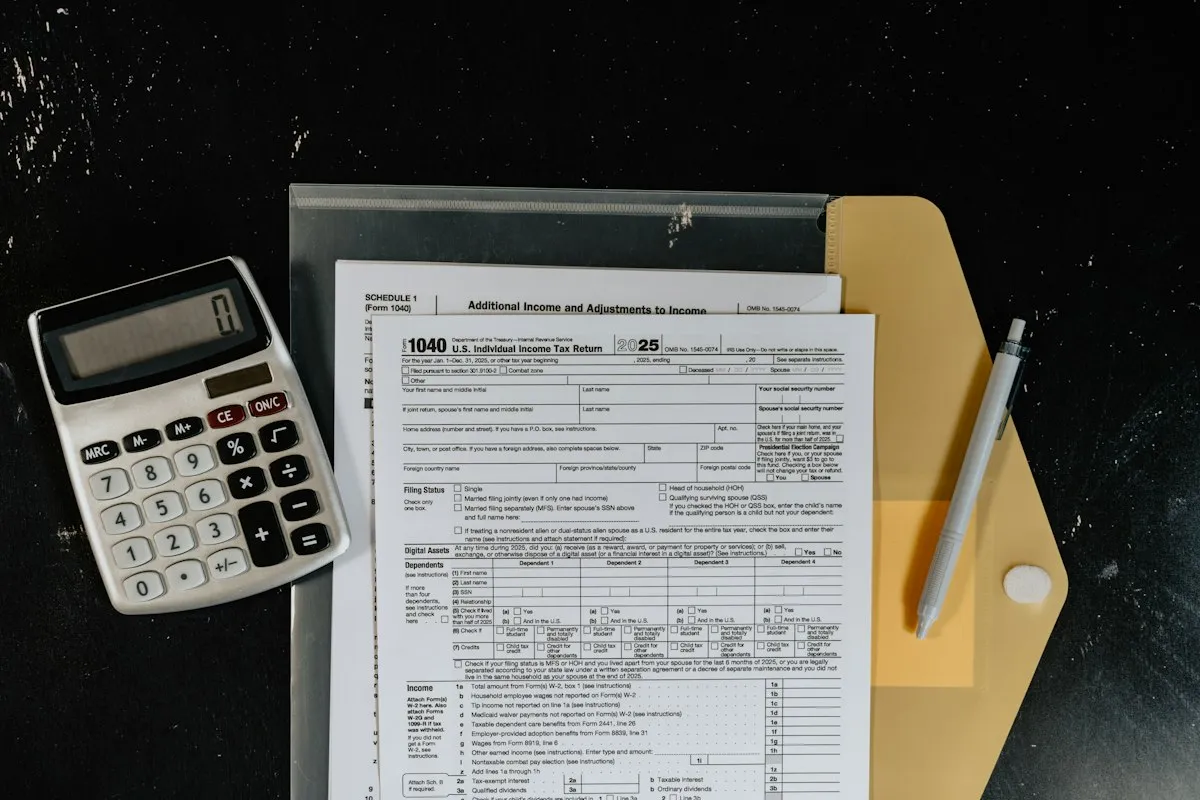
Here is what is actually happening in that moment, and it is worth naming: you are not doing your taxes. You are doing a year of bookkeeping, badly, from the worst source data you will ever have. And the categories you are inventing at 11pm already exist. They have existed all year. They are printed on the form — fifteen of them, on the 2025 Schedule E (opens in new tab), the IRS form where landlords report rental income and expenses.
That is the reframe this whole post rests on. Schedule E is not a thing you fill in at the end of the year. It is a chart of accounts — a fixed, published list of the buckets the government expects your money to fall into — and it was available to you in January. A landlord who tags every cost to a Schedule E line as it happens does not have a March problem. They have a March read. That is the entire design idea behind the Small-Landlord Income & Expense Workbook, which tags every expense by Schedule E category all year and rolls it into a year-end summary — but the method matters more than the tool, so here is the method either way.
Schedule E is a chart of accounts that happens to be a tax form
This post is about Part I of Schedule E — the part small landlords live in, and the part that decides which line each dollar lands on. If you want the short version of what Schedule E is first, the glossary entry covers the definition. Part I has a simple three-part shape:
- Lines 3 and 4: what came in. Rents received, and royalties received.
- Lines 5 through 19: what went out. Fifteen expense lines, named and numbered.
- Lines 20 through 26: the arithmetic. Total the expenses, subtract them from the rents, apply the loss limitations, and carry the result to your return.
Everything hard about Schedule E lives in the middle. The arithmetic is subtraction. The judgment is which of the fifteen buckets a given dollar belongs in — and, for two of those buckets, whether it belongs in this year at all.
The form also asks something people skim past: on line 2, the number of fair rental days and personal use days for each property. That is not a formality. If your personal use of a dwelling unit exceeds the greater of 14 days or 10% of the days it was rented at a fair rental price, IRS Publication 527 (opens in new tab) treats the unit as used as a home, and the deduction rules change. For a straightforward long-term rental, personal use days are zero and this never comes up. For a place you also stay in, it is the first question to settle, before any of what follows.
The fifteen Schedule E expense lines, and what belongs on each
This is the list, with line numbers as printed on the 2025 Schedule E (Form 1040). Read the fourth column too — a common pattern here is not a missing receipt but a correct receipt filed to the wrong line.
| Line | What the form calls it | What belongs there | Where it commonly goes wrong |
|---|---|---|---|
| 5 | Advertising | Listing fees, photography for the listing, a yard sign, paid tenant-screening ads | Swept into line 19 because it feels like a small one-off |
| 6 | Auto and travel | Trips to the property for showings, inspections, repairs, and rent collection | Never claimed at all, because nobody logged the mileage |
| 7 | Cleaning and maintenance | Turnover cleans, lawn care, snow removal, pest control, gutter clearing | Merged into line 14, which hides what routine upkeep actually costs |
| 8 | Commissions | A one-time leasing commission paid to place a tenant | Merged into line 11 |
| 9 | Insurance | The landlord or dwelling policy, plus liability coverage on the property | Missed when the premium is paid out of escrow inside the mortgage payment |
| 10 | Legal and other professional fees | Eviction filings, lease review, bookkeeping, the portion of tax prep attributable to the rental | Padded with personal tax-prep or legal costs that are not the property’s |
| 11 | Management fees | The recurring percentage a property manager takes | Merged into line 8 |
| 12 | Mortgage interest paid to banks, etc. | The interest portion only, as reported on your Form 1098 | The whole mortgage payment. See below — this is the big one |
| 13 | Other interest | Interest on property borrowing that is not a bank mortgage — seller financing, a card used only for property costs | Lumped into line 12 |
| 14 | Repairs | Returning something broken to ordinary working condition | Filled with improvements that legally belong on line 18 |
| 15 | Supplies | Filters, bulbs, batteries, cleaning supplies, small consumable tools | Merged into line 14 |
| 16 | Taxes | Property tax, plus any local rental or occupancy tax | Missed when property tax is paid out of escrow |
| 17 | Utilities | The utilities you pay: water, sewer, trash, a common-area meter | Netted against tenant reimbursements instead of reported gross |
| 18 | Depreciation expense or depletion | The annual recovery of the building’s cost, plus every capitalized improvement | Skipped entirely — which costs twice, as the line 18 section below explains |
| 19 | Other (list) | Genuine leftovers: HOA dues, bank fees on the property account, landlord software | Becomes a dumping ground, which is a bookkeeping failure, not a tax one |
Two of those fifteen — line 12 and the line 14 / line 18 pair — are where the largest dollar amounts are at stake. They are worth their own sections.
Why your mortgage payment does not go on line 12
Only the interest portion of a mortgage payment is deductible. The principal portion is not a cost of operating the property; it is repayment of borrowed money, and Publication 527 lists principal payments among the things you cannot deduct as a rental expense. Line 12 is labeled “Mortgage interest paid to banks, etc.” for a reason — the label is the instruction.
This matters more than it sounds, because a single monthly payment usually contains three or four things that belong on three different lines.
Say the payment is $1,610 a month, and the servicer’s statement breaks it down as $985 interest, $310 principal, and $315 into escrow — of which $205 is property tax and $110 is the insurance premium. That one payment scatters across the form:
- $985 goes to line 12. Mortgage interest.
- $310 goes nowhere. Principal. Not deductible.
- $205 goes to line 16. Property tax.
- $110 goes to line 9. Insurance.
So $1,300 of a $1,610 payment is deductible and $310 is not — and if you had booked the whole payment to line 12, you would have reported $1,610 of interest against a true $985, overstating that line by 63%, while showing zero on two lines that should have had numbers on them.
One further wrinkle on escrow: what you deduct is what the servicer actually paid out to the county and the insurer during the year, which appears on the year-end statement — not what you deposited into the escrow account. In a steady year those are close. In the first year of a loan, or a year the escrow gets re-analyzed, they are not.
Repairs (line 14) or improvements (line 18): the split that decides your tax bill
This is the judgment call that moves the most money, and it is not really about size: a small invoice can be an improvement while a much larger one is an ordinary repair.
A repair keeps the property in ordinary working condition and is deducted in full on line 14 the year you pay it. An improvement betters, restores, or adapts the property, has to be capitalized, and is recovered over years through depreciation on line 18.
The test is not vibes. Under the IRS tangible property regulations (opens in new tab), a unit of property is improved if the amount you paid is for one of three things:
- Betterment — amounts paid to fix a material condition or defect, for a material addition, or that are “reasonably expected to materially increase productivity, efficiency, strength, quality, or output.”
- Restoration — including replacing a major component or a substantial structural part of the property.
- Adaptation — adapting the property “to a new or different use” that is not consistent with your ordinary use of it.
Fail all three and it is a repair. Meet any one and it is an improvement. Here is that test applied to spends a small landlord actually encounters — these rulings are this post’s own application of the test, not IRS-published examples:
| The spend | Which part of the test it meets | Line |
|---|---|---|
| Replacing one cracked window pane in its existing frame | None — restores ordinary condition | 14 |
| Replacing every window in the building | Restoration: a major component | 18 |
| Patching a section of roof after a storm | None | 14 |
| Tearing off and replacing the whole roof | Restoration: a substantial structural part | 18 |
| Repainting a unit between tenants | None — ordinary upkeep | 14 |
| Converting an attached garage into a rentable studio | Adaptation: a new or different use | 18 |
| Swapping a failed water heater for a comparable one | Arguably restoration — see the safe harbors section below | 14 or 18 — depends |
That last row is the honest one. A water heater is plausibly a major component of the plumbing system, which points at line 18 — but the two safe harbors below can let a cost of that size be deducted in the year it is paid instead.
The two safe harbors that let you deduct a mid-sized improvement now anyway
The tangible property regulations (opens in new tab) carry two elections that let ordinary landlords deduct things that would otherwise have to be capitalized. Both are worth knowing before you agonize over a mid-sized invoice.
- The de minimis safe harbor. If you do not have an applicable financial statement — and a small landlord does not — you may elect to deduct amounts up to $2,500 per invoice or per item. Because the threshold is per item, it can reach a typical water heater and cannot reach a roof.
- The safe harbor election for small taxpayers. This one is for the building itself, and it has three conditions that must all hold: average annual gross receipts of $10 million or less; a building with an unadjusted basis of $1 million or less; and total spending for the year on repairs, maintenance and improvements for that building that does not exceed the lesser of 2% of the unadjusted basis or $10,000.
The practical consequence is a bookkeeping one: you cannot tell in December whether the small-taxpayer safe harbor applies unless you have been tracking building spend by property all year. Which is the same conclusion as everywhere else in this post.
Line 18: depreciation is not the optional one
Of the fifteen expense lines, line 18 is the one where leaving it blank costs you twice — once now, and again at sale.
Under IRS Publication 527 (opens in new tab), residential rental property placed in service after 1986 is depreciated over 27.5 years, straight line, under the General Depreciation System, using the mid-month convention — meaning property placed in service in any month is treated as placed in service at the midpoint of that month.
A duplex bought for $310,000, with the county assessment allocating 22% of value to land:
- Land: $68,200. Land is never depreciated.
- Building: $241,800.
- A full year of depreciation: $241,800 ÷ 27.5 = $8,793.
- Placed in service in June, the mid-month convention gives 6.5 months of that first year: $8,793 × 6.5 ÷ 12 = $4,763 on line 18 for year one.
That $8,793 is a deduction you take every year, without spending a dollar to get it, until the building’s basis is recovered — and because the mid-month convention starts you partway through a year, 27.5 years of depreciation lands across 28 tax years, with a partial first year and a partial last one. A deduction that size can be the difference between a Schedule E that shows a profit and one that shows a loss.
And here is why skipping it does not work. When you sell, you reduce your basis by the depreciation you “deducted or could have deducted” — Publication 527 (opens in new tab)’s phrase, and the word doing the work is could. Declining to claim depreciation does not preserve your basis. It just means you pay tax on a larger gain at sale without ever having taken the deduction that caused it. There is no version of this where not filling in line 18 is the cheaper choice.
Line 19 is not a category
Line 19 is labeled “Other (list)” and it exists for real reasons: HOA dues, bank fees on a dedicated property account, the annual cost of landlord software. Those have no named line, and line 19 is where they go.
The failure mode is when line 19 stops being a leftover and starts being a habit. A useful diagnostic: if line 19 is among your three largest expense lines, the problem is not the form — it is that fourteen named categories were available and you did not use them. A big “Other” also does the one thing you least want a tax form to do, which is invite a question you cannot answer a year later.
Why a Schedule E loss might not cut your tax bill at all
This surprises people the first time a rental shows a loss on paper. Rental real estate is generally a passive activity, and passive losses generally offset passive income — not your salary.
The exception is the special allowance in IRS Publication 925 (opens in new tab). If you actively participate in the rental, you may be able to deduct up to $25,000 of loss against nonpassive income. But that allowance is reduced by 50% of the amount of your modified adjusted gross income above $100,000, and it is gone entirely at a MAGI of $150,000 or more.
- Schedule E shows a $9,400 loss. MAGI is $128,000.
- MAGI over the threshold: $128,000 − $100,000 = $28,000.
- Allowance reduction: 50% of $28,000 = $14,000.
- Allowance remaining: $25,000 − $14,000 = $11,000.
- The $9,400 loss is under $11,000, so it is deductible this year.
Change nothing but the MAGI to $158,000 and the allowance is zero. The loss does not vanish — it suspends and carries forward — but it does nothing for this year’s tax bill. Which is worth knowing before you make a December decision about whether to pay for the roof now or in January.
Set the fifteen categories up now, not in March
Everything above is a bookkeeping instruction wearing a tax form’s clothes. The fifteen lines are stable, published, and known in advance. The only real question is whether a dollar gets tagged to its line on the day it moves, or eleven months later from a bank export and a shoebox.
Three things to do, in order:
- Open a dedicated account for the property. Not for tax reasons — for reconstruction reasons. It turns “which of these 214 rows were the rental?” into a non-question, and it makes line 19 honest.
- Make the fifteen lines your only categories. Not “Home Depot.” Not “misc property.” If a cost does not obviously fit one of the fourteen named lines, that hesitation is information — write down why while you still remember, because that note is what decides line 14 versus line 18 later.
- Track building spend per property, not in aggregate. Both safe harbors are per building, and the small-taxpayer one is a running annual total against a 2%-of-basis ceiling. You cannot apply it retroactively if you never separated the properties.
That is the whole system, and it is entirely doable in a plain spreadsheet you build yourself. If you would rather not build it, the Small-Landlord Income & Expense Workbook is that system already assembled — an expense log tagged by Schedule E category and split by unit, a maintenance and capital-expenditure log that keeps the repair-versus-improvement decision separate and estimates the annual depreciation, and a dashboard that folds the year onto the right tax lines. Short-term rentals have their own version of the same problem, and a different personal-use math, in the Short-Term Rental Owner P&L and Turnover Workbook.
Either way, the point stands: the categories are not yours to invent. They were published before the tax year began. Use them from January.
Two decisions that feed the top of this form are worth their own reading if you are at either one: should I raise the rent on a good tenant sets the number on line 3, and should I sell my house or rent it out is the decision that comes before you have a Schedule E at all.
Common Questions About Schedule E Expenses
Can I deduct my whole mortgage payment on Schedule E?
No. Only the interest portion is deductible, and it goes on line 12. The principal portion is not deductible at all — it is repayment of a loan, not a cost of operating the property. IRS Publication 527 is explicit that principal payments on a mortgage cannot be deducted as a rental expense.
What is the difference between a repair and an improvement?
A repair keeps the property in ordinary working condition and is deducted in full on line 14 the year you pay it. An improvement betters, restores, or adapts the property, has to be capitalized, and is recovered over years through depreciation on line 18.
Do I have to take depreciation on a rental property?
In practice, yes. When you eventually sell, you reduce your basis by the depreciation you deducted or could have deducted — so skipping it does not save the tax, it just means you pay tax on a gain you never got the deduction for.
Where do HOA dues go on Schedule E?
There is no dedicated line for them, so they belong on line 19, “Other,” with a label. Line 19 is designed for real costs the fourteen named lines do not describe — the problem is only when it becomes a dumping ground for costs that do have a home.
Sources
- About Schedule E (Form 1040), Supplemental Income and Loss (opens in new tab) — the form itself and its line numbering
- IRS Publication 527, Residential Rental Property (opens in new tab) — depreciation periods and conventions, personal-use tests, and non-deductible items including mortgage principal
- IRS tangible property final regulations (opens in new tab) — the betterment, restoration and adaptation test, the de minimis safe harbor, and the safe harbor election for small taxpayers
- IRS Publication 925, Passive Activity and At-Risk Rules (opens in new tab) — the $25,000 special allowance and its phase-out
- IRS Topic no. 414, Rental income and expenses (opens in new tab) — which rental expenses are deductible and how improvements are recovered