The buddy's one job
Strip an onboarding buddy down to what actually makes the role work, and it's one thing: they are safe to interrupt with a small question. Not a big question — those go to the manager. The small ones. Where's the good coffee. Is it actually fine to leave right at five, or does everyone quietly stay later. What did that term in the morning meeting mean. Which button on the register voids a line versus the whole sale. None of those are worth a meeting, none of them are worth pulling the manager away from something, and every one of them, left unasked, costs a new hire a small piece of confidence on a day they already have very little of.
That's the value a buddy adds that nothing else in a welcome packet can: a new hire's real friction in the first weeks is rarely one big problem. It's dozens of small unasked questions, quietly guessed at instead of asked, because asking the manager feels like it costs something. A peer close enough to the work to answer, and ordinary enough that asking costs nothing, is what lowers that cost to zero.
What a buddy is not
The role gets muddled constantly, usually by folding it into a job that already exists. Three distinctions are worth holding onto, because they change what you brief the person to do.
- Not the manager. The manager's relationship with a new hire carries the weight of their performance — reviews, feedback, whether they keep the job. A question that feels too small for the boss stays unasked if the boss is also the buddy. The two roles need two different people.
- Not the trainer. A trainer teaches the job on a schedule — how to run the register, work the equipment, follow the procedure — and is often the one who confirms the new hire can actually do it afterward. A buddy isn't running a curriculum and isn't accountable for whether the training took. They're answering whatever comes up in between, which is most of what a new hire actually notices.
- Not a mentor. A mentor works on someone's career over months or years — skills, growth, where they're headed next. A buddy's job is much smaller and much shorter: get one specific person through their first few weeks. A good buddy pairing can turn into a mentoring relationship later. That's a welcome bonus, not the assignment, and briefing a buddy as though it's the assignment sets them up to fail at a job nobody asked them to do.
- Not accountable for the hire's output. A buddy isn't signing off on whether the new hire is any good at the job. That judgment — and the discomfort of being judged — sits with the manager. A buddy who feels responsible for how the new hire performs starts supervising instead of helping, and a new hire can feel the difference immediately.
How long the role runs, and what changes week to week
A buddy assignment that never ends isn't really an assignment — it's just a coworker, and the new hire eventually figures that out and stops treating the questions as anything special. The role works best with a real span: typically the first few weeks, long enough to cover the stretch where a new hire still doesn't know what they don't know. Four weeks is a reasonable default if you don't already have your own rhythm.
What the job actually looks like changes across that span, and briefing it as a flat, unchanging duty is part of why it so often fizzles:
- Week one is presence. Check in without waiting to be asked, sit near them or make a point of walking past, and expect a lot of very small questions — that's the job working, not a sign the new hire needs more than usual.
- The weeks after taper toward availability rather than active checking-in — still the person to ask, but the questions get fewer and the new hire starts finding their own footing. A buddy who keeps checking in at week-one intensity in week four usually isn't needed there anymore, and both people can feel it.
- By the end of the span, the role can close out naturally — a short "how's it going, anything you're still unsure about" rather than a formal handoff. The point was never to be needed forever.
Choosing a buddy — and who not to choose
A good buddy sits at a specific intersection: close enough to the work to actually answer the questions, generous enough that being interrupted doesn't visibly cost them anything, and not so senior that asking feels expensive in the same way asking the manager does. Someone doing a similar job, a rung or so of experience ahead, who genuinely doesn't mind being interrupted, is usually the right pick — not automatically the most senior or most tenured person on the team.
Just as important is who to steer away from:
- The person who's already everyone's informal helpdesk. Generous, knowledgeable, and exactly who gets reached for first — which is precisely the problem. One more new hire routed to them is one more thing pulled off their own work, on top of the informal load they're already carrying for everyone else.
- Someone about to go on leave, or about to leave the role. A buddy who vanishes in week two is worse than never naming one, because the new hire doesn't just lose a buddy — they learn that asking doesn't reliably get an answer, and stop asking anyone.
- The new hire's own manager. Covered above, and worth repeating here because it's the single most common way the role gets collapsed: the manager already has a relationship with this person, and it isn't the one a buddy needs to have.
The failure mode that matters
Almost every welcome packet on the market includes a line for the new hire's buddy — a name, a photo, maybe a sentence of introduction. Almost none of them tell the buddy anything at all. Somebody gets pulled aside, told "you're Alex's buddy this week," and nothing else. Ask that person what the job actually involves and most will say some honest version of "be nice to the new person" — which isn't wrong, exactly, but it isn't a job either, and it does none of the specific work a real buddy does.
A briefing doesn't need to be long. It needs to cover three things: what they own — being interruptible and checking in, not teaching or judging; for how long — the span of the assignment, and roughly how it changes week to week; and what they're released from while they do it — that questions about pay or a real problem still go to the manager, and that it's fine to say so if their own workload is heavy that week rather than quietly doing both jobs badly. Without those three things written down somewhere, "you're the buddy" is a title, not a job, and it does about as much for the new hire as not naming anyone at all.
What to tell the buddy before day one
- Who the new hire is and what they'll be doing, in a sentence or two — enough that the first conversation isn't a cold start.
- That the job is to be interruptible, not to teach — the trainer covers the tasks; the buddy covers everything that comes up between them.
- How long the assignment runs, and that it eases off rather than ending abruptly.
- Where the line sits — questions about pay, schedule, or a real problem go to the manager, not through the buddy.
- Permission to say their own week is too full for it, rather than carrying both jobs silently and doing neither one well.
What a good buddy actually does in the first week
- Checks in without waiting to be asked — a short "how's it going, need anything" costs nothing and catches a question that would otherwise go unasked all day.
- Eats lunch with the new hire, or makes sure they're not eating alone, at least for the first couple of days.
- Answers the unglamorous questions directly instead of pointing at a policy — where the bathroom is, how the coffee machine works, what to do if they're running five minutes late.
- Introduces the new hire to people in passing rather than leaving them to learn names alone.
- Notices the question that isn't being asked — a new hire who's gone quiet or is visibly guessing at something — and asks it for them.
Own it, don't rent it
A name for the buddy on the welcome page is free, and it's what almost every blank template already gives you. The Free First-Day Agenda & Who-to-Ask Sheets are a free, no-signup place to start beyond that: an hour-by-hour first-day agenda and a who-to-ask sheet whose questions — pay, hours, calling in sick, the thing that's broken — are already printed, so you only add the names, including the buddy's.
What a blank sheet can't do is brief the buddy themselves. That's what the New-Hire Welcome Packet & First-Week Printables Pack is built around: a Buddy Briefing Note setting out what the buddy owns, week by week, for four weeks — not just a name on a welcome page — plus a cut-out desk card for the new hire so the buddy's name and how to reach them travels with them past day one. It sits inside a back-dated, print-and-fill onboarding countdown for the two weeks before a start date and the packet you hand over on it. One file you own, printed for every hire you ever make — no app, no account, and nothing to log into.
A buddy gets someone through the first few weeks; a 30-60-90 plan is what carries them from there through their first quarter. The 30-60-90 Onboarding Plan Workbook picks up where the buddy's job tapers off. See the templates for HR & team leads hub for the rest of the toolset, and what a mentorship program is for the longer-run relationship a buddy pairing sometimes, but doesn't have to, turn into.
Templates that implement this
Templates that name, brief, and run a buddy pairing
2 templates
A back-dated onboarding countdown with a Buddy Briefing Note and a cut-out buddy card, plus the plan that carries a new hire past the first week.
- $12.95 PDF

New-Hire Welcome Packet & First-Week Printables Pack — 19 Print-and-Fill Sheets, a Back-Dated 30-Task Countdown, Cut-Out Desk Cards and a Day-Five Feedback Slip
New-hire onboarding printables: 19 print-and-write-on sheets across 9 PDFs — the packet you hand over, plus the back-dated countdown you work first.
Team & TalentView details - $19.95 Spreadsheet
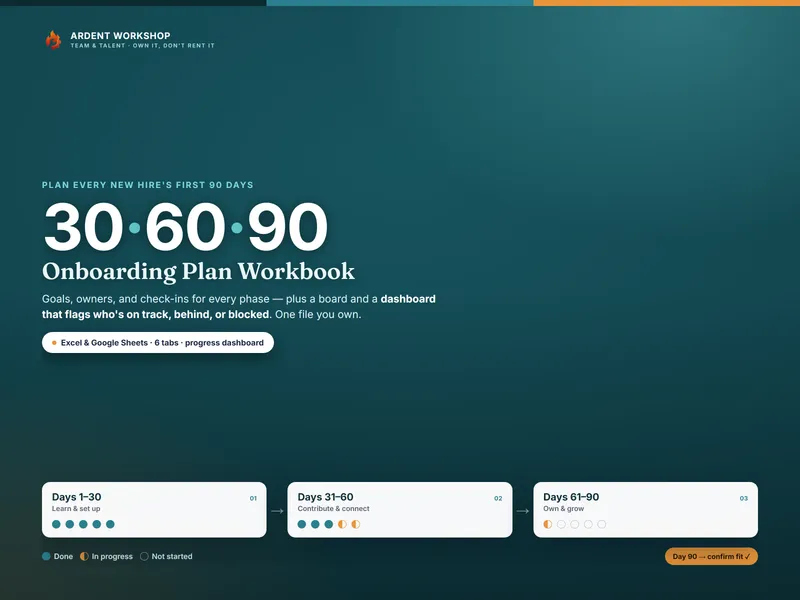
30-60-90 Onboarding Plan Workbook — New Hire Onboarding Tracker for Excel & Google Sheets
A 30-60-90 onboarding plan for Excel & Google Sheets — plan and track every new hire's first 90 days with goals, check-ins, and a progress dashboard.
Team & TalentView details
Frequently asked questions
- Is an onboarding buddy the same as a mentor?
- No. A mentor works on someone's career over the long run — skills, growth, where they're headed. A buddy has a much smaller and shorter job: get one specific new hire through their first few weeks by being safe to ask the small stuff. A buddy pairing can turn into a mentoring relationship later, and sometimes does, but that's a bonus, not the assignment. If you brief a buddy as though they're signing up to mentor someone, you've handed them a much bigger job than the one that actually needs doing.
- Is an onboarding buddy the same as a trainer?
- No. A trainer teaches the job — how to run the register, work the fryer, use the software — usually on a schedule, and is often accountable for whether the new hire can do the tasks afterward. A buddy isn't teaching anything on a curriculum and isn't accountable for whether the new hire performs. They're answering whatever comes up between the scheduled training, which is most of what actually trips a new person up.
- How long should an onboarding buddy last?
- Long enough to cover the stretch where a new hire still doesn't know what they don't know — typically the first few weeks, not the first day and not the first quarter. What changes over that stretch is the job: week one is presence and answering small questions as they come up; the weeks after that taper toward being available if asked, rather than checking in constantly. A written briefing that runs four weeks, with a different focus each week, is a reasonable default if you don't already have your own rhythm.
- Who should not be an onboarding buddy?
- Three people, specifically. Not the new hire's own manager — that relationship already carries the weight of performance, and a question that feels too small for the boss stays unasked with the boss as the buddy. Not the person who is about to go on leave or leave the role — a buddy who disappears in week two is worse than no buddy, because the new hire stops asking anyone. And be careful with the person who is already the informal helpdesk for the whole team — a generous, knowledgeable person, but one more new hire routed to them is one more thing pulled off their own work, and it's the assignment everyone reaches for first because it's easy, not because it's right for that person's week.
- What do you tell an onboarding buddy?
- Tell them what they own, for how long, and what they're released from while they do it. Concretely: that their job is to be interruptible and to check in without waiting to be asked, not to teach or evaluate anything; roughly how long the assignment runs and how that changes week to week; that questions about pay, schedule, or a real problem still go to the manager, not through them; and, if their own workload is heavy that week, that it's fine to say so rather than quietly doing both jobs badly. A buddy who was only ever told "you're the buddy" has been given a title, not a job.
- Does a small business need a buddy system?
- If you have more than one person on staff, you already have a candidate for it — the question is whether you name one on purpose or leave it to whoever happens to be standing nearest the new hire on day one. A formal buddy system with a rota, a coordinator, and reporting is overkill for a five-person shop. Naming one specific peer for each new hire, and telling that person what the job actually involves, is not — it costs a short conversation and it's the difference between a new hire who asks and one who quietly guesses.
- Should the buddy be the same person as the manager?
- No, and this is the most common mix-up. The value of a buddy is specifically that they aren't the person a new hire's performance gets judged by, which is exactly what makes a small, honestly-asked question feel safe. A manager can and should still check in with a new hire directly — that's a different, necessary relationship — but folding the buddy role into the manager role removes the one thing a buddy is for.