What a mentorship program actually is
At its simplest, a mentorship program is a set of pairings — each a mentor and a mentee — running at the same time, with someone responsible for the whole thing. That someone is usually an L&D or HR coordinator, a team lead, or a founder. Their job is not to do the mentoring; it's to make good matches, help each pair set a focus, keep an eye on whether the meetings are happening, and be able to show, at the end, whether the program was worth running.
A program is different from ad-hoc mentoring — the informal “grab a coffee with someone senior” kind — because it is tracked and intentional. Pairings have goals. Sessions have a rhythm. And the program as a whole has numbers behind it.
Mentor vs. sponsor
A common confusion is worth clearing up. A mentor advises you — they share experience, talk through problems, and help you grow. A sponsor advocates for you when you're not in the room — they put your name forward for opportunities and spend their own capital on your behalf. Most formal programs are mentoring programs; sponsorship tends to be earned, not assigned. A good mentee often turns a mentor into a sponsor over time, which is one of the quiet payoffs of a well-run program.
What makes a good match
The match is the one thing the coordinator does that a spreadsheet can't do for them, and a few principles travel well:
- Match on the growth edge, not the org chart. The best mentor for “stepping into a lead role” is someone who remembers making that leap — not simply the most senior person available.
- Keep enough distance to be safe. A mentor in the mentee's direct management line changes what's safe to say. Cross-team or skip-level pairings are often more candid.
- Willingness beats seniority. A generous person who will make time is a better match than a senior one who won't.
- The mentee has to want it. Mentoring works when the mentee drives; a pairing assigned to someone who didn't ask for it rarely takes.
Goals that stick
“I want to grow as a leader” is a wish, not a goal — you can't tell when it's done or what to talk about next week. Good program goals get three things: a focus area (leadership, a hard skill, presence, confidence), a definition of done (“run the Monday stand-up solo for a month” beats “get better at leading”), and a target date. Two or three sharp goals per pairing beats a long, vague list.
The cadence that keeps it alive
Almost every pairing that fails, fails the same quiet way: the meetings stop. A rescheduled session, then a skipped one, then a month, and it's awkward to restart. The single most valuable habit a coordinator can build is catching that drift early — setting a target cadence for each pairing (every two weeks, every three weeks, monthly) and nudging the one or two pairings that have slipped past it each week. That small habit saves more pairings than any launch event.
Measuring whether it works
Sooner or later someone who controls time or budget asks the fair question: is this worth it? A well-run program can answer with three measures:
- Participation — are pairings actually meeting? Sessions held per pairing, and how many pairings are on track versus overdue.
- Goal completion — are pairings getting somewhere? Completed goals as a share of the goals that still apply.
- Satisfaction — do the people in it find it valuable? A simple periodic 1–5 check-in from both mentee and mentor, watched for drops.
Common mistakes
- Launching and walking away. The launch event is the easy part; the program is the follow-through. Without someone watching the cadence, half the pairings quietly stop.
- No focus. Pairings told to “meet and see what happens” drift. A focus and a couple of goals give every session a reason to happen.
- No numbers. A program that can't show participation, completion, or satisfaction is the first thing cut in a reshuffle.
- Overloading a mentor. A willing mentor stretched across four pairings tends to do all of them thinly. Watch the load.
Related templates and concepts
To run one pairing for free, the single-pair mentorship log is an ungated taste of the method; the full Mentorship-Program Tracker runs your whole program on one matching board with a dashboard that flags participation, goal completion, cadence, and satisfaction. Mentoring is one thread of developing your people — see where each person sits on performance and potential with the 9-Box Talent Grid, and find the rest of the toolset in the templates for HR & team leads hub.
Templates that implement this
Templates that run a mentorship program
2 templates
One owned file that pairs mentors with mentees, sets goals, logs sessions, and rolls up participation, goal completion, and satisfaction on a dashboard — no per-seat platform.
- $19.95 Spreadsheet

Mentorship Program Tracker — Pairings, Goals, Sessions & Dashboard for Excel & Google Sheets
A mentorship program tracker for Excel & Google Sheets — pair mentors and mentees, set goals, log sessions, and see outcomes on one program dashboard.
Team & TalentView details - $24.95 Spreadsheet
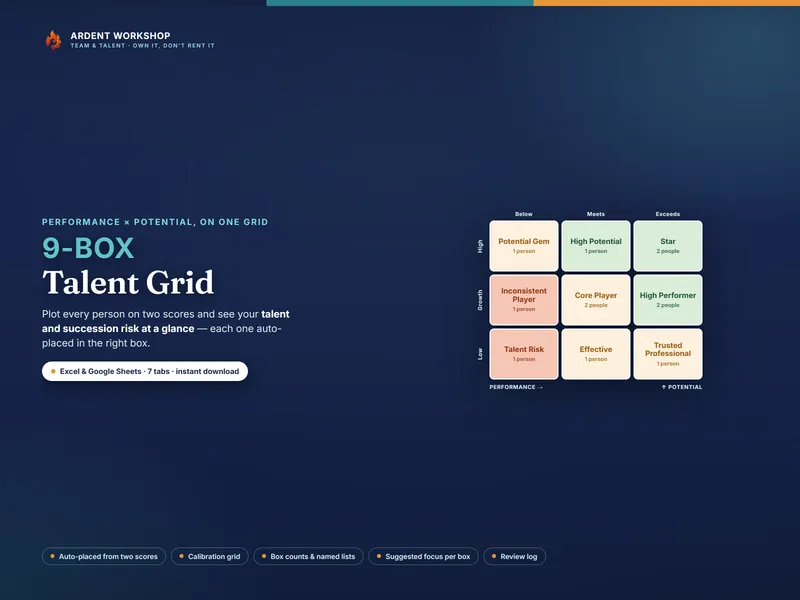
9-Box Talent Grid — Performance & Potential Matrix for Excel & Google Sheets
A 9-box talent grid for Excel & Google Sheets — score performance and potential, auto-place each person, and see succession risk on one grid.
Team & TalentView details