What a handbook is actually for
Treat an employee handbook as a document and the obvious goal is completeness — cover every topic, in polished sentences, and call it done. That framing misses what the handbook is actually doing for the business. It is not explaining policy to a reader; it is recording a decision the business already made, so that the next time the question comes up — can this person work from home on Fridays, how many warnings before a write-up, does unused time off carry over — the answer already exists. Nobody has to remember what was decided last time, and it doesn't get decided differently depending on which manager happens to be in the room that day.
That's also why a generated or AI-drafted handbook can read perfectly well and still be the wrong document. Fluent prose about attendance policy is not the same thing as this business's decision about attendance policy, made deliberately and written down in a way that holds up when someone tests it.
The sections most first handbooks need
The exact table of contents varies, but a first handbook for a small employer commonly settles the same set of decisions, roughly in the order an employee would meet them:
- Welcome and overview — what the business does and what the handbook is (and, importantly, is not)
- Employment basics and at-will status — how the employment relationship works and on what terms it can end
- Worker classifications — exempt versus nonexempt, full-time versus part-time, and what each one means for pay and benefits
- Hours, timekeeping, and overtime — how time is tracked and how overtime is authorized and calculated
- Pay and expenses — pay dates, how pay changes happen, and how business expenses get reimbursed
- Attendance — what counts as late, what counts as an absence, and what happens when either becomes a pattern
- Time off — how it's earned, requested, approved, and whether unused time carries over or pays out
- Remote or hybrid work — where relevant, the expectations for people who aren't always on-site
- Conduct — the general standard of behavior the business expects, stated once so it doesn't have to be inferred
- Health and safety — what the business does to keep the workplace safe and what's expected of employees in return
- Harassment and complaint routes — what's prohibited and, critically, more than one way to report it
- Equipment, data, and confidentiality — what belongs to the business, what's expected to stay private, and what happens to both at separation
- Social media — the narrow, defensible version of this policy, not a blanket rule that reaches further than intended
- Performance — how and when performance gets discussed, formally and otherwise
- Discipline and separation — how concerns get addressed, and how an employment relationship ends
- Acknowledgment — a signed, dated record that the employee received the handbook and understands it isn't a contract
None of that is exotic, and a generator will happily write all sixteen for you. What it can't tell you is which of the sixteen a federal statute is even in play for at your size, which carry no federal headcount threshold and are closer to your own call, and which sentence inside each one just committed the business to something it didn't mean to promise. For what a first handbook covers sorted by which authority decides each part, and the order it is easiest to settle in, see what goes in a first employee handbook.
Size changes what applies
These are U.S. federal screening rules, not a verdict based on today's headcount alone:
- EEOC coverage: most listed discrimination laws use 15 employees, and age discrimination 20, generally for at least 20 calendar weeks in the current or prior year. Check the particular law and employer type.
- FMLA: private-employer coverage generally requires 50 employees in 20 workweeks in the current or prior year. The 50-within-75-miles test is an employee-eligibility condition, alongside service requirements. Public agencies and schools have separate coverage rules.
- COBRA: group-plan coverage generally uses at least 20 employees on more than half the prior year's typical business days, with special counting rules.
- OSHA's small-employer recordkeeping exemption uses 10 or fewer employees throughout the previous year. Industry exemptions and serious-incident reporting are separate questions.
State and local rules can apply at smaller sizes. A threshold checker identifies questions to verify; it does not determine every obligation or whether a handbook sentence is legally sufficient.
The Texas Workforce Commission's disclaimer guidance illustrates how wording and context matter in one state. The drafting examples below are review prompts, not language guaranteed to avoid contractual obligations or override mandatory notice rules.
The wording trap
Handbooks rarely get an employer into trouble for what they left out. They get them into trouble for how they phrased what they put in. Three patterns come up repeatedly.
A described procedure becomes a required one. Written as a specific, ordered sequence, discipline reads as a commitment to follow those exact steps every time — including the one time there was a good reason not to.
- Before: "Employees will receive a verbal warning, then a written warning, then a final warning before termination."
- After: "Discipline is handled at the company's discretion and may include coaching, a verbal or written warning, suspension, or termination, depending on the circumstances and the severity of the issue."
A word undercuts the at-will statement pages earlier. "Permanent employee" and "probationary period" both imply a status with its own rights and a fixed evaluation window — language that sits awkwardly next to an at-will disclaimer written a few pages before it.
- Before: "After your 90-day probationary period, you will become a permanent employee."
- After: "After your first 90 days, you'll move from introductory to regular status. Employment remains at-will throughout, as described above."
An intention becomes a floor. Absolute language — "always," "will," "guaranteed" — turns a practice the business intends to follow into one it has committed to follow without exception.
- Before: "We will always give employees two weeks' notice before a schedule change."
- After: "We try to give employees as much notice as possible before a schedule change, typically at least two weeks."
None of these rewrites remove the policy or make it vaguer than it needs to be. Their effect depends on applicable law and the whole document; counsel should assess them before use.
Three sentences that should be there
Across the sections above, three short statements do more work than almost anything else in the document, and they're frequently missing from a first draft:
- The handbook is not a contract. A plain statement, near the front, that the document describes current policy and doesn't create contractual rights or alter at-will employment where it applies.
- Policies may change. A statement that the business can update its policies going forward, so a policy written in year one isn't read as frozen in place for the life of the business.
- There is more than one route to raise a complaint. A single required channel — "report it to your manager" — fails exactly when the manager is the problem. A second, named route fixes that before it becomes an issue.
Own it, don't rent it
Free prose was never the scarce part of writing a handbook — a generator or a single AI prompt supplies that in a minute. The Handbook Decision Worksheet is a free, no-signup place to start: it asks the twelve decisions that block the most drafting — at-will wording, exempt and nonexempt, overtime approval, pay dates, time-off payout, reporting routes, discipline steps, and what the acknowledgment page actually says — and shows them all answered for a worked example, so "how specific is specific enough" has a concrete answer to look at.
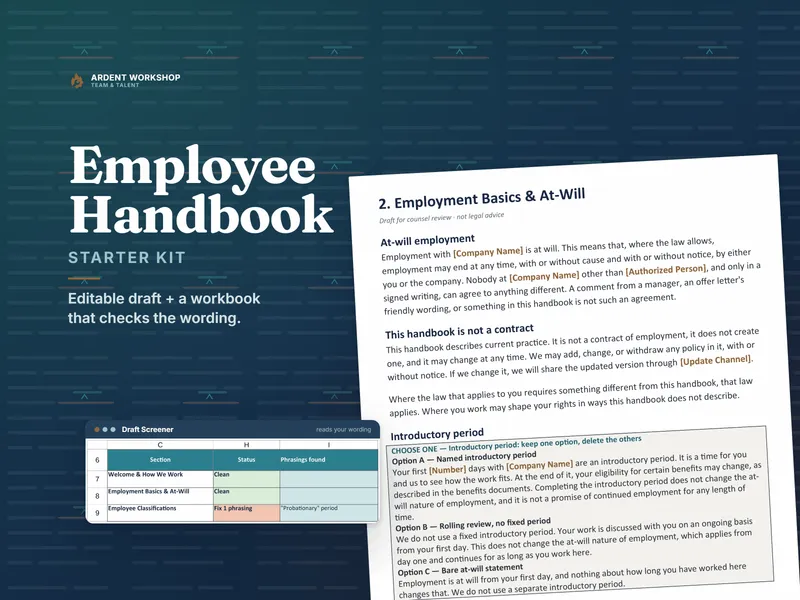
What a decision list can't do is the part that actually requires a workbook: work out which federal thresholds your headcount has crossed, or catch the wording in your own draft that just made a promise you didn't mean to make. That's what the Employee Handbook Starter Kit is built around — editable starter wording for sixteen sections in a .docx that opens in Word or Google Docs, an Excel and Google Sheets workbook whose Applicability tab computes a coverage verdict from your typed headcount and setup answers for each of sixteen federal employment laws, with the headcount each turns on where it has one, and a Draft Screener that reads your own draft for the phrasings that can create an implied contract or undercut an at-will statement. Federal floors only: where the answer is local, it names what varies and hands you the question rather than guessing at it. Files you own, bought once, with no account and no subscription — yours to re-run every time your headcount or your states change.
Next: what a first handbook covers and who decides each part, in what goes in a first employee handbook; how an owned kit stacks up against a subscription HR platform; the templates for HR & team leads hub for the rest of the toolset; and the personnel file glossary entry for where the records the handbook generates — warnings, coaching notes, separations — end up being kept.
Templates that implement this
The kit built around those two problems
1 template
Editable starter wording for sixteen sections (Word or Google Docs) plus an Excel and Google Sheets workbook that computes which federal thresholds your headcount has crossed, and a screener that checks your own drafted wording for the phrasings that can turn a policy into a promise.
Frequently asked questions
- Do I need an employee handbook?
- No single federal law says every employer must hand out a document called a handbook. What changes the answer is that several federal employment laws — and, in many states, additional state-level ones — start applying once you cross a given headcount, and a handbook is simply where a business writes down how it meets those obligations plus the calls it has made on its own. Below the thresholds that apply to you, a handbook is still useful — there are simply fewer sections a federal statute is in play for, and more that are your own call.
- How many employees before you need one?
- There is no single headcount that determines whether a handbook is needed. Each law has its own coverage and counting rules. FMLA employer coverage differs from employee eligibility; the 50-within-75-miles test is only part of the latter. State and local rules can add obligations. See the official references below before relying on a threshold.
- Is an employee handbook legally binding?
- It is not written as a binding contract, and the two sentences commonly used to say so — that the document is not a contract, and that it does not alter at-will employment where at-will applies — are there precisely because that reading is not automatic. Where those sentences are missing, or are buried in a footer nobody reads, it is harder for the document to show it was only ever describing current policy - though how much that matters is jurisdiction-specific and a question for counsel. Whether specific wording elsewhere in the document undercuts them is a separate question, and the next one below.
- Can a handbook accidentally create a contract?
- Yes, and it happens through phrasing rather than intent. A described sequence of disciplinary steps, an unqualified promise ("we will always give two weeks' notice"), or a policy written as if it were a right rather than a practice can all be read, in a dispute, as an obligation the business described for itself. Have the complete wording checked under applicable law. Discretionary language and disclaimers do not cancel mandatory protections or guarantee the absence of contractual obligations.
- Does every business need all sixteen handbook sections?
- No. The sixteen are the topics a first handbook usually settles — welcome and overview, employment basics and at-will status, classifications, hours and overtime, pay, attendance, time off, remote work, conduct, health and safety, harassment and complaint routes, equipment and confidentiality, social media, performance, discipline and separation, and the acknowledgment. Which ones a federal statute is even in play for depends on your headcount, and what your own state or city adds is a separate question this page cannot answer. The tutorial on what goes in a first employee handbook sorts what a first handbook covers by who decides each part — a federal statute at a headcount, a federal floor with the substance set elsewhere, or no federal headcount threshold at all - which makes it closer to your own call, though state law still bears on it.
- How often should an employee handbook be updated?
- Pick a fixed cadence — annually is a reasonable default — and read it again outside that schedule whenever something changes the answer to a section it already covers: crossing a headcount threshold, hiring in a new state, adding a benefit, changing pay practices, or a law changing under a policy you already have written down. A handbook that's only opened on its anniversary tends to fall behind the business it describes well before the next scheduled review.
- Is an AI-written employee handbook good enough?
- An AI will write fluent, complete-looking policies in minutes — that part was never the hard part. What it can't do reliably is tell you which policies your specific headcount and states actually put you on the hook for, or catch the phrasing in its own output that just turned a description into a promise. Those are judgment calls about your business, not writing quality, and no amount of polished prose substitutes for making them.