What a first employee handbook covers falls into three groups, and which group a topic sits in decides how it gets written. Eight topics sit on top of a federal statute that starts applying at a specific headcount. Five are a federal floor with much of the substance set elsewhere, usually at state level. Three carry no federal headcount threshold at all, which makes them closer to the employer’s own call — though state law still bears on them. The full list is below; the order this page walks starts with the decisions rather than the sections, because a section written before its decision was made papers over the gap. For the same job told from a small shop’s point of view, see writing an employee handbook for a small shop.
That ordering is what goes wrong most often in practice. A section is a decision wearing sentences — write the section before the decision behind it is actually made, and the wording ends up covering for the gap instead of stating a choice. Settle the decision first, and the section almost writes itself.
This is general information, not legal advice, and Ardent Workshop is not a law firm. What a handbook must say, and what your own state or city adds on top of the federal floors below, depends on where your employees work and is not something this page can tell you. Have qualified counsel review anything you are about to issue.
The order that actually works
- Settle the decisions. A handful of choices sit underneath most of a handbook, and they have to be made once, deliberately, before any section gets drafted.
- Work out which federal thresholds your headcount has crossed. Several federal employment laws start applying at specific employee counts. A snapshot headcount alone does not establish coverage; measurement periods and exceptions matter.
- Draft. Write what the policy is, plainly, as a description rather than a guarantee.
- Check the wording. A short, repeatable list of phrasings turns a description into a promise. Screen for them before anyone else reads the draft.
- Get a scoped review. Name the sections that carry real risk and the specific question each one raises, alongside the complete draft.
- Log the version. Date it, get it acknowledged, and write down what should trigger the next read-through.
The rest of this takes each step in turn, starting with those three groups.
What a first handbook covers, grouped by who decides it
Not every section in a first handbook answers to the same authority. Some sit on top of a federal statute that starts applying the moment your headcount crosses a line. Some are a mix — a federal floor with much of the real substance decided elsewhere. And several carry no federal headcount threshold at all — closer to the employer’s own call, though state law and other federal rules can still bear on them.
Reached by a specific federal statute, at a specific headcount
Use these as prompts to verify coverage, not a determination that a law requires a particular handbook section:
- EEO, harassment and accommodation: EEOC coverage guidance (opens in new tab) explains the usual private-employer thresholds of 15 employees for Title VII/ADA and 20 for the ADEA, with counting periods and other conditions. Check the PWFA’s coverage (opens in new tab) separately.
- COBRA: DOL’s employer FAQ (opens in new tab) explains the usual prior-year 20-employee test for covered group health plans and exceptions.
- FMLA: DOL Fact Sheet 28 (opens in new tab) distinguishes employer coverage from employee eligibility. The 50-employees-within-75-miles condition is an employee eligibility test, not the entire employer-coverage rule.
- OSHA records: 29 CFR 1904.1 (opens in new tab) uses the previous calendar year’s size for the small-employer partial exemption. Industry exemptions and incident-reporting duties are separate questions.
A mix of federal floor and something set elsewhere
- Wages, hours, and overtime. The Fair Labor Standards Act (FLSA) sets a federal minimum wage and overtime floor and governs the exempt-versus-nonexempt line — and unlike the statutes above it does not turn on a headcount test at all. Whether and how it reaches your business is worth confirming rather than assuming. What sits above that federal floor is where much of the actual variation lives.
- Meal and rest breaks. Federal law is close to silent here; where the real rules live is elsewhere.
- Paid sick leave and paid time off. There is no general federal mandate requiring it at all — what exists sits elsewhere and varies a great deal.
- Final pay at separation. Federal law says little about exactly when a final paycheck has to arrive; the timing rules generally sit at state level. Look yours up before the section asserts a deadline.
- Background and reference checks. The Fair Credit Reporting Act (FCRA) sets federal procedural steps — disclosure, authorization, and an adverse-action process — where an employer uses a consumer reporting agency. Whether and how it reaches your own screening is worth confirming, and what else is restricted around the same check varies elsewhere.
No federal headcount threshold — closest to your own call
No statute on the federal headcount list above reaches these. That is not the same as nothing reaching them: state law bears on all three, and the pay-secrecy caution further down is a federal rule that applies without any headcount test.
- At-will employment statement, if you are in an at-will jurisdiction to begin with.
- Discipline and performance process — whether it exists at all, and whether it is a fixed sequence or a flexible set of options.
- Workplace conduct, attendance, and communication — dress, attendance expectations, remote or hybrid norms, use of company property and accounts, and social-media conduct.
Say this plainly, because it is the single most common misreading of a list like this one: those federal thresholds are floors, not the whole picture. Many states and cities set lower ones, several reaching an employer at a single employee with no headcount test at all. “Not covered federally at this size” describes one statute at one level of government. It is never the same statement as “no obligation.”
The decisions that block the most drafting
Settle these before a section gets written, because most of a first handbook stalls on one of them.
- At-will wording. If your jurisdiction allows at-will employment, say so — and say it in language that does not get quietly undone three pages later by a described fixed process or the word permanent.
- Exempt versus nonexempt. Every role gets classified before anything about overtime, breaks, or timekeeping can be written honestly. Get this wrong and the sections built on top of it are wrong with it.
- Who approves overtime, and what happens if it occurs without approval. Decide both halves. A policy that only says overtime requires approval, with nothing about what happens when an employee works it anyway, leaves a manager guessing in the moment it actually matters.
- What happens when a scheduled payday lands on a holiday. Small, specific, and one of the fastest things to write once decided — pay early, pay on the next business day, or pay on schedule regardless.
- What happens to accrued, unused time off at separation. Whether it is paid out, forfeited, or something in between is frequently a matter of state law rather than pure employer choice — so the decision here is to find out which one applies to you before the section asserts either answer.
- Whether there is a genuine second route to raise a complaint. Not a formality restating the first name a second time — an actual different person, reachable a different way, for the situation where the first route is the problem.
- Whether discipline is a flexible set of options or a fixed sequence. This single choice, made once, decides how the entire discipline section gets drafted and how much room a manager has to fit a response to a specific situation instead of a script.
Draft each section as a description, not a promise
With the decision made, the drafting is short. Write what happens, not what will always happen: state the policy, name who it applies to, and say what is typically true. Leave room for a case to be handled differently, because one eventually will be. A section that reads like a guarantee gets read back as one — which is what the next step screens for.
The wording that bites
Both missing requirements and unintended promises can cause problems. The examples below are drafting prompts for review, not legally approved wording.
-
A described four-step discipline sequence. Before: “Employees will receive a verbal warning, then a written warning, then a final warning, then termination.” After: “Discipline may include coaching, verbal or written warnings, a performance improvement plan, or termination, applied in the order and combination appropriate to the situation.” The first version reads like a procedure you are expected to follow exactly, including the one time you had a good reason to skip a step.
-
“Permanent employee.” Before: “Permanent employees are eligible for the following benefits after ninety days.” After: “Regular employees are eligible for the following benefits after ninety days.” Permanent is read as a statement about job security, not payroll category, and it sits awkwardly next to an at-will statement three sections earlier.
-
“We will always give two weeks’ notice before a layoff.” Before: “The company will always provide two weeks’ notice before a layoff.” Review prompt: Identify the notice duties that apply before drafting this section. A discretionary notice clause cannot replace required notice; see DOL’s WARN overview (opens in new tab). Always is a word a handbook can rarely afford, and it turns a customary practice into a term someone can hold you to on the one occasion you cannot deliver it.
-
A blanket ban on discussing pay. Before: “Employees may not discuss their pay with coworkers.” After: “Employees may not access or share pay information they are not authorized to see through company systems.” (Or omit the restriction entirely.) The NLRB explains covered employees’ right to discuss wages (opens in new tab). Have any confidentiality wording checked against those protections; the sample is not a safe-harbor clause.
The three sentences that are easiest to leave out
- This is not a contract. State it plainly, near the front, in its own sentence — not implied by a footer disclaimer nobody reads.
- Policies may change. Say that the company can update the handbook, and how employees will be told when it does.
- Here is a second person to talk to. Name an actual alternate contact for a complaint or a concern — not the same name restated, a different one.
All three are short, all three are cheap to add, and all three are more often missing entirely than worded badly.
What to take to a lawyer
Send the complete draft and a list of specific questions. A handful of sections carry most of the actual risk, and each is worth one specific question rather than a general read-through:
- The harassment policy and its reporting route — does the second route actually reach someone other than the person most likely to be the subject of a complaint?
- Wage and hour classifications — are the exempt-versus-nonexempt calls in this handbook consistent with how the roles are actually described and paid?
- Leave and accommodation sections — do the accommodation and leave procedures match what an interactive process with an employee is expected to look like?
- The at-will statement, read against the discipline section — does anything elsewhere in the document — a described fixed sequence, the word permanent, an absolute promise — undercut the at-will language you just wrote?
Four named sections and four specific questions is a review a lawyer can actually do something with. A forty-page document and a general “does this look okay” invites a general read-through rather than an answer to anything in particular.
Log the version, and name what makes it stale
Record the date the handbook was adopted, keep the acknowledgment from every employee who received that version, and write down the handful of events that should trigger a re-read — a hire that crosses one of the headcount thresholds above, the first employee in a new state, a new benefit, a change to pay practices, a law you heard about secondhand. A handbook does not go stale on its anniversary. It goes stale the week the business changes and nobody connects the two.
Own it, don’t rent it
None of this is a reason to avoid writing a handbook, or to buy one that reads well and quietly asserts things it should not. The Handbook Decision Worksheet is free, needs no signup, and walks twelve decisions, among them versions of the ones under the decisions that block the most drafting above: at-will wording, exempt classification, overtime approval, pay frequency and pay date with its weekend fallback, accrued time off at separation, the second complaint route, and the discipline structure. Each is shown blank to answer, then answered for a worked example, so you can see how specific an answer has to be before it counts as settled.
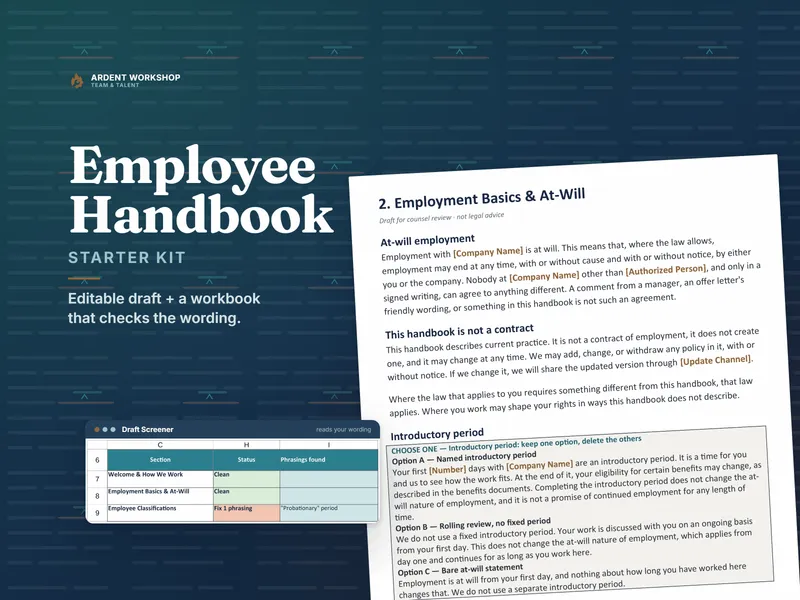
The Employee Handbook Starter Kit is the full method:
- An editable starter draft of all sixteen sections, a .docx that opens in Word or Google Docs, written to avoid the phrasings above.
- A workbook for Excel or Google Sheets that computes a coverage verdict for each of sixteen federal employment laws from your own headcount and setup answers, with the headcount each turns on where it has one.
- A screener that reads your own edited sections for the phrasings that turn a description into a promise.
- A counsel-review triage that turns “have a lawyer look at it” into a named list of sections, with a question already written beside each one.
- Printable section shells and worksheets for drafting on paper.
Files you own, bought once, with no account and no subscription; re-run the workbook every time your headcount or your states change. For the definitions behind all of this, see what an employee handbook is and what an at-will acknowledgment is, or weigh an owned kit against an HR platform. Settle the decisions once; the sections follow from them.