Skip Navigation

What is an At-Will Acknowledgment?

An at-will acknowledgment is the signed page at the back of a handbook that records one thing: a named person received a named version on a named date. It is an easy page to copy without reading closely, and word it wrong and it quietly does a much bigger job instead — turning a signature meant to confirm receipt into one that reads as agreeing to terms.

What at-will means, and what the acknowledgment doesn't do

In plain terms, at-will employment means either side can end the working relationship at any time, for any lawful reason or no reason at all, and without advance notice — the same freedom runs in both directions. A handbook's at-will section usually states this plainly, near the front.

The acknowledgment page at the back doesn't create any of that. At-will status generally exists in the employment relationship itself — set at hire, often spelled out in an offer letter — well before anyone hands over a handbook to read. What the acknowledgment page does is much narrower: it records that a specific person received a specific document. It restates the arrangement; it doesn't establish it.

One more thing worth flagging here rather than assuming it away: a small number of states don't follow the standard at-will framework in the same way. This page won't say which ones or what their rule is — that's a question about where your employees actually work, not something a general answer can get right for every reader. Check it locally before leaning on any at-will language, acknowledgment page included.

What the signature is actually evidence of

Strip an acknowledgment page down to what it's genuinely useful for, and it's three facts: a named person, a named handbook version, and a named date. The signature matters less than those three facts do — it's really just what ties the name to the date.

That's why version and date carry more weight than most people give them. If a question ever comes up later — did this employee actually receive the policy that's now in dispute, and which version was current when they signed — the acknowledgment record is the only place that question gets answered. Not memory, not whoever happened to be handing out handbooks that month. A signed page with no version identifier or date on it answers a much weaker question: that someone signed something, at some point, without saying what.

The wording that undoes it

A handbook usually opens by saying it isn't a contract. The acknowledgment page at the back is where that promise most often gets broken by accident — a few common phrasings do the damage.

  • “I agree to the terms of this handbook.” Agreement, not receipt. This single substitution — agree for acknowledge receipt of — is what turns a receipt line into contract language, on the one page most likely to get pulled into a dispute about whether the handbook was ever meant to bind anyone.
  • “I understand my employment is permanent once I pass probation.” This undercuts at-will twice in one sentence: it implies employment stops being at-will after some point, and it treats an internal review period as if it were a contractual gate an employee passes through into something more secure. Neither idea belongs on a page meant to preserve the at-will relationship, not narrow it.
  • An acknowledgment that restates a discipline sequence. Once a specific sequence of steps is written down and signed for, it reads as a procedure the employer described exactly and is then expected to follow exactly — including the one time there was a good reason not to. That problem belongs to the discipline policy itself, not the receipt page, and restating it here just gives it a second signed copy to be held to.

What belongs on the page instead

The fix for all three isn't clever wording — it's narrower wording. A page that only ever claims what it's actually for holds up better than one that reaches further:

  • Receipt, not agreement. “I acknowledge that I received the [handbook name], version [X], dated [date]” — not that its terms were agreed to.
  • A restatement that the handbook isn't a contract. The same not-a-contract language that opens the handbook, said again here, closes the loop rather than leaving it open at the one page most likely to be read in isolation.
  • A note that policies may change. Nothing on this page should read as a fixed promise about what the handbook says today staying true indefinitely.
  • The version identifier and date. The most useful pair of fields on the page, and the ones a copied acknowledgment paragraph often lacks.
  • A printed name, signature, and date line. Simple, and exactly as much as the page needs.

None of this is legal advice, and Ardent Workshop is not a law firm — have the specific wording reviewed by counsel who knows the law where your employees actually work before adopting it.

When someone won't sign

A refusal isn't a crisis, and arguing the point or withholding the handbook over it doesn't help. Note the date, who presented the handbook, and that the person received it — a second person present as a witness helps. A refusal that's written down still leaves a record that the document reached the employee, which is most of what the page was for anyway.

A signature is evidence that a document was received, not consent to anything in it — and saying that plainly, right on the page, is often what actually gets people to sign. Reluctance here usually traces back to the same assumption, that signing means agreeing; a page that says in its own words that it doesn't takes the objection away before it is raised.

Re-acknowledgment after an update

A handbook that changed without anyone signing for the new version is a change you can't show anyone received. That gap matters most exactly where it's most likely to open — when conduct, discipline, harassment, or the at-will language itself is what moved, since those are the sections most likely to matter again later. Each meaningful update calls for its own acknowledgment, tied to its own version and date, rather than stretching a signature from an earlier version to cover changes it never saw.

Electronic vs. wet signature

A typed name with a timestamp, a click-to-accept step in an HR system, and a scanned wet signature are all in ordinary use for this page. Whichever form is used, the record it leaves behind needs to tie a named person to a named version on a named date — that's the part that has to survive, regardless of the method. Which form counts as sufficient can vary by jurisdiction, so this is worth confirming for where your employees work rather than assuming one method travels everywhere.

Common mistakes

  • Writing agreement language instead of receipt language. The single most common way this page turns into something it was never supposed to be — see “the wording that undoes it” above.
  • Leaving off the version and date. A signature with no version identifier answers a much weaker question than the one that usually gets asked later.
  • Treating a refusal to sign as a reason to escalate. It isn't — note it, keep the copy on record, and move on.
  • Skipping re-acknowledgment after a real update. Especially where discipline, conduct, harassment, or at-will language changed — that's precisely where a missing signature is most likely to matter.
  • Copying a generic acknowledgment paragraph wholesale. A page written for a different handbook, in a different state, for a different business, carries whatever assumptions that version made — including, sometimes, the agreement-language problem above.

The acknowledgment page only makes sense next to the document it closes out — see what an employee handbook is for the rest of what it's typically built from, and where the acknowledgment sits inside it. Once it's signed, it commonly files alongside the rest of an employee's record — see what a personnel file is for where that generally lives.

Start with the decisions, not the drafting. The Handbook Decision Worksheet is free and needs no signup: twelve decisions a small business can settle in one sitting — including what the acknowledgment page actually says — each shown blank to answer, then answered for a worked example. For what a first handbook covers and which authority decides each part, read what goes in a first employee handbook.

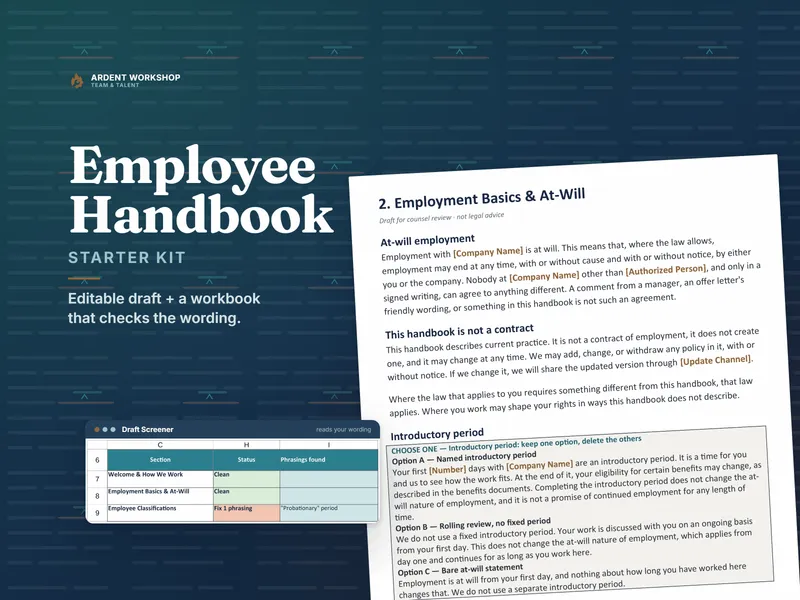
When it is time to write the sections themselves, the Employee Handbook Starter Kit builds this page as one of its 16 section shells — section 16 is the acknowledgment itself, and section 02 covers the at-will basics it depends on. Both are classified by the kit's own applicability engine - and both come back Required at any size, which is the point: the engine tells you which sections your headcount decides and which it does not, rather than handing over one-size-fits-all boilerplate. One file you own, bought once, with no account and no subscription. See how that compares with a subscription HR platform, or the templates for HR & team leads hub for the rest of the toolset.

Frequently asked questions

Does signing an employee handbook make it a contract?
It shouldn't, and a well-worded acknowledgment page says so directly. The trouble is wording, not the signature itself — 'I agree to the terms of this handbook' reads as agreeing to terms, which is contract language. 'I acknowledge receipt of this handbook' reads as confirming a document arrived. Those two sentences do very different jobs, and the second one is the job the page exists to do.
What if an employee refuses to sign the acknowledgment?
It isn't a crisis, and it isn't a reason to argue the point or withhold the handbook. Note the date, who presented it, and that the person received it — a witness helps. A refused signature still leaves a record that the document was handed over; what it can't show is agreement, which the page was never supposed to claim in the first place.
Do employees have to re-sign after a handbook update?
Whenever the content actually changes, yes — a new version needs its own acknowledgment, not a signature carried over from the last one. This matters most where conduct, discipline, harassment, or the at-will language itself moved, because those are the sections most likely to get pulled into a later dispute. A signed acknowledgment for a version nobody updated proves nothing about the version that's actually in force.
Does an at-will acknowledgment create at-will employment?
No. At-will status typically exists in the employment relationship itself — set at hire, often in an offer letter — well before anyone hands over a handbook. The acknowledgment page restates that arrangement and records that a named person received a named version on a named date. It documents the arrangement; it doesn't establish it.
What should an at-will acknowledgment actually say?
Receipt, not agreement: that the named employee received the named handbook version, on a named date. A plain restatement that the handbook isn't a contract of employment. A note that policies may change. And the version identifier and date, which matter more than the signature itself if anyone ever needs to know which version was in force at a given time.
Is an electronic signature enough for a handbook acknowledgment?
Commonly, yes — a typed name with a timestamp, a click-to-accept in an HR system, or a scanned wet signature are all in ordinary use, and the record either way needs to tie a named person to a named version on a named date. Which form counts as sufficient can vary by jurisdiction and by what a court expects to see, so this is worth confirming for where your employees actually work rather than assuming one form travels everywhere.
Do all states follow at-will employment the same way?
No — a small number of states depart from the standard at-will framework in ways that matter, and this page won't tell you which ones or what their rule is, because that's exactly the kind of local variation a general answer gets wrong for somebody. Two places to get the answer for where your employees actually work: your state labor or workforce agency, many of which publish employer guidance, and an employment attorney licensed in that state. Ask before you issue anything that relies on at-will language.

General information and document templates — not legal advice, and not a substitute for it. Nothing here tells you what the law requires of you; that is set by your jurisdiction and by your own agreements.

Further reading

What actually goes in a small shop's handbook, what the first day looks like when someone receives it, and what closes out when they leave.