What typically goes in it
The personnel file is the employment record proper. It should let anyone with a legitimate need to know — a new manager, an auditor, the employee themselves — reconstruct the shape of the working relationship without having to ask around. In rough chronological order, that commonly means:
- The offer letter and any signed acknowledgments
- The job description and any later updates to it
- Role-change and pay-change letters
- A probation or introductory-period review
- Coaching notes and check-in records
- Verbal and written warnings
- A performance improvement plan (PIP), where one was used
- Attendance records
- A resignation letter or separation letter
- A final-pay and equipment-return checklist
- Employment-verification and reference-check responses
- An index page listing what's inside the file and when each document was filed
None of that is exotic. It's the paper trail any employment relationship produces on its own, filed in one place instead of scattered across email and a manager's desk drawer.
For covered U.S. employers, EEOC's ADA guidance requires confidential medical information to be kept separately with limited access. Other record categories can have different legal and access requirements; a two-folder model is an organizing aid, not a complete compliance rule.
What does not belong in it — and where it goes instead
This is the part that trips people up, because the instinct is to file everything about a person in the same place. A few categories are commonly kept apart instead, in a separate confidential file with narrower access:
- Medical information and doctor's notes. Keeping health information confidential and apart from the general personnel file is a well-established practice — a doctor's note tells whoever reads the folder something about a person's health that they have no need to know just to do their job.
- Accommodation and leave records. A request for a modified schedule, a changed role, or leave tied to a health condition carries the same reasoning as the medical note behind it, so it's kept with it.
- Work-authorization records. Verification paperwork is commonly kept separately too — less because of what it contains than for a practical reason: it keeps whoever reviews or re-verifies it from being handed the rest of the folder in the process, and keeps that narrow, recurring task from getting mixed in with a decade of unrelated notes.
- Background-check results. Screening reports are widely kept apart for the same practical reason — narrowing who ever sees them, and keeping them out of a folder a manager might casually flip through for something else.
- Investigation notes. A complaint, an investigation, and its findings commonly stay separate too, both to protect the people named in them and because they may need to be handled — shared, or withheld — in ways a routine look at the personnel file was never meant to trigger.
A rule of thumb
If a supervisor could be handed the whole folder without you wincing, it's the personnel file. If a single page in it would tell that supervisor about a diagnosis, a disability, a medical leave, a test result, or an immigration status, that page belongs in the confidential file instead. Sorting document by document against that one question catches most of what should move, even on days when nobody remembers the underlying reason for the split.
How long to keep it
Choose a retention schedule by record type, governing law and pending matters. EEOC's recordkeeping requirements describe federal retention periods for covered employers and preserving relevant records through final disposition of a charge. Payroll has separate requirements under DOL's FLSA guidance. State rules and legal holds can require more; do not delete a whole file on a generic anniversary.
Who can see it
Access is commonly limited to people with a real need to know — the employee's manager, HR, and the employee themselves. Beyond that, rules vary a lot by state: some give an employee a clear right to review or copy their own file, some don't, and some attach conditions, like requiring an appointment or limiting how often a request can be made. Check what applies where you are before you promise an employee anything about access.
Related templates and concepts
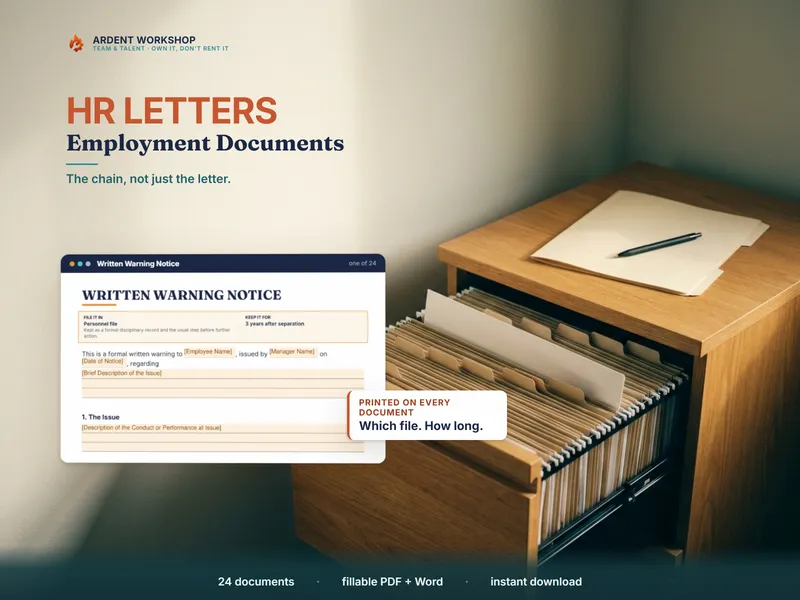
A performance improvement plan is one of the documents that ends up in the personnel file, and it's a good example of why the filing question matters — medical information related to a performance discussion needs separate confidential handling; keep ordinary performance facts distinct from diagnoses and accommodation records. For a free, ungated first document, the Coaching Note & Verbal-Warning Record is a taste of what a filed record looks like; the HR Letters & Employment-Document Template Pack carries the full set — 24 fillable documents from offer letter to separation letter, each stamped with which file it belongs in and how long it's commonly kept, plus a Personnel File Index and a Confidential File Index. Own the paperwork once, and it's yours for as long as the business exists — no per-seat platform, no subscription. See the templates for HR & team leads hub for the rest of the toolset.
Templates that implement this
Templates that build the two files
1 template
Twenty-four fillable employment documents, each stamped on its own front page with which of the two files it belongs in and how long it's commonly kept — plus a Personnel File Index and a separate Confidential File Index.