This isn't really template-versus-platform, because a first handbook rarely reaches the part a platform is built for. The mistake is paying a recurring per-employee fee for distribution and e-signature infrastructure before you've done the harder, one-time work: deciding what each policy actually says for a business your size.
What each one is for
- A handbook template is a drafting tool. It gives you the sections to fill in, names the decision each one forces, and — in the better ones — computes which policies a business your size and structure is likely subject to before you write a word. It answers “what should this document say, and did we decide that on purpose?”
- An HR platform is a system of record. Handbook authoring is usually one module inside a much larger product: onboarding workflows, e-signature and acknowledgment tracking, an employee database, and often payroll integration — sold as a recurring subscription, typically billed per employee. It answers “how do we get this handbook in front of everyone, prove they read it, and keep that proof current as we grow?”
A full explanation of what an employee handbook is and does is in the glossary.
When an owned handbook template is exactly right
- You're writing your first handbook, not maintaining your fiftieth revision.
- You employ people in one or two states, not a dozen.
- You want to make each policy decision yourself, not accept a generator's defaults.
- You'd rather own the finished document than log into a system to read it.
- You want a fixed, one-time cost instead of a bill that grows every time you hire.
At this stage the template does the part that matters most — the decisions — better than a platform does, because a handbook module inside a larger platform is usually shaped around producing output rather than around making you sit with each choice. The free Handbook Decision Worksheet is a no-signup way to see the shape of those decisions before you buy anything, and what goes in a first employee handbook sorts what a first handbook covers by which authority decides each part. The page at the back has its own entry — the at-will acknowledgment — and the templates for HR & team leads hub collects the rest of the people-ops kits.
The signals you may want a full platform
- You operate in many states at once. Tracking which policies need which state-specific variants, and keeping each one current, is worth paying someone else to stay on top of every month.
- You need acknowledgment tracking at scale. Distributing an updated handbook to dozens or hundreds of employees and proving, individually, that each one signed the current version.
- You need it wired to onboarding and payroll. New hires flowing into the same system that houses the handbook, without re-keying records by hand.
- You have someone whose job is running HR systems. A platform needs an administrator; a template needs an owner and an afternoon.
Even then, the document itself still has to say something specific and deliberate for your business — the platform hosts and distributes it, but it doesn't make the underlying decisions for you. The template is the thinking; the platform is the plumbing.
Side by side
| What matters | Handbook template (owned document) | HR platform (subscription) |
|---|---|---|
| What it is | A drafting kit that helps you decide and write | A system that hosts, distributes & tracks |
| Cost over three years | One fixed cost, paid once | Recurring, usually growing as you hire |
| If you stop paying | You keep the finished document, forever | Access and hosted content may end with the account |
| Who decides what a policy says | You — edit starter wording, with the decision behind each section named | Often the platform's default prose, editable by you |
| Wording risk screening | Screens your own drafted sentences for risky phrasing | Not typically what it is for — it mainly hosts what you wrote |
| Distribution & e-signature | No sending or e-signature — the kit logs who signed which version | Built-in — send, sign, track at scale |
| Multi-state operations | You research and track each state yourself | Some platforms track law changes across states for you |
| Maintenance when law changes | You watch for law changes and update the file; the kit separately flags a re-read when the business changes | Often flagged or updated by the vendor |
| Data ownership | The file is yours, offline, no account needed | Hosted in the vendor's platform |
| Best for | A first handbook, one or two states, a deliberate draft | Many employees, many states, ongoing distribution |
The honest middle ground
If you are writing a first handbook for a business with fewer than fifty employees in one or two states, what you need most is to make the underlying decisions — what counts as misconduct, what leave policy applies, what wording creates a promise the business didn't mean to make — not a system to broadcast whatever default wording a generator produced for you. A subscription platform is the right call once distribution, acknowledgment tracking, and multi-state law-change monitoring across a real headcount become the actual job, and plenty of growing organizations reach that point. Buying the platform before you reach it just adds a recurring bill on top of a document you still have to decide the contents of yourself. And in neither case does the tool substitute for having counsel review the finished wording — the platform changes what you hand to that review, not whether you need it.
Write the handbook either way
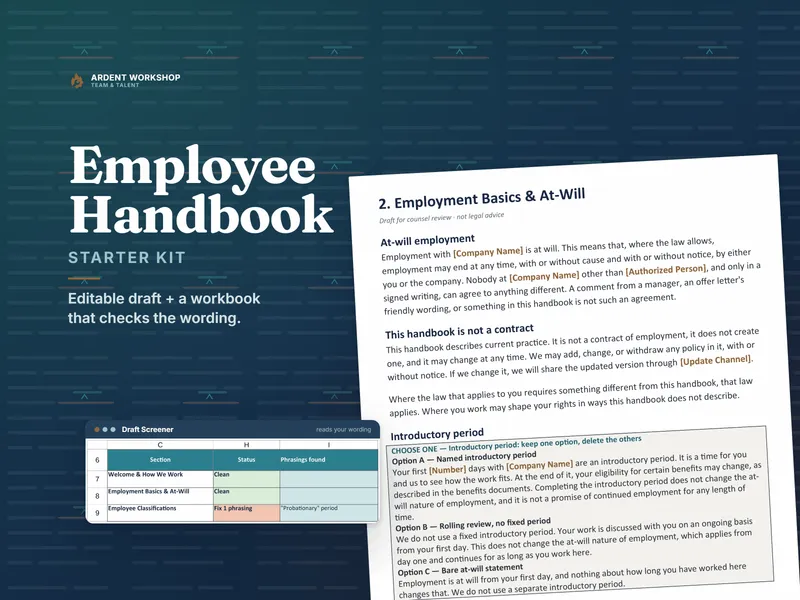
Whichever stack you're on or headed toward, the document itself still has to say something specific and deliberate for your business. Settle the twelve decisions underneath all of it first — free, no signup — in the Handbook Decision Worksheet. When you're ready to draft, the Employee Handbook Starter Kit gives you editable starter wording for sixteen sections, a workbook that computes a coverage verdict from your own headcount for each of sixteen federal employment laws — with the headcount each turns on where it has one — and a screener that checks your own drafted wording for the phrasings that can create an implied contract or undercut an at-will statement. Files you own, bought once, with no account and nothing to log into. Federal floors only: where the answer is local it names what varies and hands you the question. Own the decisions first; add a platform only when distributing and tracking a handbook at scale becomes the actual job.
Frequently asked questions
- What's the difference between a handbook template and an HR platform?
- A handbook template is a document — a set of policy sections you fill in once, own outright, and edit whenever you want, with no login and no ongoing cost. An HR platform is a subscription system that may include handbook authoring alongside a much wider job: distributing the finished handbook, collecting e-signed acknowledgments, tracking who has and hasn't signed, storing employee records, and often running payroll or onboarding workflows too. One is a document you own; the other is infrastructure you rent for as long as you keep paying. For a business writing its first handbook, the document is usually the whole job — the distribution and audit-trail machinery only starts to matter once headcount and hiring volume make it worth automating.
- Can a handbook template replace HR software?
- For deciding what your policies say and getting a first handbook drafted and issued, yes — a template does that completely, and arguably does the hard part better, because it forces you to make each decision rather than accept a generated default. What a template does not do is track e-signed acknowledgments across dozens of employees automatically, push updates the moment a policy changes, or keep a live compliance record across multiple states and locations. If you're already running that scale of distribution and recordkeeping, a platform earns its ongoing cost. If you're writing your first handbook for a small team in one or two states, the decisions are the job, and a template gets those decisions made and documented without a recurring bill.
- How much does a handbook template cost compared to an HR platform?
- The shapes are opposite, not just the amounts. A handbook template is a single one-time cost — the Employee Handbook Starter Kit is $29.95, paid once, and rewriting a section next year costs nothing extra. HR platforms publish their own pricing and it varies widely, but the shape is consistent: a recurring subscription, commonly billed per employee or per seat, so the running cost grows every time you hire and does not stop while you use it. Over a few years the template's total is fixed at the outset; the subscription keeps compounding, and if you stop paying, what you keep is usually far less than the finished document a template would have left you owning.
- Do I still need a lawyer if I buy a handbook template or a platform?
- Yes, either way. Neither a template nor a platform can tell you what your state or city requires, and neither one makes a finished handbook compliant just by existing — that determination has to come from someone licensed to make it for your jurisdiction. What a good template changes is what you bring to that review: a document where every decision was made deliberately, with the risky phrasings already flagged, instead of a stack of generated prose nobody has scrutinized. A platform can change the mechanics of getting an updated policy back out to staff, but it doesn't remove the need for counsel to review the wording in the first place.