Stay interview vs. exit interview
The two ask nearly the same questions — what did you value, what frustrated you, what would have made you stay — but the timing is everything. An exit interview happens on the way out, when the decision is already made; its value is a trend you can act on for the next person. A stay interview happens while someone is still on the team and still winnable, so the same honest answers become a fix you can make for this person, now. Exit interviews tell you why people left; stay interviews help you keep them.
What a stay interview asks
A good stay interview is a handful of open questions, asked in your own words, across a few areas:
- What keeps them here. What makes a great day at work, what they'd miss if they left — the anchors you can protect.
- What frustrates or drains them. What gets in the way of their best work — usually where the fixable problems live.
- Where they want to go. What they want to learn or become next, and whether the path here feels open — a stalled sense of growth is a common reason good people start looking.
- The manager relationship. What they need from you that they aren't getting — often the cheapest, most overlooked lever.
- The honest question. On a scale from “looking” to “happily staying,” where are they, and what would move them up a point? Naming it respectfully beats guessing.
When and how often to run them
Stay interviews work when they're a rhythm, not a fire drill reserved for people halfway out the door. A light one every quarter for anyone at elevated risk, and at least once a year for everyone, keeps the read honest and catches drift while it's still cheap to fix. Hold them separately from performance reviews — mixing the two makes people guard what they say, because a stay interview only works if it feels safe to be candid.
How to run a stay interview well
- Ask, then listen. Resist fixing or defending in the moment. Take notes and follow up later.
- Only ask what you're willing to act on. One of the fastest ways to raise flight risk is to run a stay interview, hear a clear ask, and do nothing — it signals that input doesn't matter.
- Close the loop. Within a week, tell them what you heard and what you'll do — even if the honest answer is “not yet, and here's why.” This is the step that actually lowers risk.
- Keep it good faith. A stay interview is a genuine offer to listen and act, not a tactic to extract a counteroffer or a loyalty test. Treated that way, people are honest.
From stay interview to retention action
A stay interview is the evidence; the action is what keeps someone. The common pattern is to pair the conversation with a simple retention-risk score — how likely each person is to leave (flight risk) and how much it would hurt to lose them (impact) — so a vague sense of “a couple of people might leave” becomes a short, prioritized list of who to talk to first. Every stay interview should end with at least one committed action: a growth step, a workload fix, recognition, or a role change — with an owner and a date.
Common mistakes
- Running it like an interrogation. A checklist read stiffly gets guarded answers. It's a conversation, not a form.
- Asking and doing nothing. Nothing erodes trust faster. If you can't act on something, say so and explain why.
- Only talking to people who are already leaving. By then it's usually too late. The point is to ask while someone is still settled.
- Treating the notes as confidential to no one and everyone. Keep what you hear to those who genuinely need it for retention decisions, and never use a flight-risk read against someone.
Related templates and concepts
Stay interviews pair naturally with a read on succession planning and key-person risk — the people you most need to keep are often your single points of failure. To triage one team for free, the flight-risk checklist is an ungated taste; the full Stay-Interview & Retention-Risk Tracker auto-ranks your whole team, adds a curated question bank, and tracks the action for each at-risk person. Weighing build-versus-buy? See stay-interview template vs. engagement software, and the templates for HR & team leads hub for the rest of the toolset.
Templates that implement this
Templates that run stay interviews and track retention risk
2 templates
Score who's most at risk, run a stay interview with a curated question bank, and track the retention action you commit to — in a workbook you own.
- $19.95 Spreadsheet

Stay-Interview & Retention-Risk Tracker — Flight Risk Scoring for Excel & Google Sheets
A stay-interview & retention-risk tracker for Excel & Google Sheets — score flight risk and impact, auto-rank who to keep, and track the action for each.
Team & TalentView details - $24.95 Spreadsheet
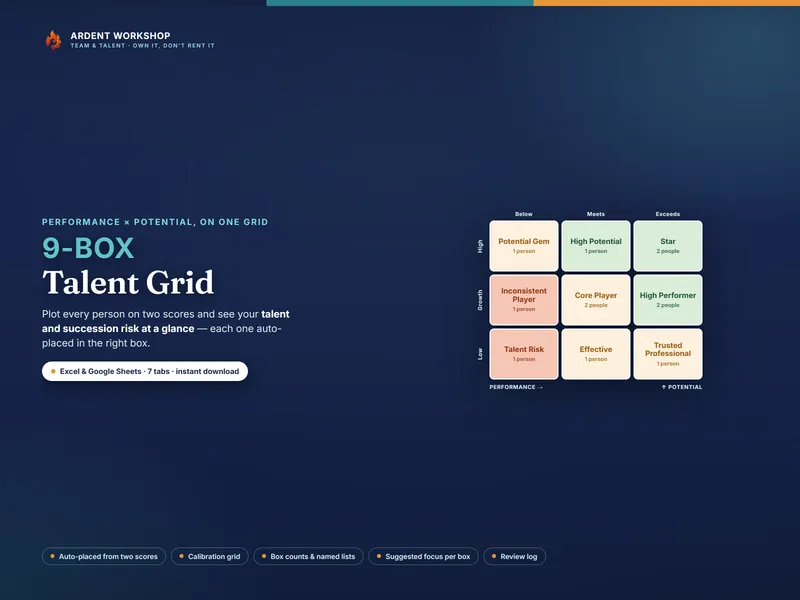
9-Box Talent Grid — Performance & Potential Matrix for Excel & Google Sheets
A 9-box talent grid for Excel & Google Sheets — score performance and potential, auto-place each person, and see succession risk on one grid.
Team & TalentView details