A RIF is not a firing
The distinction is the whole basis of the process, and it is easy to blur when you are under pressure.
- A termination for cause is about a person: conduct, or performance that did not improve after it was raised and documented. The role usually still exists afterward, and often gets refilled.
- A reduction in force is about a role: the work has gone, or the business cannot fund it. The person is selected because their role is on the list, not because they failed. The role is not refilled.
Blurring the two is a real risk. Using a RIF to move on someone you could not performance-manage — and then refilling the role two months later — is a pattern that can turn a business decision into a dispute, because the written record says one thing and the hiring page says another.
Reduction-in-force vocabulary
- Selection criteria. The factors every affected person is measured on — skill breadth, documented performance, cross-coverage, fit to the plan you are going to, certifications you still need, and so on. They are written down, weighted, and dated before anyone is scored.
- Comparator pool (sometimes “selection pool”). The group of genuinely interchangeable roles you rank against each other — the same work, comparable with training. Everyone in a pool is scored, not just the people under consideration. Note that “decisional unit” is a specific term in the U.S. age-waiver rules with its own definition; it is not automatically the same as your comparator pool, so ask counsel rather than assuming they match.
- Reduction target. How many roles a pool has to lose, decided from the operating plan before the names are read.
- The selection. The ranking that falls out of the criteria and the target — not a list you write and then justify.
- The file. Everything that shows how the decision was made: the business case, the alternatives considered, the dated criteria memo, the pool definitions, the completed scoring for everyone, the composition review, the approvals, and the notices. It holds rated comparisons of named employees, so restrict access to the decision-makers and counsel wherever it lives, rather than leaving it in a folder the wider team can open, and retain it under your own records-retention policy.
The order a reduction should happen in
A great deal of what goes wrong in a reduction is a step done in the wrong order rather than a step done badly.
- Business case. What the reduction is for, the number it has to reach, and the operating plan you are going to.
- Alternatives. Hiring freeze, reduced hours, contractor spend, unpaid voluntary leave, pay reduction, redeployment, voluntary exits — each with a written line saying why it is or is not enough.
- Criteria and weights. Agreed and dated before the roster is opened. This is the step that cannot be done late.
- Pools and targets. Who is genuinely comparable with whom, and how many roles each group loses.
- Score. Everyone in a pool, on the same criteria, from records rather than memory — ideally reviewed by a second person.
- Review. Look at who the selection lands on, then take the completed file to qualified counsel.
- Approve. The final list signed off in writing, before a word is said to anyone.
- Notify and close. Deliver each notification with a witness, work the final-steps checklist per person, tell the remaining team, and file everything.
Steps 3 to 5 in miniature: the free single-factor selection starter takes one comparator pool, one scoring factor and a target you set first, then ranks everyone on that factor — no signup, and it deliberately shows you where one factor runs out.
What can never be a selection criterion
In the United States, the Equal Employment Opportunity Commission lists race, color, religion, sex (including pregnancy, sexual orientation and gender identity), national origin, age (40 or older), disability and genetic information as protected bases, and separately prohibits retaliation against someone who raised a complaint or took part in an investigation. Its guidance is explicit about layoffs: an employer may not choose the oldest workers because of their age (EEOC prohibited employment policies and practices (opens in new tab)).
The proxies matter as much as the factors themselves. Attendance can carry protected leave. Shift availability can carry caregiving or religious observance. Recent performance can carry a period of accommodated or reduced duties. Length of service can track age. None of those criteria are automatically off limits, but each has to be measured in a way that strips the protected part out, applied identically across the pool, and checked with counsel. Many states and cities protect more than the federal list, and other countries differ — get your own list from a qualified employment lawyer rather than a template.
U.S. rules that may apply on top
Two U.S. rules come up often enough to be worth naming, though whether either reaches you is a question for counsel, not for a glossary page:
- Advance notice. The federal Worker Adjustment and Retraining Notification (WARN) Act generally applies to employers with 100 or more employees and requires at least 60 calendar days’ written notice of a plant closing or a mass layoff affecting 50 or more people at a single site, to employees or their representatives, the state dislocated-worker unit, and the local chief elected official (the U.S. Department of Labor’s plant-closings page (opens in new tab)). The full rule attaches further conditions — a mass layoff below 500 people also turns on the share of that site’s workforce affected — so the headline numbers are a prompt to ask, not a test you can apply yourself. Some states have plant-closure laws of their own, with different thresholds.
- Release agreements. If severance is offered in exchange for signing away legal claims, a waiver of age-discrimination claims under U.S. law carries its own timings: at least 21 days for the individual to consider it, at least 45 days when it is part of a group termination or exit-incentive program, and 7 days to revoke after signing. A group program also requires written information about the group the selection was drawn from, including the job titles and ages of those eligible or selected, and the ages of others in the same job classification or organizational unit who were not (EEOC guidance on waivers in severance agreements (opens in new tab)). Counsel drafts that document and compiles that age information with you for the disclosure alone — it does not belong in the criteria memo, the scoring grid, or the selection file.
Common reduction-in-force mistakes
- Criteria written after the names. They are then a description of a decision already made, and everyone involved can tell.
- A pool of one. A pool drawn narrowly enough to contain exactly the person you had in mind is one of the most recognizable flaws in a selection.
- Scoring only the people you selected. That is a conclusion, not a comparison. Keep the whole pool’s scoring.
- Ratings from memory. A score with no document behind it is an opinion with a number on it.
- Breaking a tie on preference. When two people tie at the cut line, go back to the evidence and write down what you found.
- No contemporaneous notes. Notes written on the day are far easier to stand behind than anything reconstructed a year later.
- Skipping the composition check. Looking at who the selection lands on, before anyone is notified, is cheap. Learning it afterward is not.
Related templates and concepts
Before you draw the pools, succession planning maps the seats a team cannot carry the loss of, and the cost of turnover is what a seat costs to refill if you get the call wrong. The free single-factor selection starter does steps 3 to 5 in miniature; the full Reduction in Force (RIF) Layoff Workbook weights eight criteria, reviews who the selection lands on by department, site and length of service, models the severance cost, and keeps the twenty-document file index. If you are weighing that against bringing someone in, see a RIF selection spreadsheet compared with HR consulting, or the templates for HR & team leads hub for the rest of the toolset.
Nothing on this page is legal advice. Employment rules vary by country, state and locality, and by the size of your business and of the reduction. Take your completed selection file to a qualified employment lawyer before you notify anyone.
Templates that implement this
Templates for a documented reduction — and the seats behind it
2 templates
Set the criteria and weights before the names, rank each comparator pool against its own target, and keep the file that shows how and why — plus the succession workbook that maps which seats you cannot afford to lose.
- $29.95 Spreadsheet

Reduction in Force (RIF) Workbook — Layoff Selection, Impact Review & Severance Cost (Excel & Sheets)
A reduction in force (RIF) layoff selection workbook for Excel & Google Sheets — set the criteria first, rank each pool, keep the file that shows why.
Team & TalentView details - $29.95 Spreadsheet
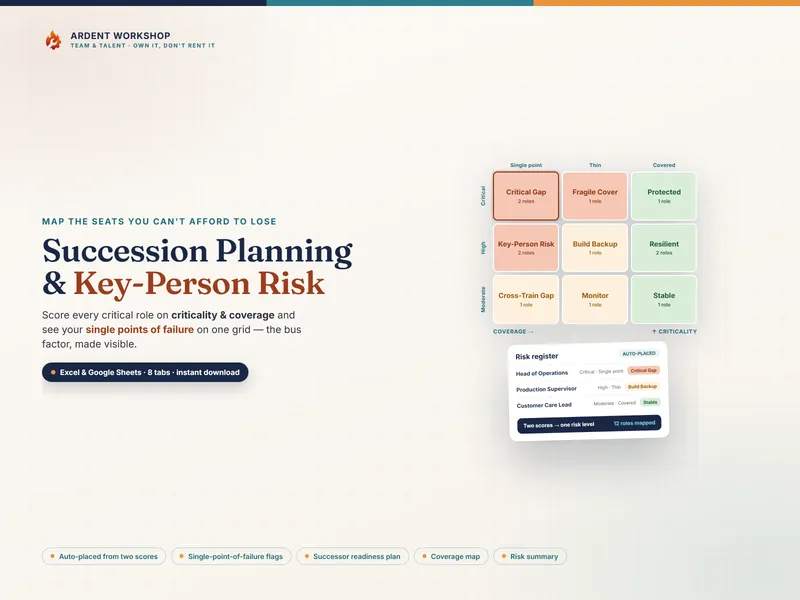
Succession-Planning & Key-Person-Risk Workbook for Excel & Google Sheets
A succession-planning & key-person-risk workbook for Excel & Google Sheets — score criticality and coverage to map your single points of failure.
Team & TalentView details