The three numbers in a band
Every pay band is built from three figures, and each answers a different question:
- Minimum. The floor of the band — roughly where you'd start someone still learning the role. Pay below it is off-band and should be fixed or documented.
- Midpoint. The anchor — the rate you intend to pay a fully competent person in the role, usually set to the market median for that level. Most measures of pay are taken against the midpoint.
- Maximum. The ceiling — the most you'd pay before the role itself has to grow. Pay above it is off-band too, and worth a look.
Range spread and midpoint differential
Two health checks tell you whether a structure holds together:
- Range spread is how wide a band is — the maximum as a percentage above the minimum. As a common rule of thumb (conventions vary by source and sector), professional bands run roughly 30–50% wide, widening at senior levels where one person's impact varies more.
- Midpoint differential is how far each band's midpoint sits above the one below it — usually around 10–25%. Wide enough that a promotion is a real raise, narrow enough that the bands don't leave a gap nobody's pay can fall into. Neighboring bands should overlap: a top-of-band senior person out-earning a brand-new manager is normal and healthy.
How pay bands are used
Once the bands are set and people are placed in them, two ratios do the work of telling you whether any given salary is high or low for the role:
- Compa-ratio — a salary divided by the band midpoint. 1.00 sits right at the midpoint; below 0.90 is typical for someone newer to the role; well above the midpoint is worth a look.
- Range penetration — where in the band the salary sits, from the floor (0%) to the ceiling (100%). It's the cleaner placement measure when bands have different widths.
Together they let you compare a coordinator and a director on the same scale, surface pay that has drifted off the structure, and screen for pay-equity gaps between groups — a first-pass screen and a prompt to look closer, not a finished analysis or legal advice.
How to build pay bands
- Group your roles into levels by scope and responsibility, not title — most small organizations land on six to eight, though it varies.
- Set each midpoint to the market rate for the level, using public range data or a salary survey.
- Pick a spread and set the minimum and maximum around the midpoint.
- Check the differentials and overlap up the ladder, then place your people.
Common mistakes
- Letting the bands go stale. The market moves every year; a structure set once and never revisited slowly stops matching reality.
- Treating the structure as the decision. Bands inform pay; they don't make it. A person below midpoint isn't underpaid by definition.
- Bands too narrow or too wide. Too narrow and people top out in a year; too wide and the band stops meaning anything.
- Leaving the data unprotected. Salary data is sensitive — keep it confidential to those who need it.
Related templates and concepts
Pay bands pair naturally with compa-ratio (how you measure a salary against a band). To check one role for free, the Compa-Ratio Calculator is an ungated taste; the Compensation Pay-Band & Pay-Equity Workbook builds your whole structure, places every employee, and screens pay equity. See how a workbook compares with compensation management software, and the templates for HR & team leads hub for the rest of the toolset.
Templates that implement this
Templates that build pay bands
2 templates
Set a minimum, midpoint, and maximum per level, place every employee against it, and screen pay equity by group — in one owned spreadsheet.
- $29.95 Spreadsheet
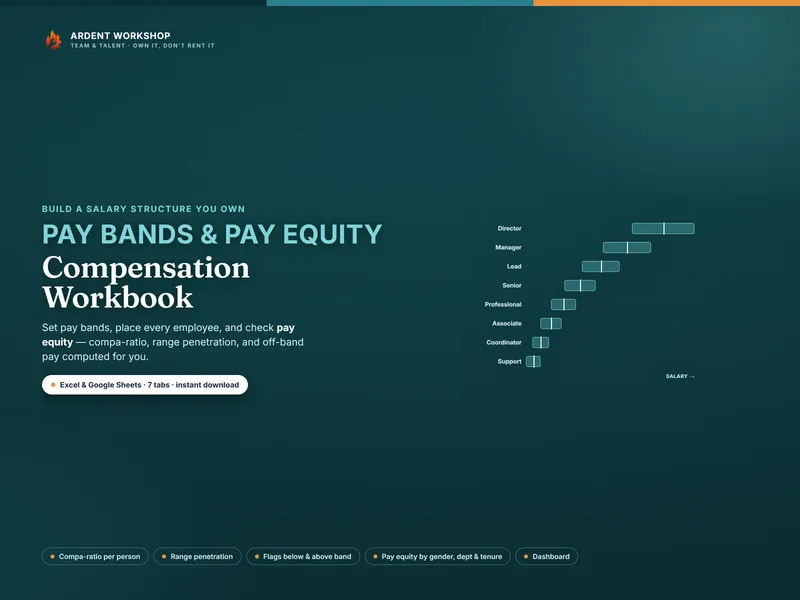
Compensation Pay-Band & Pay-Equity Workbook — Salary Bands, Compa-Ratio & Pay Equity for Excel & Google Sheets
A pay-band & pay-equity workbook for Excel & Google Sheets — set salary bands, compute compa-ratio and range penetration, and screen pay equity.
Team & TalentView details - $24.95 Spreadsheet
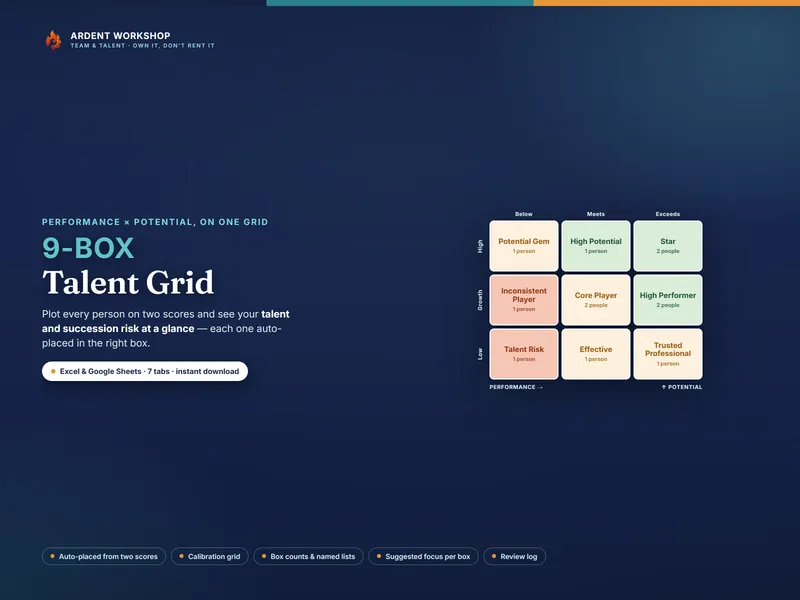
9-Box Talent Grid — Performance & Potential Matrix for Excel & Google Sheets
A 9-box talent grid for Excel & Google Sheets — score performance and potential, auto-place each person, and see succession risk on one grid.
Team & TalentView details