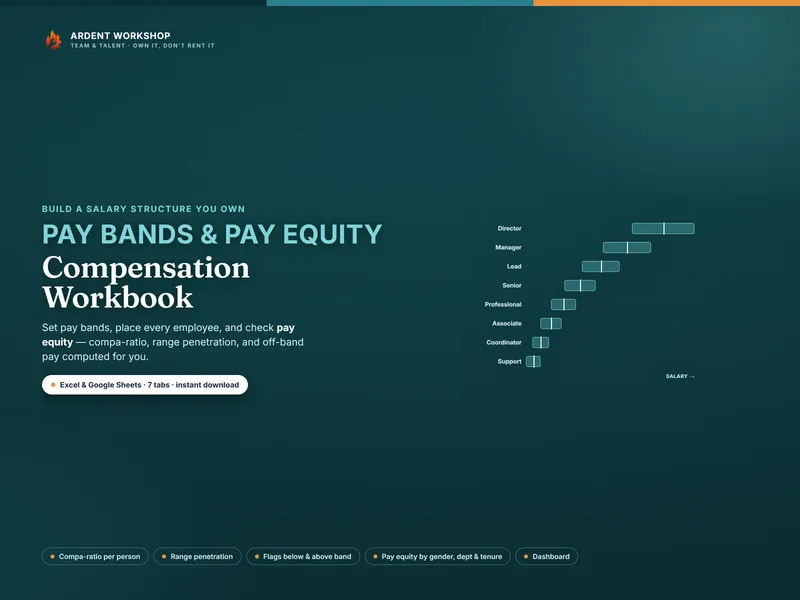
This isn't really workbook-versus-platform. A pay-band structure and a pay-equity check are features a compensation platform happens to include. The mistake is buying the whole per-employee system when the part you'll actually use — the bands, the compa-ratios, and the equity screen — is something you can own outright.
What each one is for
- A pay-band workbook is a structure-and-equity tool. Set a minimum, midpoint, and maximum for each level, place every employee, and read compa-ratio, range penetration, off-band pay, and a first-pass pay-equity screen by group. It answers “what is our pay structure, and is pay landing evenly?”
- Compensation management software is a platform. Merit- and bonus-cycle automation, live market-data benchmarking, total-rewards statements, approval workflows, and HRIS integration — with band structures usually one module inside it. It answers “administer our whole comp process,” at a price to match.
A full explanation of the building blocks is in the glossary: what a pay band is and what compa-ratio means.
When a pay-band workbook is exactly right
- You're setting salary bands for the first time, or sanity-checking the pay you already have.
- You're an HR manager, founder, or finance partner — not a dedicated compensation team.
- You run a merit review once or twice a year, not a continuous automated cycle.
- You want a first pay-equity screen without buying a platform to get it.
- You'd rather own the file, offline, than rent a system per employee.
At this stage a workbook beats a platform outright for the structure-and- equity question. The free Compa-Ratio Calculator is a no-signup taste of the math, and the templates for HR & team leads hub collects the rest.
The signals you may want a full platform
- You run automated merit and bonus cycles. Manager worksheets, budgets, and approvals across the whole org, every cycle.
- You need live market data. Survey benchmarks flowing automatically into every band and role.
- You issue total-rewards statements. Per-employee summaries of pay, equity, and benefits at scale.
- You have a compensation team to run it. A platform needs an owner; a workbook needs an HR manager and an afternoon.
Even then, the pay structure underneath is still a set of bands and compa-ratios — the platform just automates the cycle around them. The workbook is the structure; the platform is the administration.
Side by side
| What matters | Pay-band workbook (owned) | Compensation management software |
|---|---|---|
| What it is | A focused structure-and-equity tool | A broad compensation platform |
| Cost | One-time, low — you own the file | Ongoing subscription, often per employee |
| Pay bands & compa-ratio | The whole point — bands, placement, off-band flags | One module among many |
| Pay-equity screen | First-pass by gender, department & tenure | Deeper analytics, often a paid add-on |
| Merit cycles & market data | Not its job — you bring the numbers | Automated cycles and live benchmarks |
| Setup | Open it and set your bands — an afternoon | Implementation, config, rollout |
| Data ownership | The file is yours, offline | Hosted in the vendor's platform |
| Best for | An HR manager or founder building a structure | A comp team running cycles at scale |
The honest middle ground
Plenty of organizations grow into a compensation platform eventually, and that's the right move when automated merit cycles and live market data across a large workforce become the job. The mistake is the reverse: buying a per-employee suite to set a handful of bands and check compa-ratio, when an owned workbook does that part better and costs once.
Build your pay structure either way
Whichever stack you end up on, the structure underneath is bands and compa-ratios. The Compensation Pay-Band & Pay-Equity Workbook sets your bands, places every employee with compa-ratio and placement, flags off-band pay, and screens pay equity by group — one owned file for Excel, Google Sheets, and LibreOffice. Own the structure; add a platform only when administering comp at scale becomes the job.
Frequently asked questions
- What's the difference between a pay-band workbook and compensation management software?
- A pay-band workbook is the artifact: a spreadsheet where you set salary bands, place each employee, and read compa-ratio, range penetration, and a first-pass pay-equity screen. Compensation management software is a platform that may include band structures alongside merit-cycle automation, market-data feeds, total-rewards statements, approval workflows, and HRIS integration — usually sold as a per-employee subscription. One is a focused tool you own; the other is a broad system you rent. For most small and mid-size teams, the band structure and the equity check are the parts they actually use, and a workbook delivers them without the platform.
- Can a spreadsheet replace compensation management software?
- For the job most teams actually do — setting pay bands, placing people, checking who is off-band, and screening pay equity by group — an owned workbook does it completely. What a spreadsheet doesn't do is run an automated merit cycle across hundreds of managers, pull live salary-survey data, generate per-employee total-rewards statements, or push approvals through an HRIS. If you're a compensation team administering structured cycles at scale, a platform earns its keep; if you're an HR manager or founder building and checking a pay structure, the workbook is the right size of tool.
- How much does a pay-band workbook cost vs compensation software?
- An owned pay-band workbook is a single low one-time cost — you keep the file, edit it offline, and pay nothing monthly. Compensation management software is typically a recurring per-employee subscription, often with an annual contract, market-data add-ons, and an implementation. The subscription pays off when you need the full platform and the market data; paying per employee just to set bands and check compa-ratio once or twice a year is renting far more system than the job needs.
- Is salary data confidential in a spreadsheet?
- A spreadsheet you own is as confidential as the file controls you put around it — and unlike a hosted platform, the data never leaves your control. Salary data is sensitive, so keep it to those who genuinely need it and handle it the way your privacy policy and local law require, whether it lives in a spreadsheet or a vendor's cloud. And remember a workbook is a planning tool, not compensation, legal, or HR advice: a pay-equity flag is a prompt to investigate, not proof of unfair pay or a finished analysis.