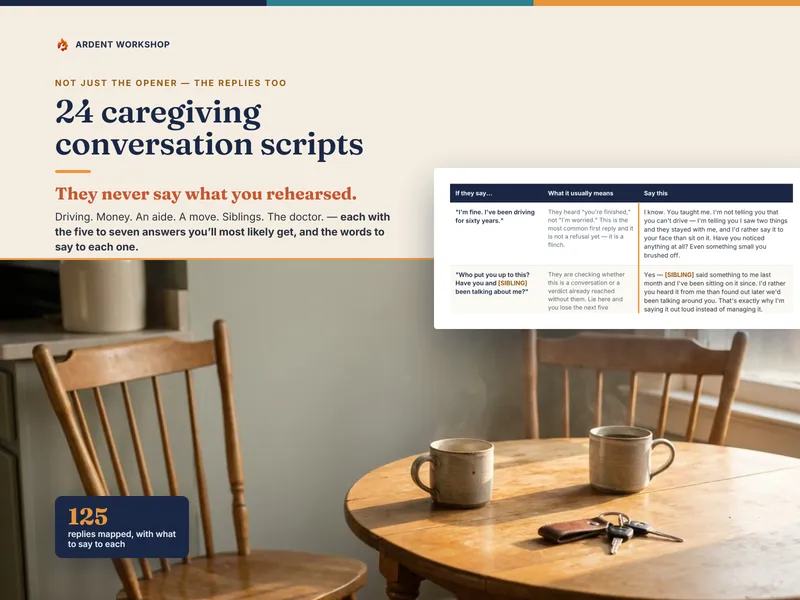
Everybody knows the opener. Search for it and you will find a dozen versions of the same reasonable, gentle first sentence, and most of them are fine.
Almost nobody has the next sentence.
That is the actual problem. These conversations do not die at the start — they die about twenty seconds in, at the first reply, when your father says “I’m fine, I’ve been driving for sixty years” and every sentence you had rehearsed in the car has stopped applying. You improvise, it gets worse, somebody leaves the room, and the subject becomes untouchable for six months.
So the useful preparation is not a better opening line. It is knowing what you will say to each of the five answers you are most likely to get.
The short version. The full script for this conversation — the opener, the reply map, what not to say, and a written follow-up — is free and ungated. No email asked for.
How to talk to a parent about giving up driving, in nine steps
- Write down two things you actually saw, with dates. Not a conclusion — two observations invite an explanation; a verdict invites a defense.
- Find out what would replace the trips that matter. One replacement, already priced, turns the conversation from a subtraction into a swap.
- Pick the room, and go alone. One person, their home, in daylight, never at a holiday. Twenty minutes, and be willing to stop at five.
- Open by saying what you are not asking for. I’m not here to take your keys. Then the two observations, with their dates.
- Ask what they have noticed, then stop talking. Leave a silence longer than is comfortable — most of what you need arrives in its second half.
- Know what to say to each of the five replies. The flinch, the who-put-you-up-to-this, the how-do-I-get-anywhere, the hurt, and the offer.
- Ask for the smallest real thing, with a date on it. Not the keys — one month without night driving, or one eye test.
- Write down what was agreed, the same day. Two people remember a hard conversation differently, surprisingly quickly.
- Know where the conversation stops being the right tool. If waiting is not safe, this is a conversation with their doctor, not one you have alone.
The rest of this guide is those nine steps in full.
What to have in hand before you raise driving
Three things, and none of them takes long.
Two observations, with dates. Write them down. A scrape along the passenger side that wasn’t there in March. A wrong turn onto Kestrel instead of Fielding on the 4th, on a road he has driven since 1998. Two facts invite an explanation. A verdict — you can’t manage on your own anymore — invites a defense, and defending is what your parent will spend the next twenty minutes doing instead of thinking about the road.
Two is the right number, incidentally. Five reads as a case that has obviously been building, and a case gets answered like one.
The trips that actually matter, and what would replace one. List the trips the car is really for, in your parent’s order of importance rather than yours — and it is rarely the errands. Then find out what covers the most important one and what it costs. Arriving with one replacement already priced turns the whole conversation from a subtraction into a swap.
The smallest thing you’d accept today. Decide before you sit down, because in the room you will drift toward the biggest thing you want. It is not the keys. It is one month without night driving, or one eye test, or not the highway.
When and where to have the driving conversation
Getting the timing wrong costs as much here as getting the words wrong.
- One person, on their own. Two of you is an intervention, and people brace against those for years. Tell your siblings you are doing it. Do not bring them.
- Their home, sitting down, in daylight. Not at the end of a visit, not in the car, and not after dark.
- Never at a holiday. An occasion is the one situation nobody can walk out of, which is exactly why it feels like a good opportunity and exactly why it is not.
- Twenty minutes, and be willing to stop at five. Getting it opened and leaving it open beats getting it finished badly.
What to say to open the driving conversation
The specific line most people skip is the one that does the most work:
I’m not here to take your keys. That isn’t mine to take and I’m not going to try.
Then the two observations, with their dates, flat and with no adjectives. Then the question that turns it into a conversation rather than a delivery:
What’s your read on it?
And then — this is the hard part — stop talking. Leave a silence longer than is comfortable. Your parent has more information about this than you do; they are in that car every day and you are not. A great deal of what you most need to hear arrives in the second half of that silence, and it is very often “…the lights bother me now. They didn’t used to.”
The five replies, and what to say to each
| If they say | What it usually means | Say something like |
|---|---|---|
| “I’m fine. I’ve been driving for sixty years.” | They heard you’re finished, not I’m worried. This is a flinch, not a refusal. | “I know. You taught me. I’m not telling you that you can’t drive — I’m telling you I saw two things and they stayed with me. Have you noticed anything at all? Even something small you brushed off.” |
| “Who put you up to this? Have you and your brother been talking about me?” | They are checking whether this is a conversation or a verdict already reached without them. | The truth. “Yes — he said something last month and I’ve been sitting on it. I’d rather you heard it from me than found out we’d been talking around you.” |
| “So how am I supposed to get anywhere?” | The real conversation, and a good sign — they have stopped arguing about competence and started asking about their life. | “That’s the actual question and I don’t have the whole answer yet. Tell me the trips you’d hate to lose, and I’ll find out what covers each one and what it costs.” |
| “Fine. Take them. Take the car, take everything.” | Hurt, not agreement. Accepting it is the fastest way to turn one conversation into a year of silence. | “That’s not what I’m asking for and I don’t want to leave it there. Can we stop for today? I’ll come back Sunday and we can pick it up then — or not.” |
| “Maybe not at night. The headlights bother me now.” | An offer. Take it exactly as given. | “That would mean a lot. Can we call that the plan from this week — nothing after dark, everything else unchanged? And sit down again in a month and look at it honestly.” |
What not to say when you raise driving
- “You’re going to kill someone.” It makes the conversation about their character instead of about the road, and you will not get to raise it again for months.
- “The doctor says you shouldn’t be driving.” If a doctor has not said that in those words, don’t say it. If one has, it belongs in the doctor’s mouth in the doctor’s office — secondhand in a kitchen it sounds like a card you were saving.
- “We’ve all been talking about it.” It turns a worry into a verdict reached in their absence, and it makes every future conversation feel like an ambush.
What a good outcome from the driving conversation looks like
Much smaller than you think, and knowing that is what stops you pushing past a yes.
One concession with an edge on it — not at night, not on the highway, not with the grandchildren in the car — and a date to look at it again. That is a success. You were never going to end driving in one conversation on a Tuesday morning, and trying to is how families lose the next two years of being able to raise it at all.
The best version — and it happens more often than families expect it to — is a line they set themselves: “If I get properly lost again — not a wrong turn, lost — that’s the point.” Write it down. It is now their line, and you are only the person who reminds them that they set it.
Then write it down the same day
Not to build a case. Because two people remember a difficult conversation differently, surprisingly quickly, because the sibling who was not there will otherwise hear only your summary of your own argument, and because a note is much easier to read than the conversation was to hear.
Four things: what you said, what they said, what you agreed, and what you have arranged. Then the practical line — the Thursday van is $9 each way, booked, nothing to do — because a promise that has already been kept is worth more than one that has not.
When to stop and involve their doctor
If the answer is a flat no and what you saw is serious enough that waiting is not safe, this is no longer something to handle alone. Raise it with their doctor, factually, and ask about a formal driving evaluation or an occupational-therapy assessment. What a physician can and will do about driving, and what a state licensing agency does with a report, differ by state and sometimes by county — look up your own rather than relying on what anyone told you, including this page.
And hold onto the line the whole thing is built on: persuasion, not override. An adult who has capacity has the right to make choices their family thinks are unwise, and being old is not the same as lacking capacity. Whether a particular person can make a particular decision at a particular time is a clinical and legal judgment rather than a family one — which is precisely why none of this ends with you taking a set of keys off a table.
Where to get the script
The full version of this conversation — the opener, the reply map, what not to say, the written follow-up, and the whole thing played out in full for an invented family — is free and ungated. No email asked for.
It is one of twenty-four. The Caregiver Conversations Scripts & Letters Swipe Bank covers the other seven situations the same way — help in the home, money and documents, a move or a change in level of care, siblings, doctors and facilities, work and the wider family, and your own — with 125 replies mapped in all.