The pass question is usually argued in prices: this pass costs more, that one covers fewer mountains, a ticket at the window is a lot for one day. Prices are the part that changes every year and the part you cannot do anything about. The part you can know is how many days you ride, at which mountains, and who in the household rides them. That is what decides between these three. The Ski & Snowboard Season-Pass Value & Days Log compares all three for the whole household, rider by rider. If you already hold a pass, the free ski pass break-even checker tests whether one rider's pass has caught up yet.
| Consideration | Multi-resort pass | Local (single-resort) pass | Day tickets |
|---|---|---|---|
| Wins when you | Ride several mountains it covers, or travel to a high-priced one | Ride mostly one home mountain, often | Ride few days, or at mountains no pass covers |
| Resort mix it suits | Varied: home hill plus trips | One mountain, repeated | Anything, including one-offs |
| Days ridden it needs | Enough days at covered mountains for their walk-up value to pass the price | Enough days at that one mountain for their walk-up value to pass its price | None. You pay only for days you ride |
| What you risk | Paying for coverage you never use | Being tied to one hill when a trip lands somewhere else | Paying the window rate on every day, peak days included |
| When you commit | Before the season, often months ahead | Before the season, often months ahead | Day by day, no commitment |
| What you need to know to choose | Your days per mountain, by rider | Your days at the home mountain, by rider | Your total days and whether any pass would have caught up |
| Can differ rider to rider | Yes. Each rider can hold a different one | Yes | Yes. One rider can simply buy tickets |
When each one wins, in days and mountains
Day tickets win on low days. A pass is a bet that enough days at the ticket window would have cost more than the pass did. If your winter is a few trips, no pass catches up, and the flexibility of paying only for the days you ride is worth something real.
A local pass wins when the days pile up at one mountain. Every pass day there is valued at that mountain's walk-up rate, and if it is your home hill the drive is short, which matters when you add up the real cost of a day.
A multi-resort pass wins when your days are spread across the mountains it covers, or when you regularly ride somewhere with a high window rate. A day at a pricey mountain counts for much more toward paying the pass off than a day at a small local hill, even though the pass cost the same. The coverage is only worth what you ride of it.
The household angle: riders can be on different passes
Picking one answer for the whole family can hide a cheaper mix. An adult who rides every weekend, a youth who rides at the home hill and a beginner who rides a few times are three different cases. The right comparison prices each rider separately, then sets the mixed plan beside putting everyone on one pass.
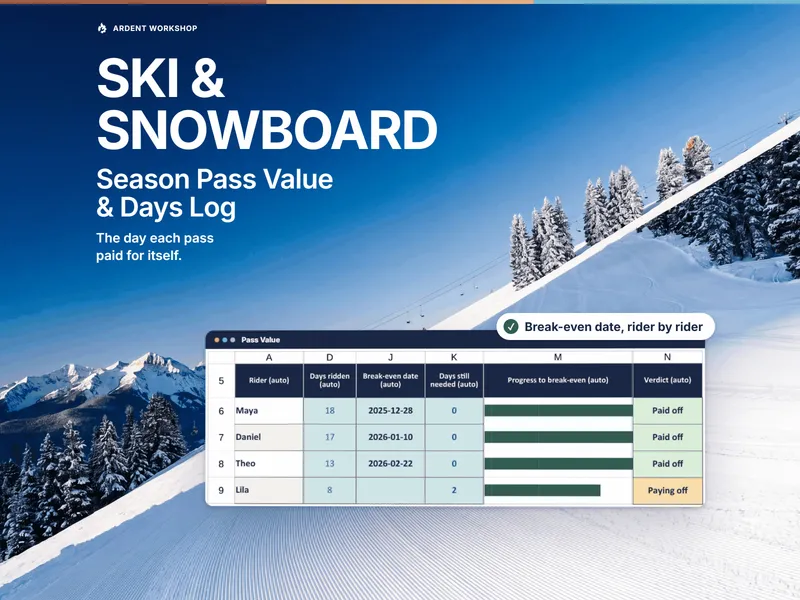
Here is how that looks in the Ski & Snowboard Season-Pass Value & Days Log's own worked example, a fictional household of four riders and 56 logged rider-days. Three riders' passes paid for themselves, on December 28, January 10 and February 22 respectively. The fourth was still paying off, at 70% with two more pass days needed. Priced for next season at this season's achieved days and resort mix, the cheapest plan, all four riders on one multi-resort pass, came to $3,538, against $4,486 for keeping this season's setup, a difference of $948. (Illustrative figures from a fictional household, not market prices or typical results.)
What each option costs you to find out
Day tickets cost nothing to find out: you simply buy them. A pass costs the full price up front, and you only learn whether it was the right bet at the end of the winter. That is why the answer matters most as input to the next purchase.
To get it, you need three things in one place for each rider: the days you rode, the resort for each, and whether the pass covered it. From those the calculation is simple. For each day on a pass, take the walk-up window rate for that rider at that mountain. Add them up as the season goes. The day the running total reaches the price you paid is your season pass break-even date. Until then, the count of pass days still needed tells you how far off it is.
How to decide with your achieved days, not your hoped-for days
- Start from the log. Take the days each rider actually rode this season, and where. Not the winter you planned in October.
- Price every option rider by rider. For each pass, add the pass price to the window tickets for any day at a mountain it does not cover. Set that beside buying every day at the window. A pass that looks cheaper on paper can lose once the mountains it does not cover are added back as tickets.
- Compare plans, not just passes. A plan can put adults on one pass, a youth on another and one rider on tickets. Compare the cheapest mix with keeping this season's setup.
- Then adjust on purpose. If you know you will ride more or less next year, scale the days up or down deliberately, rather than letting optimism do it for you.
Two things this does not model: family or bundle discounts, and partner discounts at other resorts. If a pass you are weighing carries either, read its terms and treat the result as the lower-discount baseline.
The cost beyond the lift ticket
The pass price is only one line of what a day costs. The drive, the motel split between riders, parking, rentals, lessons, food and gear upkeep belong to the same winter. Counted together they give an all-in cost per day, and the pass is not always the biggest line. A pass that lowers your cost per lift day can still sit alongside a season of expensive trips. If you want the definitions for both measures, the season pass break-even explainer covers pass-only against all-in cost per day.
Where a tracking app fits
A ski tracking app logs runs, vertical and where you rode, and some now show ticket savings. Use one if you like the stats. What tracking apps generally do not do is add up what the day cost you or price next season's passes at the days you actually rode. That needs a file you own, where the money and the days sit side by side.
Where to start
The free ski pass break-even checker is a one-rider season day log that marks the date the pass paid for itself, or tells you how many more pass days it needs. No signup. It settles the first question: did this pass catch up?
The Ski & Snowboard Season-Pass Value & Days Log does the rest for the whole household: a break-even date for each rider, an all-in cost per day across eight categories of spending, a trip planner, and a next-season tab that prices every pass option rider by rider at your achieved days and resort mix, against day tickets and against keeping this season's setup. It opens in Excel and Google Sheets, and you own it outright with no account and no subscription.
See everything we make for people who plan their time outdoors on the outdoor enthusiasts page.
Frequently asked questions
- Is a multi-resort pass worth it compared with a local pass?
- It depends on where your days actually land, not on the pass's reputation. A multi-resort pass earns its higher price only if you really ride more than one mountain it covers, or ride a high-priced mountain often enough that each day is worth a lot at the ticket window. A local pass wins when most of your days are at one home hill. The way to find out is to log where you rode this season and price each option at those days, rather than at the days you hope to ride next year.
- When are day tickets cheaper than a season pass?
- When you ride too few days for any pass to catch up. A pass is a bet that you will ride enough days for the walk-up value of those days to pass its price. If your honest count is a handful of days, or your days are spread across mountains no single pass covers, paying at the window for each day can come out ahead. Your own log tells you which side of that line you are on.
- Can different people in one household be on different passes?
- Yes, and it can be the right answer. An adult who rides every weekend, a teenager who rides at one hill and a beginner who rides three times may each be best served by a different option. Price every rider separately at their own days and resorts, then compare the mixed plan against putting everyone on one pass. Check each pass's own terms for any family or bundle discounts, because those are not part of this kind of comparison.
- Should I decide next season's pass from the days I hope to ride?
- Hoped-for days are the weakest input you have, because a planned winter is easy to overestimate. Use the days you achieved this season, by rider and by resort, as the baseline, and then scale up or down deliberately if you know something will change, such as a move, a new rider or a new job. Starting from the log keeps the decision honest.
- What does a ski tracking app tell me about which pass to buy?
- A tracking app is good at runs, vertical and where you rode, and some now show ticket savings. What it generally does not do is add up what each day cost you in drive, lodging, rentals, lessons and food, or price next season's passes at your real day count and resort mix. For that you need your own file, where those figures sit next to each other.
- Do blackout dates change the comparison?
- They can. A pass that does not let you ride on certain dates is worth less to you if those are the dates you ride. A spreadsheet that marks coverage as a plain yes or no per resort does not know the blackout calendar, so a day you rode a covered resort during a blackout is still credited as a pass day. Log what you paid for that day's ticket so it reaches the all-in cost. So read that rider's break-even date as slightly early. And check the current terms for any pass you are weighing.