Ask a family of four where to go on vacation and you’ll somehow get five answers. One wants a beach. One wants a city with museums. One wants the theme park, non-negotiable. One just wants air conditioning and no walking. And the fifth person changes their vote every time someone else opens their mouth.
Here’s the thing: this is a high-stakes decision dressed up as a fun one. A family vacation can run into the thousands, and it’s the one big block of shared time you get all year. In 2025, only 46 percent of U.S. adults said they planned to travel this summer (opens in new tab), and cost was the number-one reason the rest stayed home. When a trip is that expensive and that rare, “let’s just wing the destination” is how you end up spending real money on a place half the group quietly resents.
So how do you choose a vacation destination everyone actually agrees on — without a three-week group chat war and without one person steamrolling everyone else?
The short answer: score it, don’t argue it. List three to five real candidates, agree on the handful of things your group actually cares about (budget, travel time, kid-friendliness, downtime), weight each one, rate every destination against them, and let the numbers narrow the field to a final two you choose between. It turns a five-way argument into a fifteen-minute decision. The rest of this post shows why the two usual approaches — “just book it” and “put it to a vote” — both fall apart, and how the scoring method fixes them. Jump to the five steps if you want the method now.
The real argument isn’t beach vs. mountains
The fight over where to go is almost never really about the destination. It’s about how the decision gets made. Beach-versus-mountains is just the surface. Underneath, everyone is asking the same two questions: Did my vote count? And is this fair?
That’s why the same family can happily agree on a restaurant in ten minutes but spend a month deadlocked on a vacation. The restaurant is low-stakes and easy to change. The vacation is expensive, once-a-year, and loaded with the feeling that if you don’t speak up now, you’ll be stuck somewhere miserable for a week.
So before you argue destinations, it’s worth looking at the two decision methods most groups fall into by default.
Side A: Just let one person book it
The case for it is speed. Someone appoints themselves trip planner — or gets appointed — and just decides. They pick the place, book the flights, and announce it to the group. Done. No polls, no spreadsheets, no “but what about…” for three weeks.
And honestly, this works better than group-decision purists want to admit. A single planner who actually knows the group can make a great call fast. Decisiveness is a feature, not a bug — analysis paralysis has ruined more trips than bad weather. When one person owns the decision, one person also owns the research, the deadlines, and the blame, which means things actually get booked before the good flights sell out.
Where it breaks: the quiet people never told you what they actually wanted. The planner optimizes for their own idea of a good trip and assumes everyone shares it. The beach lover books a beach; the museum person spends the week sunburned and bored, says nothing, and remembers it for years. You didn’t get consensus — you got compliance. And the next time this person “just handles it,” the resentment is already loaded.
The single-planner method fails not because one person decides, but because nobody told them the constraints before they decided.
Side B: Put it to a vote
The case for it is buy-in. Everyone gets a say, so everyone is invested. This isn’t just feel-good — it’s measurable. In the 2025 NYU family travel survey, 61 percent of parents said involving their kids in planning improved the child’s happiness and engagement on the actual trip (opens in new tab). A kid who helped pick the destination complains less when the museum line is long, because it was their museum. The same is true for adults.
Where it breaks: raw democracy produces mush. When five people each push their favorite and you average it all together, you don’t get everyone’s dream trip — you get the beige compromise nobody actually wanted. The city person and the beach person “meet in the middle” at some lake town neither one chose, and both feel like they lost. Worse, an open vote rewards whoever argues longest and loudest, not whoever has the best case. The person who keeps changing their mind gets dragged along, and the quiet veto — “I physically cannot do a 12-hour drive with my back” — never surfaces until you’ve already booked.
Democracy without structure isn’t fairness. It’s just a slower version of the loudest-person-wins.
Where the real dividing line is
Here’s where it gets interesting: the real split isn’t “one decider vs. everyone votes.” It’s “structured vs. unstructured.”
- An unstructured single planner books their own preference and calls it a family decision.
- An unstructured group vote dissolves into the longest argument.
- A structured single planner collects everyone’s must-haves first, then decides — and lands a trip the group is happy with.
- A structured group vote captures real priorities, weights them, and produces a clear winner nobody can call unfair.
Notice that structure — not who holds the pen — is what separates the trips people love from the trips people tolerate. Both methods work when the priorities are on the table before the decision. Both fail when they’re not.
So the question isn’t who decides. It’s how do you get everyone’s real priorities out in the open and turn them into one clear answer?
The verdict: score it, don’t fight it
The approach that actually holds up is to score the decision instead of arguing it. A vacation decision matrix is a simple grid that lists your candidate destinations down one side, the things your group actually cares about across the top, and a weighted score in each cell — so the winner is the place that best fits everyone’s real priorities, not the place whoever argued hardest picked.
It sounds clinical for something as fun as a vacation. It’s the opposite. Scoring the decision is what ends the argument fast so you can get to the fun part. Here’s the five-step version.
1. Everyone gets one veto
Before anything else, go around and let each person name a single non-negotiable — the one thing that would ruin the trip for them. “No 12-hour drive.” “Must have a pool for the kids.” “I need at least one day that isn’t scheduled.” These are hard filters. Any destination that trips a veto is out, no debate. This surfaces the quiet dealbreakers before you’ve fallen in love with a place that violates one.
2. Agree on the criteria and their weights
Now list the things that matter and how much. Budget almost always leads — 73 percent of parents call affordability their single biggest travel obstacle (opens in new tab), so it’s rarely just one factor among many. Then travel time, kid-friendliness, weather, things to do, and downtime. Give each a weight from 1 to 5 based on how much it matters to your group, not to a travel blog.
3. Put three to five real contenders on the board
Not fifteen. Everyone throws in one or two genuine candidates, and you cap it at five. A short list forces real choices; an endless list is just the argument in spreadsheet form.
4. Rate each destination, 1 to 5, on every criterion
Go criterion by criterion, not destination by destination — it keeps you honest and stops the loudest advocate from inflating their favorite across the board. Multiply each rating by that criterion’s weight and add up the column.
5. Let the numbers pick your top two — then let gut break the tie
The math almost never crowns a runaway winner, and it doesn’t need to. What it does brilliantly is narrow five options to the two or three that genuinely fit the group and quietly retire the ones that only one person was fighting for. From that short, pre-vetted top tier, go ahead and let feeling decide. Now you’re choosing between two good trips, not refereeing a five-way brawl.
A worked example: the scoring table in action
Here’s an illustrative example — the numbers are made up to show the mechanics, not to rank real places. In each cell, the first number is the 1-to-5 rating and the second is that rating multiplied by the criterion’s weight (shown as rating → weighted score):
| Criterion (weight) | Beach town | Mountain cabin | Big city |
|---|---|---|---|
| Budget (5) | 4 → 20 | 5 → 25 | 2 → 10 |
| Travel time (4) | 5 → 20 | 3 → 12 | 4 → 16 |
| Kid-friendly (4) | 5 → 20 | 3 → 12 | 3 → 12 |
| Things to do (3) | 3 → 9 | 3 → 9 | 5 → 15 |
| Downtime (3) | 4 → 12 | 5 → 15 | 2 → 6 |
| Weighted total | 81 | 73 | 59 |
The city loses not because anyone hated it, but because it only won on one thing the group didn’t weight heavily. The beach and the cabin are close — and that’s the real decision, the one worth talking through over dinner. You’ve gone from five opinions to a genuine two-way choice in about fifteen minutes.
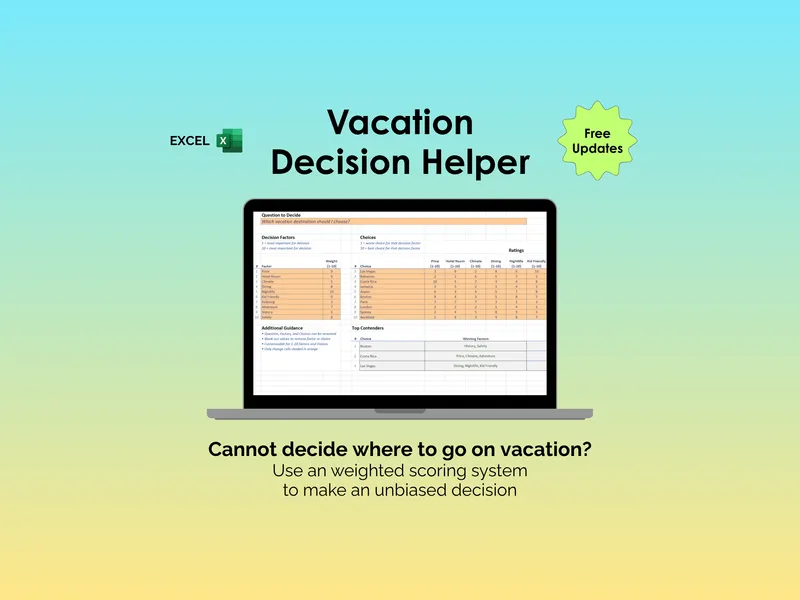
This is exactly the job the Vacation Decision Helper was built for: you type in your contenders and criteria, weight what matters, and it does the scoring so the conversation moves straight to the top two — no formulas to build, no spreadsheet to rebuild next year.
How to run the family vacation vote without a fight
If you want the short, no-spreadsheet version, here’s the checklist:
- Set the budget first, out loud. The single most common trip argument is really a money argument in a trench coat. Name the number before anyone names a place.
- Collect vetoes before candidates. Dealbreakers first, wish list second. It saves the heartbreak of scoring a place that was never eligible.
- Cap the list at five. More options means more argument, not more freedom.
- Score in private, reveal together. Have each person rate the finalists on their own, then compare. It stops the anchoring that happens when the loudest voice goes first.
- Separate “where” from “how.” Pick the destination on its own merits. Then work out the logistics — whether to road-trip or fly is its own decision, and mixing it into the destination fight is how both stall.
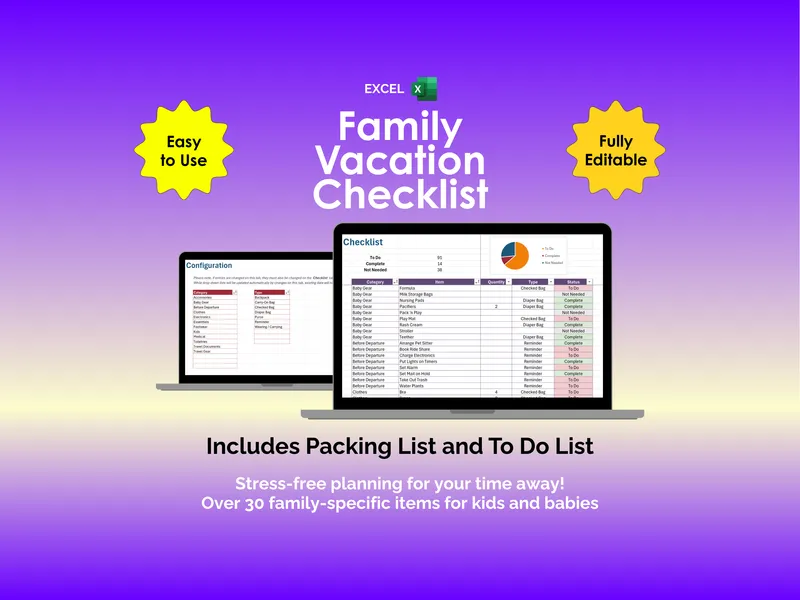
Once the destination is locked, the rest is logistics you can actually enjoy: a family vacation packing checklist so nothing gets left behind, and a clear-eyed look at what a family trip really costs before you book — because with nearly 3 in 10 summer travelers planning to take on debt for their trips (opens in new tab), the destination you agree on should also be the one you can afford.
Own the decision, don’t rent the chaos
The reason vacation planning turns into a fight isn’t that your family is uniquely difficult. It’s that most groups make an expensive, once-a-year decision with no method — just vibes, volume, and whoever caves first. Every year they rebuild the same argument from scratch.
A decision matrix is a small, reusable system you own: same grid, new destinations, every year. It doesn’t take the feeling out of choosing a trip — it just makes sure the feeling comes at the end, from a short list of places everyone can live with, instead of a shouting match at the beginning. And the same weighted-scoring model works far beyond travel — the general-purpose Decision Helper runs it for any high-stakes group choice, from a car to a school to a major purchase.
So next time someone asks where you’re going, don’t take a poll and don’t just book it. Put it on the board, weight what matters, and let the group choose from the two that survive. Score it with the Vacation Decision Helper and you’ll spend fifteen minutes deciding instead of three weeks arguing — and you’ll actually agree on where you’re going.